Welcome to spring term!
Administrative Office open hours in PLC 118 will be Mon. and Wed.-Fri. from 8:30am-Noon and 1pm-3:30pm. Please note that open hours are 9:30am-Noon and 1-3:30pm on Tues. to allow for a standing staff meeting early in the morning.
Please see our web pages for more information about courses and our degree programs. Questions may be emailed to flr@uoregon.edu.
University of Oregon Coronavirus Information
Check out the first translation of The Secret Commonwealth of Elves, Fauns, and Fairies
Welcome to the homepage of the Folklore and Public Culture Program at the University of Oregon. The Folklore and Public Culture Program is one of a few major centers of folkloristic research in the United States. With more than thirty core and participating faculty, the program provides an interdisciplinary approach to an undergraduate major and minor as well as a Master’s Degree, allowing students to create a focused course of study in their areas of interest. Participants in the Folklore and Public Culture Program use theoretical analyses, research methods, and fieldwork techniques to study the ways tradition continues to enrich human behavior throughout the world. Participants examine the historical, cultural, social, and psychological dimensions of expressive forms such as mythology, legend, folktale, music, dance, art, belief, food, ritual, and ceremony. Students will gain fresh perspectives on the ethnic, regional, occupational, gender, and other identities of individuals in specific communities.
Students, faculty, and staff associated with Folklore and Public Culture are committed to learning, working, and living in an environment free of discrimination and hate. We take responsibility for maintaining an environment free of prohibited harassment and discrimination. Resources are readily available on campus for all students, faculty, and staff: https://respect.uoregon.edu/.



Traditional Arts Apprenticeship Application Deadline EXTENDED: October 31, 2022
The University of Oregon’s Oregon Folklife Network has been awarded a $40,000 grant from the National Endowment for the Arts plus $40,000 from Oregon Arts Commission to support Oregon’s Traditional Arts Apprenticeship Program.
Oregon Folklife Network is accepting applications until October 21, 2022 for the Traditional Arts Apprenticeship Program (TAAP) for projects in 2023. The program offers folk and traditional master artists and culture keepers a $3,500 stipend to teach their art form to apprentices from their same communities, Tribes, sacred or occupational groups. The stipend
...
Speaker Event: Kinga Povedak
Public Health Hazard or Miraculous Water? Science and Progress in Soviet-Style Anti-Religious Propaganda Films
Tuesday, Nov. 7, 4:00-6:00 pm; Knight Library Browsing Room
This presentation focuses on Soviet-style anti-religious propaganda films produced in the 1960s and illustrates how religious practices were portrayed as “subversive,” “unhealthy,” or anti-progressive. These films attempted to convince people of the fraudulent nature of religious pilgrimage sites during the Cold War era by focusing on the public health hazards associated with bacterial and virus infection from
...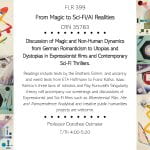
Spring 2023 – FLR 399: from Magic to Sci-Fi/AI Realities
CRN 35783 Professor Dorothee Ostmeier T/Th 4:00-5:20
Discussion of Magic and Non-Human Dynamics from German Romanticism to Utopias and Dystopias in Expressionist films and Contemporary Sci-Fi Thrillers. Readings include texts by the Brothers Grimm, and uncanny and weird texts from ETA Hoffmann to Franz Kafka. Isaac Asimov’s three laws of robotics and Ray Kurzweil’s Singularity theory will accompany our screenings and discussions of Expressionist and Sci-Fi films such as Bicentennial Man, Her, and Transcendence. Analytical and creative public humanities projects are welcome.