Events
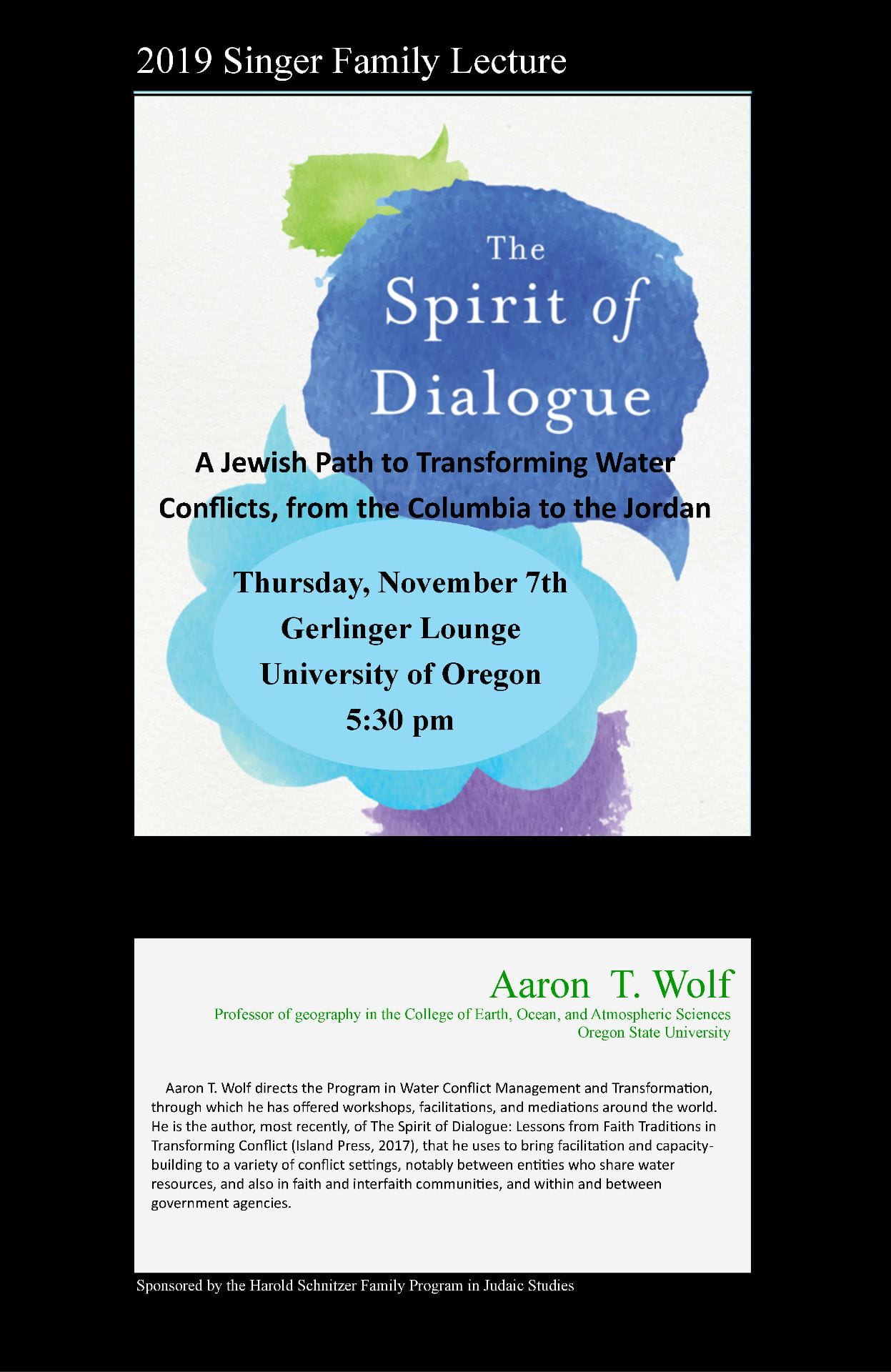
The Spirit of Dialogue: A Jewish Path to Transforming Water Conflicts, from the Columbia to the Jordan
2019 Singer Family Lecture presented by Aaron T. Wolf
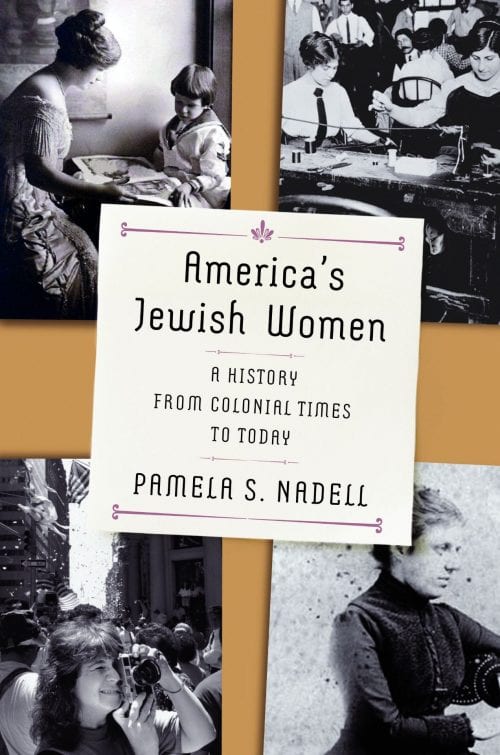
America’s Jewish Women: A History From Colonial Times to Today
Pamela S. Nadell,
Professor and Patrick Clendenen Chair in Women’s & Gender History, American University
Tuesday, April 16th, 2019
7:30 PM
Knight Library Browsing Room
The Harold Schnitzer Family Program in Judaic Studies is delighted to announce that Dr. Pamela S. Nadell, Patrick Clendenen Chair in Women’s and Gender History in the Department of History at American University will be speaking at the University of Oregon on Tuesday evening, April 16, at 7:30 PM, in the Knight Library Browsing Room. The talk is free and open to the public.
Professor Nadell will be addressing her major new book, AMERICA’S JEWISH WOMEN: A History from Colonial Times to Today. The book was reviewed in the New York Times Sunday Book Review on March 29, 2019 New York Times.
Professor Nadell, who served as president of the Association for Jewish Studies between 2015-17, also chairs American University’s Critical Race, Gender, and Culture Studies Collaborative and is Director of the Jewish Studies Program. Her 1998 study, Women Who Would Be Rabbis: A History of Women’s Ordination, 1889-1985, was a National Jewish Book Award Finalist.
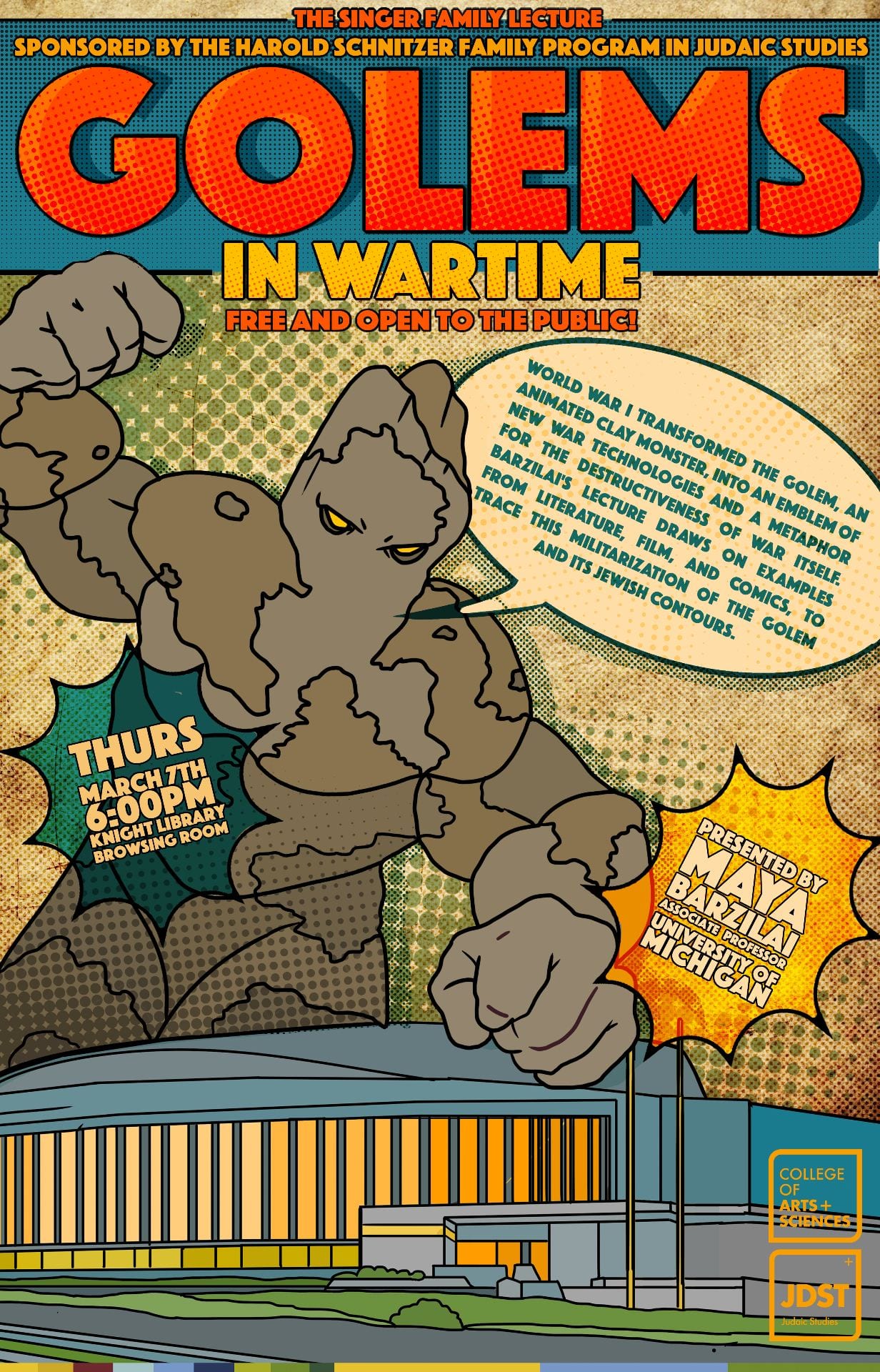
The Golem at War: Animation in an Age of Destruction
Lecture by Maya Barzilai, Associate Professor, University of Michigan
Thursday, March 7th, 20196
6:00 pm
Knight Library Browsing Room
Free and open to the public
Sponsored by the Singer Family and the Harold Schnitzer Family Program in Judaic Studies.
“Jews as Fences in Early Modern Europe”
Lecture by Dr. Shaul Stampfer
Thursday, January 24th, 2019
358 Susan Campbell Hall
Please join us at 2:00pm this Thursday (January 24th) in SCH 358 for a lecture by Dr. Shaul Stampfer, Sandrow Professor of Soviet and East European Jewish History (emeritus) at Hebrew University. Dr. Stampfer will speak on “Jews as Fences in Early Modern Europe.”
“Fences are an interesting topic to study. It is certainly not a respectable profession and some people may be uncomfortable with the fact that there were Jews who made a living this way. What interested me was why ‘fences’ could operate openly for centuries and what was the impact of the activity of fences on society. The answers are not so simple!”
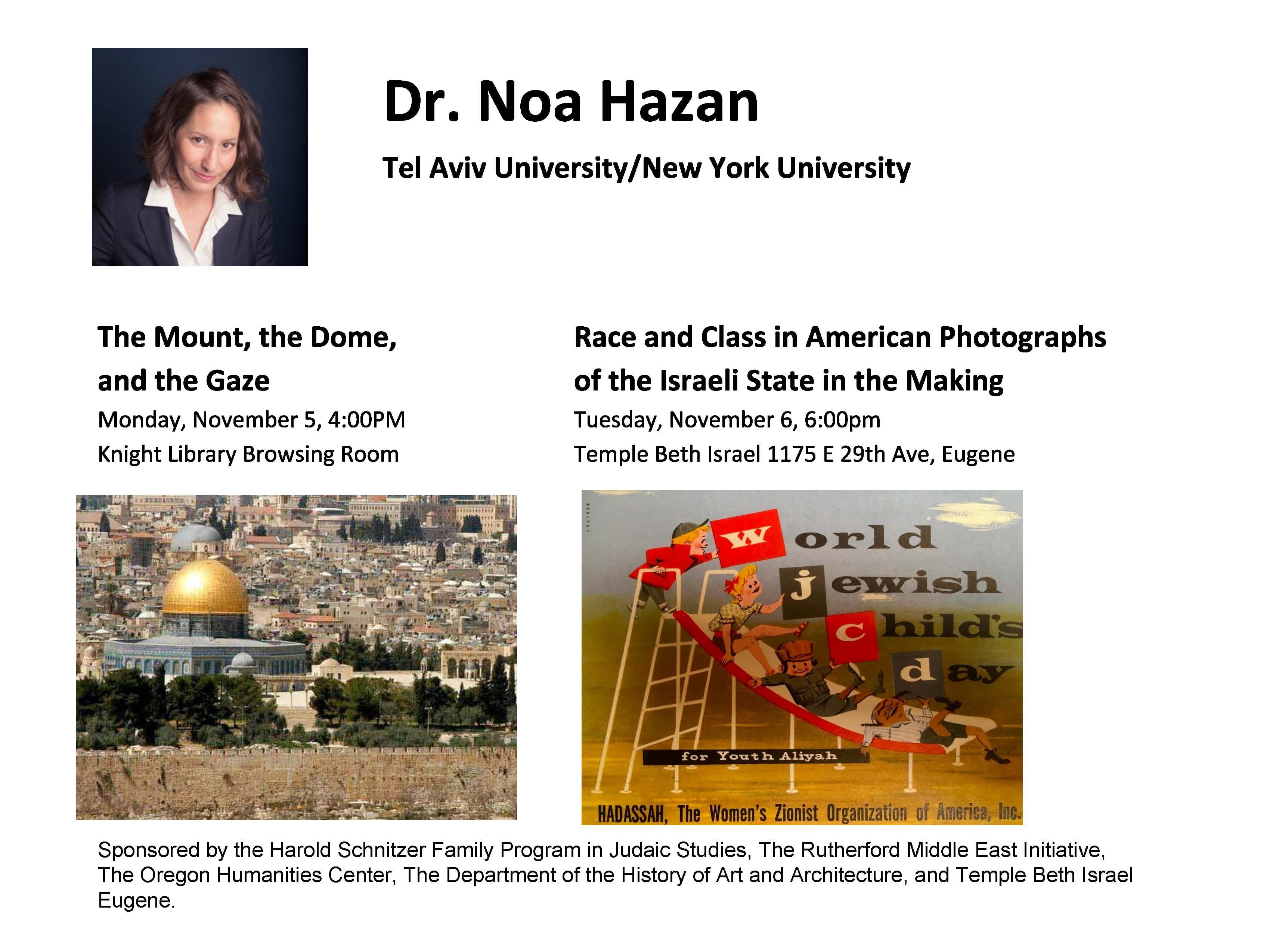
Lectures by Dr. Noa Hazan
The Mount, the Dome, and the Gaze
Dr. Noa Hazan, Tel Aviv University/New York University
Monday, November 5, 2018
4:00pm
Knight Library Browsing Room
Race and Class in American Photographs of the Israeli State in the Making
Dr. Noa Hazan, Tel Aviv University/New York University
Tuesday, November 6
6:00pm
Temple Beth Israel
1175 E. 29th Ave., Eugene
Justice and Poverty in the Ancient Near East
Erica Mongé-Greer, University of Oregon, Harold Schnitzer Family Program in Judaic Studies
Friday, October 26
4:00 PM
Room 111 Susan Campbell Hall
Ethical reflections on language and attitudes toward the poor in religious texts from ancient Mesopotamia, Egypt, Israel, and Palestine with particular focus on the Book of Psalms.

Museum Exhibition: Upon Thy Gates
Upon Thy Gates: The Elaine K. and Norman Winik Mezuzah Collection
Oregon Jewish Museum and Center for Holocaust Education
724 NW Davis St. Portland, OR 97209
June 7, 2018 – September 23, 2018
Exhibition Gallery Hours:
Tuesday-Thursday 11am-5pm
Friday 11am-4pm
Saturday-Sunday 12pm-5pm
Placing a mezuzah on the doorpost is among the most ancient of Jewish traditions. Elaine and Norman Winik collected mezuzahs throughout their numerous visits to Israle and other Jewish communities. Their collection, bequeathed to OJMCHE in 2017, reflects a wide range of styles and materials and is on public exhibition for the first time.

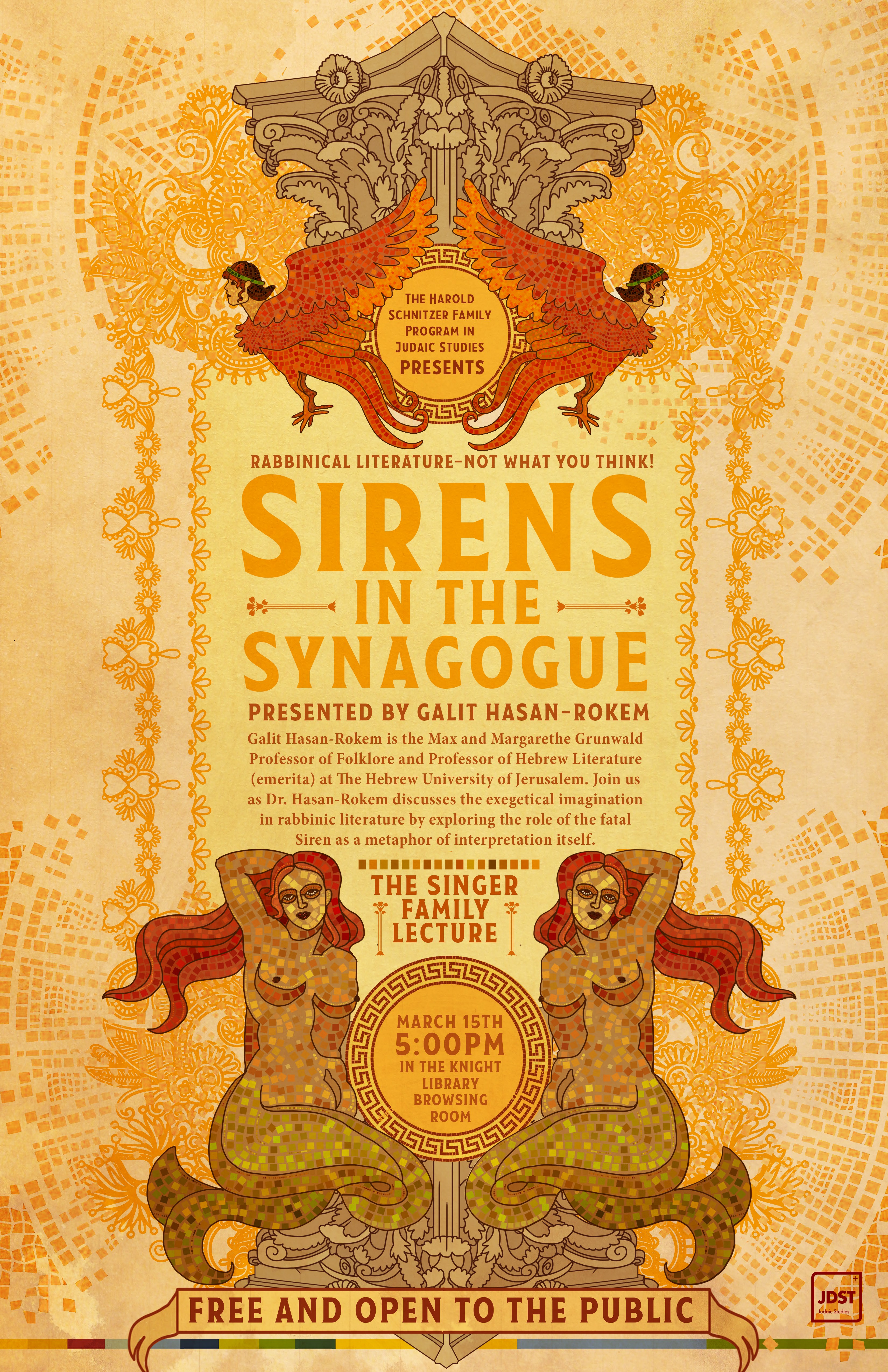
“Sirens in the Synagogue”
2018 Singer Family Lecture
Galit Hasan-Rokem, Max and Margarethe Grunwald Professor of Folklore and Professor of Hebrew Literature (emerita) at The Hebrew University of Jerusalem.
Thursday, March 15, 2018
5:00 pm
Knight Library Browsing Room
Join us as Dr. Hasan-Rokem discusses the exegetical imagination in rabbinic literature by exploring the role of the fatal Siren as a metaphor of interpretation itself.
This event is sponsored by the Singer Family and the Harold Schnitzer Family Program in Judaic Studies.
Free and open to the public. Refreshments provided.
“Kafka’s Theatre: According to Benjamin and Brecht”
Freddie Rokem, Professor Emeritus from Tel Aviv University
Wednesday, March 14, 2018
5:00 pm
Knight Library Browsing Room
This event is sponsored by the Singer Family and the Harold Schnitzer Family Program in Judaic Studies.
Free and Open to the Public. Refreshments will be provided.

Events honoring Judith Baskin
Scroll down for the conference program
Program – PDF Version
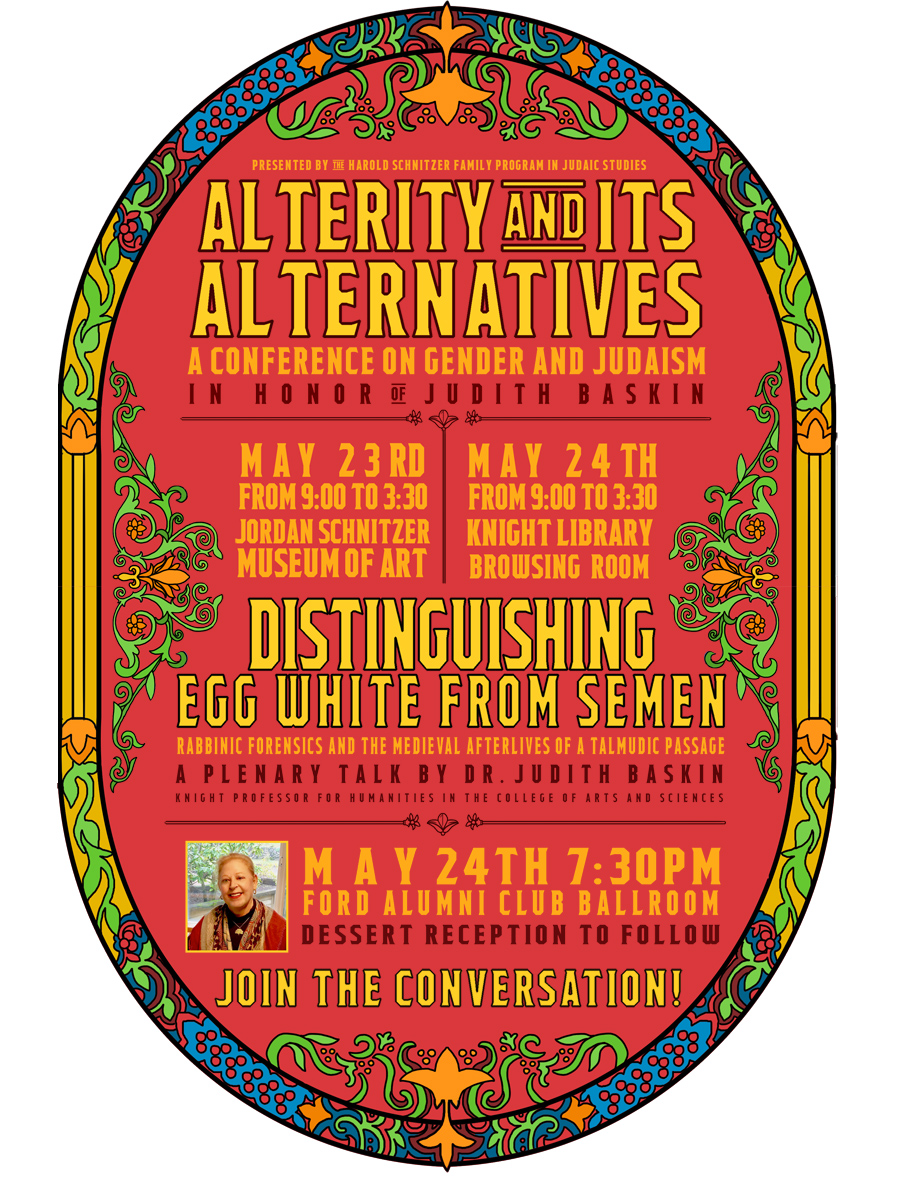
Alterity and Its Alternatives:
A Conference on Gender and Judaism in Honor of Judith Baskin
Tuesday, May 23
Jordan Schnitzer Museum of Art
9:00-10:30 In Her Voice: Female Jewish Writers
Moderator: Anne Kreps – University of Oregon
Gantt Gurley – University of Oregon
“The Other Goldschmidt: Ragnhild and Alleotheta”
Naomi Sokoloff – University of Washington
“Modern Women Poets and the Kaddish: Teaching Jewish Literature as World Literature”
Monique Balbuena – University of Oregon
“From tHEiR mouths: Contemporary Women Poets Write in Ladino”
11:00-12:30 Gender, Transition, and Sexual Ambiguity
Moderator: Federica Francesconi – College of Idaho
Kevin Osterloh – Oregon State University
“The Diplomatic Discourse of Judean Masculinity: Intra-Jewish Relations in the Days of Hyrcanus I”
David Hollenberg – University of Oregon
“Gender Anxiety or Intellectual Virtuosity? Discussions of the khunthā mushkil (sexually ambiguous adult) in classical Islamic jurisprudence.”
Howard Tzvi Adelman – Queen’s University, Kingston, Ontario
“Concerning a Woman Who Became a Man and a Man who Became a Woman”
2:00-3:30 Women and the Law
Moderator: Jeffrey Librett – University of Oregon
Tal Ilan – Freie Universität Berlin, Institut für Judaistik
“A Feminist Commentary on Esther in Tractate Hullin”
Rena Lauer – Oregon State University
“Real and Imagined Jewish Women in Late Medieval Crete”
Federica Francesconi – College of Idaho
“Women’s Life, Rabbinical Attitudes and Gendered Spaces in Early Modern Italy”
Wednesday, May 24
Knight Library Browsing Room
9:00-10:30 Re-Depicting the Bible: Gardens, Women, and Representation
Moderator: Evlyn Gould – University of Oregon
Deborah Green – University of Oregon
“Stuck in the Middle: The Motif of the Vulnerable Female in the Garden”
Kenneth Helphand – University of Oregon
“My garden, my sister, my bride.”
Susan Niditch – Amherst College
“The Iron Fist in the Velvet Glove: Jael, Judith, and Beyond”
11:00-12:30 The Feminist Lens: Using the Methods of Judith Baskin
Moderator: David Hollenberg – University of Oregon
Gail Labovitz – American Jewish University, Los Angeles
“Lest Someone Else Precede Him: Bavli Mo’ed Qatan 18b and Rabbinic Discourse on the Divine Role in Marital Matches”
Rebecca Winer – Villanova University
“Wet nurses, Gender, and Judaism in Medieval Spain and Southern France”
Anne Kreps – University of Oregon
“Midrashic Women, Gnostic Women: Some Biological Considerations”
2:00-3:30 Witnessing the 20th Century
Moderator: Evlyn Gould – University of Oregon
Mark Raider – University of Cincinnati
“The Political Theology of Rabbi Stephen S. Wise”
Gina Hermann – University of Oregon
“Jewish women at Ravensbruck through the eyes of political prisoners”
Sara Horowitz – York University, Toronto
“Midrash and Gender in Holocaust Testimony”
Jeffrey Librett – University of Oregon
“Remarks on Freud’s ‘The Moses of Michelangelo’”
7:30 p.m. Judith Baskin – University of Oregon
Ford Alumni Ballroom
“Distinguishing Egg White from Semen: Rabbinic Forensics and the Medieval Afterlives of a Talmudic Passage”
A passage in Babylonian Talmud Gittin 57a discusses a scientific test the Rabbis used to clear a woman falsely accused of adultery. This talk reveals the larger context of that accusation and explores references to this forensic technique in medieval Jewish and Muslim sources.