Keep a record of ALL YOUR OWN WORK in your
journal. The journal will become a clear record of your reading in the library,
surfing through SAC [ID], and studying
other course materials and completing exercises defined in week-by-week listings
in the course ACADEMIC CALENDAR
Table of Contents of this Explanatory Page =
Thoughts about
"Reading" in the Academic Setting [Hop to new page then return] --- Some course exercises will be completed within one week, some will stretch
through the whole term. Some of the exercises (like number one, "purchase the
journal") obviously require no entry in the journal. Be smart
about what is most journal-worthy in the exercises, and use your nine hours of
work outside class wisely. The week-by-week readings in SAC and the
library do require constant attention, and should be entered in the journal from
the early days to the end of the term. The Academic Calendar in the course webpage syllabus suggests readings for
each week. The journal provides an opportunity for
thoughtful and careful reading of primary documentation [ID]
as well as quick reference to secondary monographs and certain general reference
works. Here are
a few paragraphs from the SAC instruction page
that explain the presentation of primary and secondary sources in SAC entries. How much should you read and write? There's enough suggested in the syllabus and
in SAC to occupy a lifetime. So, the answer is this = limit yourself to nine
hours of course work outside of class time. Not everyone will read the same things, but everyone has
a chance to become closely acquainted with the general topics raised in the
syllabus and to explore individual interests as well. Put in the time, and
you'll be happy with the results. I guarantee it. Take guidance from lectures, and follow your own interests and instincts. Branch
out on occasion to these suggested readings embedded in SAC entries, especially
when you come across them as you follow LOOPS
suggested in the course webpage syllabus. Here we touch on one of the most difficult but useful skills this course
will ask you -- and the journal will allow you -- to cultivate. Work constantly
to familiarize yourself with the central issues of the course, as defined by the syllabus
and in SAC. But at the same time, develop your own interests, guided still by the syllabus
and in SAC. Follow these leads
without losing your own identity. You could describe this skill as an ability to
adjust to your environment but also to thrive individually. Table of Contents and
Bibliography Work on the the journal-worthy exercises should be entered in the order you
do them. For example, you may take up one exercise on a sequence of journal
pages, interrupt it with work on another, recorded on the next sequence of
journal pages, then take up the original exercise again on a third sequence of
journal pages. This works for you and for your readers because your Table of Contents, kept as a register of
your work in the first several pages of the journal, will provide guidance to
work on any given exercise, even when it is distributed over several different
sections of your journal. Typically, the Table of Contents will list exercises,
weekly topics (as indicated in the course ACADEMIC CALENDAR) and/or titles of
the readings you have done, listed in the order in which you do them. You may integrate your list of readings (your
"bibliography") with the table of contents or keep a separate list. In either
case you may use SAC and Syllabus abbreviations or codes. Organize your reading and
writing as you wish, but you need not expand your time commitment. The
standard 9 hours/week can be distributed over any number of different reading
and writing schedules,
but if you deviate much from the broad outline in the syllabus, be sure to
consult with the course professor(s). You will submit your journal and the results of
your work at the times indicated in the course syllabus. Your professor(s) are happy at any time to look at
journals with you during office hourse. This library, internet and journal based course is very different from
what you might be familiar with. Your professor(s) are confident you can do it, but
we also know
that we can help you get untracked and adjusted, especially in the early days of
the term. You know or
will soon learn how to pace yourself. Steady work is good, about 9 hours per
week, but sometimes you will have reason to give more time one week than the
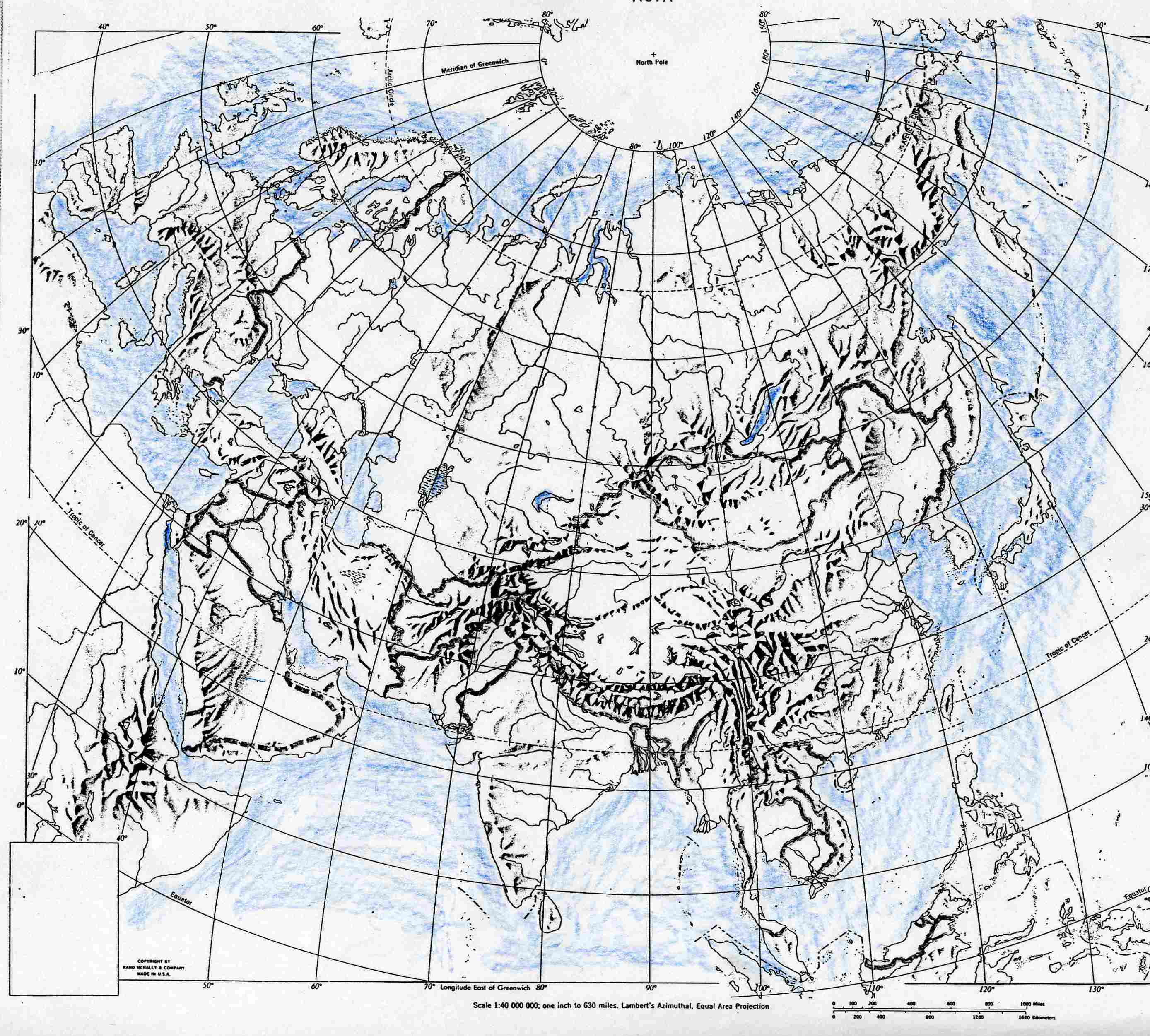
next, etc. --- Feel free to put photocopy outline maps in
your journal. You may fill these outline maps with as much hand-written
information as you wish. An
outline map filled in by you can be called YOUR WORK and belongs in the journal.
[Here's
an example of a good outline relief map of Eurasia.] It is recommend that you learn to sketch
outline maps yourself, and that you do so occasionally in your journal. This is a good way
to consolidate your grasp of relevant geography. In turn, grasp of geography seriously
expands your ability to remember the events that take place on the geo-physical
"stage". Remember that your outline or hand drawn maps can include dates and other key words. DO NOT INSERT IN YOUR JOURNAL MAPS WITH PRE-PRINTED NARRATIVE. --- It is wise to photocopy your journal to create a
"backup" copy. A good time to photocopy your journal would be just before
submitting it. If for some reason the original is lost, you have a copy to
fall back on. --- A central concept here is this: When you
"process" information from a source through your eye and onto the blank page by
hand, while in the process of analysis and synthesis of the information, you
will remember it better, you will "make it your own". And your journal will
preserve a record of that work, for your professor(s) to see, but for you to see and use,
perhaps for years to come. And that's what you should to do with the history before us in this course =
MAKE IT YOUR OWN. The Golden Rule of the journal is this: Record everything you
need in order to complete course exercises with precision and detail.
Record your work on each journal-worthy enumerated assignment in
the course syllabus.
What Should
You Enter in the Journal, and How Much?
The Journal's table of contents and bibliography
Start Your Own Library of Copied Material
Become Map Savvy
Make a Backup Copy of Your Journal
Final Words on the Concept of the Journal
What Should You Enter in the
Journal, and How Much?
Start Your Own Library
Photocopy or "cut-and-paste" into word-processing text, as you will.
But Don't Put These in the Journal.
Remember = The Journal is a Record of Your Own Work only.
Make a Backup Copy of the Journal
Final Words on the Concept of the Journal