


 RICHARD A. SUNDT
As an architectural historian, my research and teaching covers three main areas: medieval Europe, the Pacific Islands and Latin America. It was while growing up in Argentina that I first became acquainted and fascinated with Gothic buildings (Gothic Revival, of course), and this led me decades later to pursue graduate work in medieval art at the University of Wisconsin, Madison. After becoming a naturalized American citizen and prior to entering graduate school, I served as a Peace Corps volunteer in the Marshall Islands, and little did I know then that living in a Pacific atoll would stir my interest in Oceanic art as well. It is the totality of these experiences and encounters that has shaped and driven my career in art and architectural history.
My research as a medievalist began with a doctoral dissertation on the architecture of the Dominican Order in southern France. After receiving a Ph.D., I was hired in 1983 by the University of Oregon to teach ancient and medieval architecture. Some years later, I also found myself offering courses on the art of the Pacific Islands, a specialty that I developed gradually. In 1997 I spent a semester teaching Oceanic art at Victoria University of Wellington, New Zealand. While there I learned that the form of the Maori meeting house (whare runanga) had been adapted in the 19thcentury to serve as church buildings. This interested me in particular because those Maori churches (with supports down the central axis) were similar in plan to the medieval churches in France that I had researched for my dissertation, and which, some years later, I had encountered and studied elsewhere in Europe.
This coincidence of types in two separate hemispheres and in distinctly different cultural settings led me to investigate Maori churches and to consider how Christian ritual functioned in them. After spending over a decade writing several monographic articles and a book (2010) on Maori structures, I am now again engaged in studying the European Middle Ages. Current projects deal with Franciscan legislation in the arts, the structure and aesthetics of the Gothic wall (or the “DNA” of Gothic), Gothic Revival architecture in the Americas, and more in the future, a book on double-nave churches from the Early Christian period through the 21st century. When not teaching and researching, I like to hike in the mountains, canoe in crystal clear lakes, and do some landscape photography.
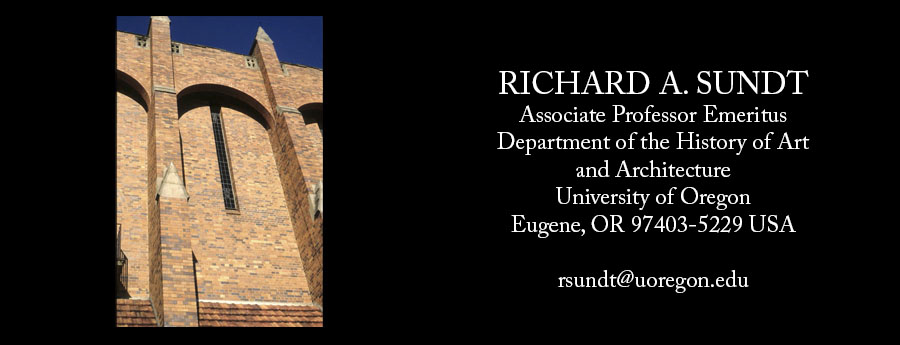
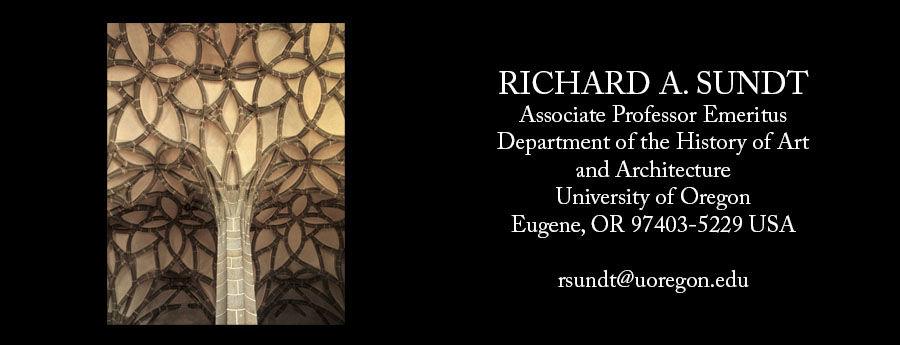
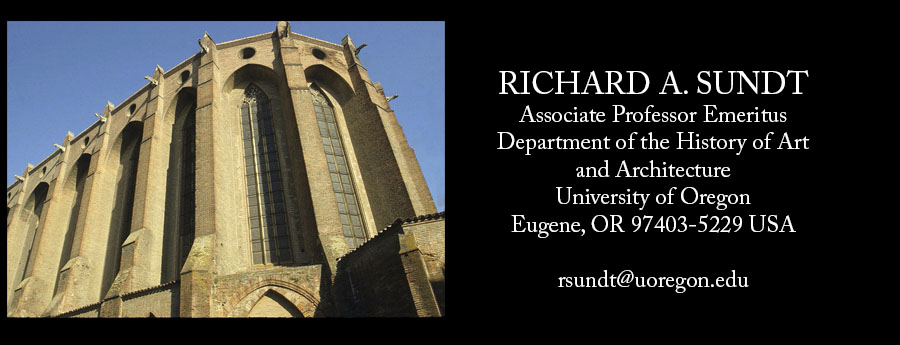
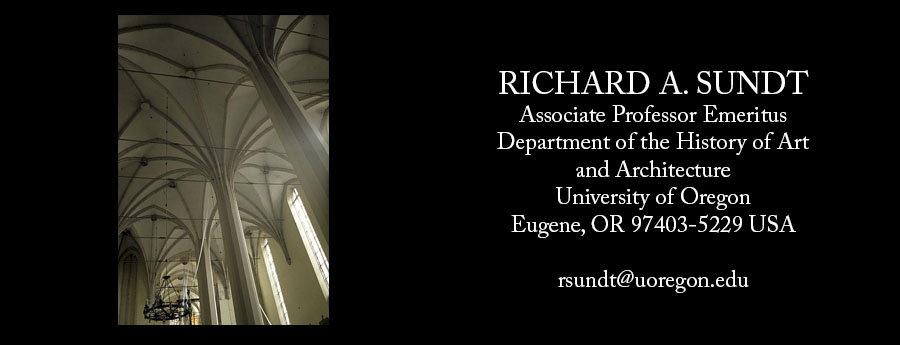
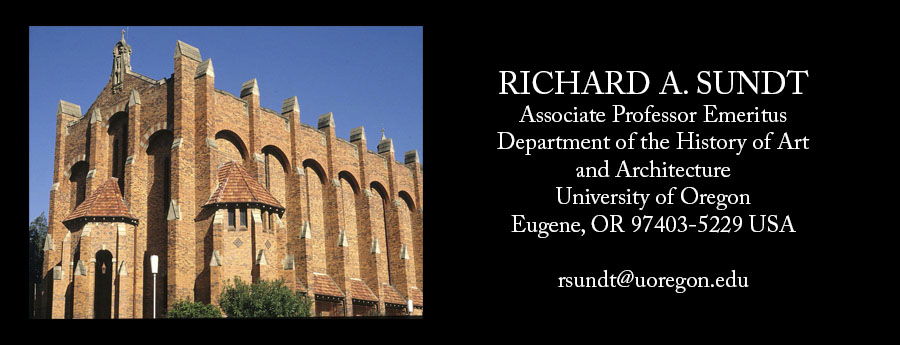
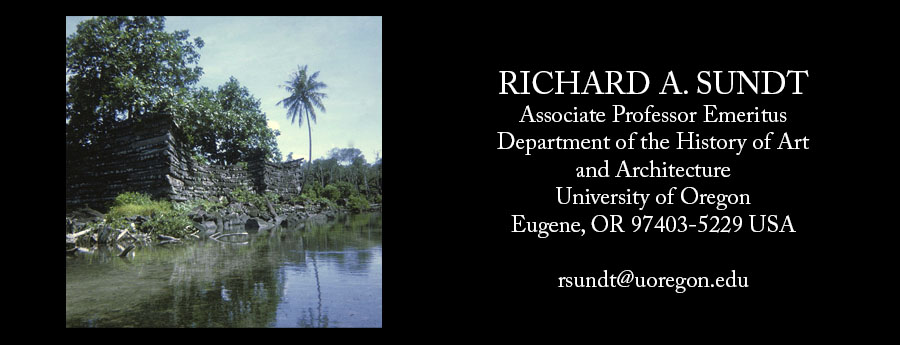
The sequence of images at the head of this web page represents monuments in my areas of teaching and research.
I. CURRICULUM VITAE
EDUCATION
Ph.D., 1981 and M.A., 1973, University of Wisconsin, Madison
B.A., 1963, Indiana University, Bloomington
EMPLOYMENT
1983-to present: University of Oregon. Department Head, 2002-2005
1997 (winter): Victoria University of Wellington (New Zealand), Visiting Senior Lecturer
1982 (fall): University of Illinois, Urbana-Champaign, Visiting Assistant Professor
1982 (winter): Beloit College (Wisconsin), Instructor
1974 (fall): Edgewood College (Madison, Wiconsin), Instructor
1973, 1974 (summers): University of Wisconsin, Madison, Instructor
PUBLICATIONS
Book:
Whare Karakia: Maori Church Building, Decoration and Ritual in Aotearoa New Zealand, 1834-1863 (Auckland: Auckland University Press, 2010).
Journal articles, chapters and encyclopedia entries:
“Reconstruction of a Carved Maori Church: Controversy and Creativity at Manutuke, 1849-1863, Part I,” Journal of the Polynesian Society, vol. 117, no. 2 (June 2008), 129-210.
“Reconstruction of a Carved Maori Church: Controversy and Creativity at Manutuke, 1849-1863, Part II,” Journal of the Polynesian Society, vol. 117, no. 3 (September 2008), 223-66.
“Northern Gothic Southernized and Mendicanized?: The Buttresswork of the Friars’ Brick Churches in Toulouse,” Proceedings of the International Congress on Medieval Studies, Kalamazoo, Michigan, May 2005, in AVISTA Forum: Journal of the Association Villard de Honnecourt, 15, no. 1 (Fall 2005), 37-40.
“Architectural Simile, Copy, or Original Creation?: The Church of St. Brigid in Brisbane (Australia) and Its Relationship to Gothic Architecture in Southern France,” Visual Resources: An International Journal of Documentation, 15, no. 2 (August 1999), 149-202. Special issue devoted to “The Culture of the Copy.”
“On the Erection of Maori Churches in the Mid-19th Century: Eyewitness Testimonies from Kaupapa and Otaki,” Journal of the Polynesian Society, 108, no. 1 (March 1999), 7-37.
“Albi,” entry on the city and its cathedral in the Dictionary of Art (London: Macmillan,1996), I, 576-78.
“From Half to Full Palmier: Factors Contributing to the Final Chevet Design of Toulouse’s Jacobin Church,” AVISTA Forum: Journal of the Association Villard de Honnecourt, 9, no. 2 (Fall 1995/Winter 1996), 7-15.
“La cathédrale d'Albi et les églises gothiques à chapelles hautes: Style, fonction et difussion,” in Autour des maîtres d'oeuvre de la cathédrale de Narbonne: Les grandes églises gothiques du Midi, eds. M. Demore, J. Nougaret and O. Poisson. Narbonne: Ville de Narbonne, 1994, 121-28.
“Monastic Architecture for Women: A Review and Appraisal of Recent Literature,” AVISTA Forum: Journal of the Association Villard de Honnecourt, 7, no.2 (Fall 1993/Winter 1994), 12-15.
“Monastery of Santa Maria da Vitória, Batalha, Portugal,”entry in the International Dictionary of Architecture and Architects, ed. R. J. Van Vynckt (Detroit, 1993), II, 748-50.
“The Jacobin Church of Toulouse and the Origin of Its Double-Nave Plan,” Art Bulletin, 71, no. 2 (June 1989), 185-207.
“Mediocres domos et humiles habeant fratres nostri: Dominican Legislation on Architecture and Architectural Decoration in the 13th Century,” Journal of the Society of Architectural Historians, 46, no. 4 (December 1987), 394-407.
“Text as Visual Document: The Case of the Dominican Church at Nîmes,” Visual Resources: An International Journal of Documentation, 4, no. 3 (Autumn 1987), 223-36.
Book reviews:
Eric Kjellgren and Carol Ivory, Adorning the World: Art of the Marquesas Islands, exhibition catalogue, Metropolitan Museum of Art, New York, 2005, in the Journal of the Council for Museum Anthropology, 30, no. 2 (Fall 2007), 163-165.
Ian Lochhead, A Dream of Spires: Benjamin Mountfort and the Gothic Revival, Christchurch, 1999, in Victorian Studies, 43, no. 4 (2001), 676-77.
Terryl N. Kinder, L'Europe cistercienne, Zodiaque, 1997, in Speculum, 75, no. 2 (2000), 485-87.
Lynn T. Courtenay, ed., The Engineering of Medieval Cathedrals, Burlington, VT, 1997, in Technology and Culture, 40 (July 1999), 657-58.
Jean Mesqui, Ile-de-France Gothique 2: Les demeures seigneuriales, Paris, 1988, in the Journal of the Society of Architectural Historians, 51, no. 2 (1992), 93-95.
Jan van der Meulen with R. Hoyer and D. Cole, Chartres: Sources and Literary Interpretation; A Critical Bibliography, Boston, 1989, in Art Documentation, 8, no. 4 (1989), 203-204.
Conference proceeding, translation and report:
“Northern Gothic Southernized and Mendicanized?: The Buttresswork of the Friars’ Brick Churches in Toulouse,” Bricks and Brickwork in the Medieval World/Proceedings of the International Congress on Medieval Studies, Kalamazoo MI, May 2005, in AVISTA Forum: Journal of the Association Villard de Honnecourt, vol. 15,/1 (Fall 2005), 37-40.
“Bwebwenato in kin jorren eo an dri Rongelap,” and other accounts on the nuclear fallout on a Marshall Islands atoll by John Anjain. Excerpts of my translations from the Marshallese (an Austronesian language) published in B. R. Johnston and H. M. Barker, The Rongelap Report: Consequential Damages of Nuclear War (Walnut Creek CA, 2008), 11-13.
“Special Report: Report on the Study of Medieval Art in Argentina,” International Center of Medieval Art Newsletter, December 2012, no. 3, 6-7.
CONFERENCE PAPERS, A BRIEF SELECTION:
Representative Selection of Topics in Gothic, Neo-Gothic and Maori Architecture (since 1992)
Key to conference sponsoring associations:
CAA College Art Association
CCMAH Canadian Conference of Medieval Art Historians
ICMS International Congress on Medieval Studies at Kalamazoo Michigan
SAH Society of Architectural Historians
March 2014: “The Stone Church at Hovedøya in Oslo Fjord and the Tradition of Double-Nave Planning in Scandinavia,” CCMAH, Victoria, BC
July 2012: “From Late Gothic to Gothic Revival in Latin America,” New Directions in Gothic Revival Studies Worldwide, School of Architecture, University of Kent, Canterbury, UK
May 2009: “St.-Jacques de Fromentas: A Late Gothic Version in the Gers Countryside of Toulouse’s Jacobin Church and Its ‘Palmier,’” International Congress on Medieval Studies, Kalamazoo
February 2007: “To Worship the Lord in the Beauty of Holiness (Psalm 29:2): The Employment of Western Forms and Materials in Maori Ecclesiastical Architecture during the First Half of the Nineteenth Century,” Annual Meeting and Conference of the College Art Association, New York
May 2006: “Baptisteries, Baptism and the Conferral of Spiritual and Secular Citizenship in the Communes of Medieval Italy,” roundtable presentation on the Cities of God by A. Thompson, International Congress on Medieval Studies, Kalamazoo
May 2002: “Neo-Gothic in Argentina: Protestant Churches and Catholic Cathedrals,” International Congress on Medieval Studies, Kalamazoo
May 2002: “The Maori-zation of Neo-Gothic Architecture in Colonial and Post-Colonial New Zealand,” International Congress on Medieval Studies, Kalamazoo
May 1999: “Separate but Equal/Separate and Unequal: Lay Women’s Space in the Double-Nave Churches of Male and Female Religious Orders,” International Congress on Medieval Studies, Kalamazoo
March 1999: “The Interpretation of Albi Cathedral in 19th-Century Architectural Literature and Practice,” Canadian Conference of Medieval Art Historians, Victoria, BC
March 1996: “The Franciscan Church and Wallseerkapelle at Enns in Upper Austria: Building Chronology, Function and Meaning,” Canadian Conference of Medieval Art Historians, Montréal
July 1995: “Interpreting the Form and Character of Medieval Architecture in Southern France: A Critical Evaluation of 19th- and 20th-century Art Historical Literature,” International Medieval Congress, University of Leeds, England
March 1994: “The Great Portal of Batalha’s Capelas Imperfeitas: The Question of Its English Sources Re-examined,” Canadian Conference of Medieval Art Historians,Victoria, BC
April 1992: “Up from the Grassroots: The Development of Building Codes among the Mendicant Orders in the 13th Century,” Annual Conference of the Society of Architectural Historians, Albuquerque, NM
March 1992: “Eccleston’s De adventu Fratrum Minorum in Angliam and the Concept of Architectural Poverty in the English Franciscan Province, 1224-1259,” Canadian Conference of Medieval Art Historians, Toronto
LECTURES/ADDRESSES (selected)
September 2005: “Reconstructing the Decorative Scheme of the Second Manutuke Church (1849-63) and Its Relationship to the Fourth and Present Church, Tokotoru Tapu,” keynote address, Annual Meeting of the New Zealand Historic Places Trust/Pouhere Taonga, Tairawhiti Branch, Tairawhiti Museum, Gisborne
June 2001: “Albi y Tolosa: Las dos iglesias más destacadas del gótico meridional y sus reflejos adentro y afuera de Francia,” University of Buenos Aires
April 2001: “Maori vs. Missionaries: Cultural Interference and Compromise in the Decoration of Traditional Maori Churches in 19th-Century New Zealand,” University of Oregon Faculty Lecture Series
March 1997: “Spaces of Male and Female Religious Communities in Gothic Europe: Uses of the Double-Aisled Church,” University of California, Santa Cruz
March 1990: “St.-Sernin at Toulouse: Restoration, Derestoration and the Distortion of Architectectural History,” Lehman Lecture, Reed College, Portland, Oregon
PROFESSIONAL ACTIVITIES: SELECTED
2002-2007: Member of the Board of Directors of the International Center of Medieval Art (ICMA)
1999-2002: Member of the Board of Advisors of the International Center of Medieval Art (ICMA)
1999-2007: Project Director (and Webmaster) of the on-line International Census of Doctoral Dissertations on Medieval Art and Architecture, sponsored by the ICMA
1997-present: Member of the Board of Directors of the Association Villard de Honnecourt (AVISTA)
1990-1997: Treasurer of the Association Villard de Honnecourt (AVISTA)
MEMBERSHIP IN PROFESSIONAL SOCIETIES
Association Villard de Honnecourt (AVISTA)
College Art Association
International Center of Medieval Art
Pacific Art Association (for Oceanic art)
Society of Architectural Historians
-End of Curriculum Vitae-
II. RESEARCH INTERESTS
My research lies in two main areas, and although disparate in time and location, most of the monuments are nevertheless linked by a commonality of distinctive architectural elements, similar problems relating to ritual function, and a methodology grounded on the analysis of standing structures and a critical reading of archival documents. My research on Gothic architecture focuses on the cathedral of Albi and the churches of the mendicant orders (both male and female branches). I pay particular attention to problems involving the allocation of space among diverse members of the faithful and how the liturgy was accommodated within the non-traditional spatial settings characteristic of certain mendicant churches in medieval Europe. The other area of investigation concerns the 19th- and 20th- century edifices that reflect, either consciously or as an independent phenomenon, the aforementioned medieval monuments. My studies on Albi seek to account for the flurry of Albi-inspired churches during the Gothic Revival in Europe, the Americas, and Australasia. With respect to the mendicant churches, I demonstrate similarities in planning and liturgical accommodation between these medieval edifices and the timber churches erected by Maori in Aotearoa New Zealand during the 19th century. Study of these New Zealand monuments includes consideration of their internal ornamentation as it relates to Maori vs. missionary controversies regarding the admissibility of carved imagery in places of worship.
KEYWORDS RELATING TO WESTERN TOPICS: mendicants, Franciscans, Dominicans, women, nuns, liturgy, liturgical space, Gothic architecture, double-nave plan, Austria, Enns
KEYWORDS RELATING TO MAORI TOPICS: Maori, Anglican, Church Missionary Society, William Williams, Richard Taylor, Raharuhi Rukupo, Te Rauparaha, Manutuke, Otaki, Rangiatea, Turanga, Waimate, Bay of Islands, East Coast, Waiapu, whare, double-nave plan, manaia, altar, pulpit, liturgy, liturgical space, gender
-End of Research Interests-
III. WORK COMPLETED & IN PROGRESS
COMPLETED
 |
Whare Karakia: Maori Church Building, Decoration & Ritual
cover image: Otaki, Rangiatea (1848-1851). Interior view. Photograph by G. Simpson, 1995. Courtesy of Rangiatea Vestry Committee |
Introduction
I. Missionaries, Maori and the Beginnings of Ecclesiastical Architecture in New Zealand
II. Maori Training in European Technology and Indigenous House Construction
III. Early Maori Essays in Church Design and Construction
IV. The Era of Monumental Whare-style Mission Churches
V. The Decoration of Maori Churches and the Polemic of Imagery
VI. Missionary Critique and Acceptance of the Whare-style Church
VII.The Shaping of Liturgical Space for Anglican Worship in Whare-style Churches
Atlas of Plans, Notes, Bibliography and Index
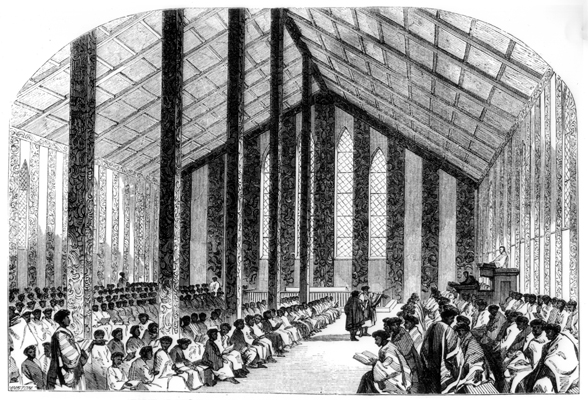
Figure 87. Manutuke IIB, Interior as originally planned, with a single “stemmed” manaia panel.
Published in the Church Missionary Intelligencer, 1852
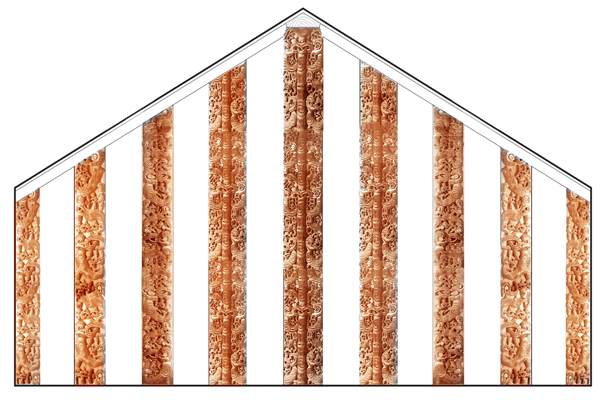
Figure 92. Author’s conjectural reconstruction of Manutuke II'Bs end wall with three “stemmed” manaia panels
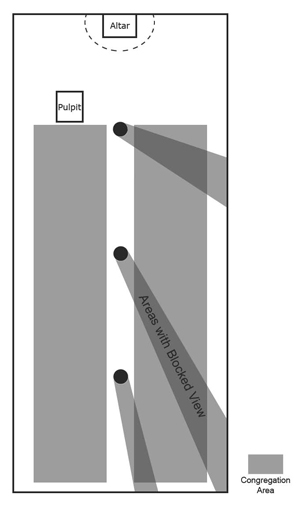
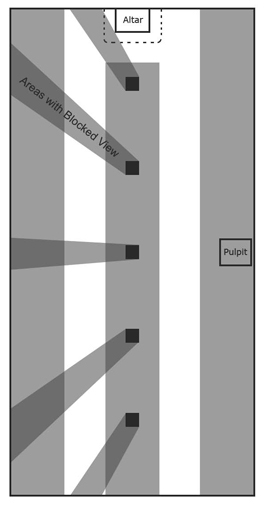
Figures 121 & 122. Sight and voice lines in two double-nave Maori churches with different liturgical arrangements
FORTHCOMING
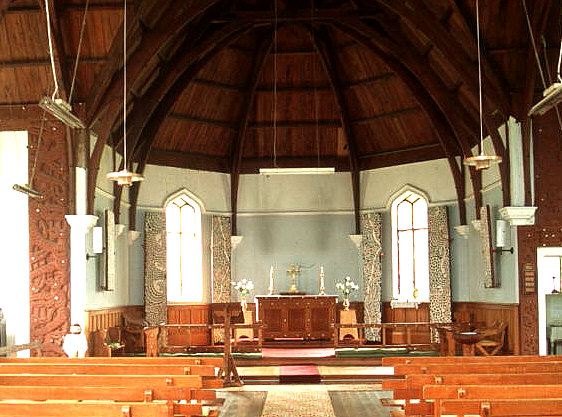 |
“The Four Maori Churches at Manutuke.” An invited essay commemorating the centenary of the fourth Maori church (Tokotoru Tapu [Holy Trinity]), at Manutuke, Aotearoa New Zealand. Forthcoming in 2014 |
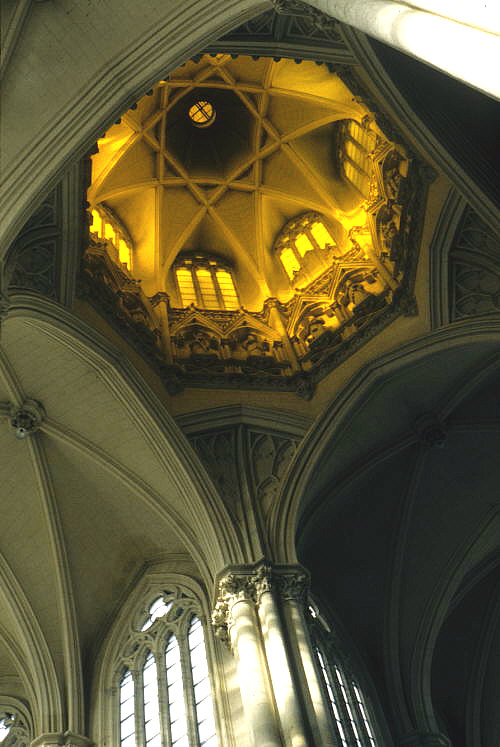 |
Architecture of Colonizers/Architecture of Immigrants: Gothic in Latin America from the 16th to the 20th Centuries, special issue of eight essays, edited by Richard A. Sundt and Paul Niell, in postmedieval: a journal of medieval cultural studies [sic], vol. 6, no. 3, 2015
image: La Plata Cathedral, Argentina |
IN PROGRESS
“La iglesia del Inmaculado Corazón de María: Evocación del gótico languedocien y catalán en Buenos Aires a principios del siglo XX,” in (tentative title) Neogótico en América Latina, ed. Martin Checa Artasu
“Mural ‘DNAs’ and the Structuring of the Architectural Envelope: Memberization (or Membranization) and Planarity in the Churches of Medieval Europe”
“On the Structure of St.-Denis’ Triforium (in cross-section) and its Relation to the Design of Amiens’ Nave Triforium”
“Rapanui (Easter Island) Statues and Their Representation in the Comics”
-End of Works Completed and in Progress
IV. PROFESSIONAL & TEACHING-RELATED ACTIVITIES
April 2010: Organizer and presider of a session on “Late Gothic and Neo-Gothic in Latin America,” Annual Meeting and Conference of the Society of Architectural Historians, Chicago. Participants from Argentina, Mexico, Peru and USA.
May 2005: Organizer and presider of three sessions on “Medieval Brick and Brickwork,” for AVISTA at the International Congress on Medieval Studies at Kalamazoo. Participants from England, Spain, Germany, Turkey and the USA.
July 2003: Photographic project in Italy realized under the auspices of a grant obtained by Prof. Augustine Thompson, Department of Religious Studies, University of Virginia. The project entailed photographing churches, manuscripts and inscriptions in a manner that would elucidate ritual aspects as they relate to the devotional life of the laity for Thompson’s book, Cities of God: The Religion of the Italian Communes, 1125-1325, Penn State University Press, 2005.
2008: Publication of my translation, from the Marshallese, of John Anjain’s account (bwebwenato) of the radiation fallout on Rongelap, Marshall Islands, in Barbara Rose Johnston’s and Holly M. Barker’s Consequential Damages of Nuclear War: The Rongelap Report (Walnut Creek, California: Left Coast Press, 2008). For a brief article on John Anjain’s account, see: the University of Oregon’s A&AA Review 09: School of Architecture and Allied Arts (vol. 27, no. 2, Fall 2009), p. 9, or on online at: http://aaa.uoregon.edu/sites/aaa.uoregon.edu/files/docs/news/aaa_review_fall09.pdf
1993: Organized and mounted an exhibit (with C. Gabai) entitled Ritual Spirits: The Art of New Guinea (accompanied by a catalogue). This project was realized as part of an Art History seminar offered winter term 1993. The exhibition was displayed at the University of Oregon Museum of Natural History in the spring and summer of 1993 and at the Schneider Museum of Art, Oregon State College, Ashland in the fall of 1993.
-End of Professional & Teaching-Related Activities-
V. COURSES
At the University of Oregon, in addition to my specialty, Medieval Architecture, I have taught courses in two other areas: Ancient Architecture and the Art and Architecture of the Pacific Islands. I have also offered undergraduate and graduate seminars on various topics dealing with medieval and Oceanic architecture. During my retirement I will be teaching courses on Gothic architecture with an occasional offering involving some aspect of architecture in the Pacific.
LECTURE COURSES (upper-level undergraduate):
History of Western Architecture I, Ancient and Medieval
Art and Architecture of the Pacific Islands I, Melanesia
Art and Architecture of the Pacific Islands II, Polynesia and Micronesia
LECTURE COURSES (upper-level undergraduate/graduate):
Greek Architecture, Roman Architecture
Romanesque Architecture
Gothic Architecture I (focusing on the Ile-de-France)
Gothic Architecture II (mainly England, France outside the Paris basin, Spain, and Germany)
SOME RECENT SEMINARS (upper-level undergraduate/graduate):
Albi Cathedral and Its Influence in the 19th Century in Europe, the Americas and Australasia
Architecture, Ideology and Ritual
Appropriation and Art
The Architecture and Decoration of the Maori Whare (House)
Oceanic Architecture
-End of Courses-