Glare is visual discomfort due to an extreme brightness contrast. There are two types of glare. One is direct glare and is a result of contrast in the visual field. The other type of glare is indirect glare and is a result of light reflected off a surface. Indirect glare is also referred to as reflected glare or veiling reflection. Direct glare is the focus of this case study.
The words "task area" and "visual field" generally refer to a desktop and a 60 degree cone of vision from the person at the desk. This remains true, however, more and more people are using personal computers. This has many implications with respect to glare. As heads rise from looking at desktops to looking at computer screens, people's cones of vision encompass many more opportunities for glare problems: their neighbor's task light, the window off in the distance,etc.
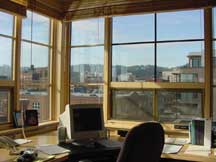
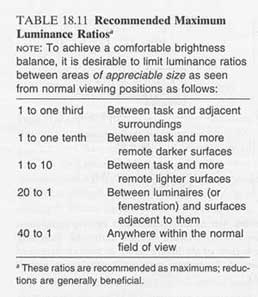
Since glare is perceptual, much depends on the individual and the task being performed. Table 18-11 in MEEB provides us with a way of quantifying what is perceptual and can be used as a guideline. For instance, the ratio 20 to 1 is suggested as the maximum recommended between fenestration and surfaces adjacent to them. Anything higher indicates too much brightness contrast, or direct glare.
The advent of personal computers has increased worker productivity, and perhaps improved worker posture, yet long-term studies on visual comfort remain to be conducted. It is with this in mind that we conducted a post-occupancy study of direct glare.