|
|
Case Study Overview
How We Got There
After throwing out ideas about the possibilities for study at the Watzek House (like pieces of a giant puzzle), the members of the class chose topics which interested them. We chose the issues we did partly because we knew if we could put together the edge of the puzzle we could slowly work our way into the middle. Our group (Christina Bollo, Robin Elder, and Greg Thomson) was interested in areas of the house which had to do with thermal comfort. The primary areas we wanted to focus on were the radiant loss of heat through the glazing, the affect of the basement/crawlspace configuration on room temperature, and the switchable characteristics (with respect to daylight, fresh air, and privacy) of the different rooms.
Addressing basic thermal comfort issues and discovering reasons and sources for heat loss would ensure that the remaining pieces of the puzzle weren’t all similar shades of gray. A second reason for looking at the performance of the glazing and the impact of the basement on thermal comfort was the fact that the various rooms had similar, but not identical, characteristics. Having variables which didn’t vary dramatically from room to room would allow us to reasonably infer that our results were accurate to an acceptable degree of error. The other reason for chosing the topics we did, was our mutual interest in the beauty and simplicity of “switch rich” architecture, of which the Watzek House is a wonderful example. Being able to analyze the capacity of a user controlled house to perform its tasks of thermal comfort would help us all to be better designers of sustainable buildings.
What We Did Once We Were There
Our first task was to further define the nature of the labyrinth we had navigate in order to answer our questions. The development of our hypotheses was a real shot in the dark. We were trying to complete a puzzle without knowing what the final picture looked like - or if we had all of the pieces.
We began by describing the component pieces of each of the rooms which would have an impact on the questions we would ask, as well as the type of information we would gather. In our initial wanderings toward our hypotheses we examined all of the major rooms of the house. Bedrooms one, two, and three (the two main bedrooms and the guest bedroom), as well as the dining room, the living room, and the library. It quickly became apparent that this was far too much to study in the limited time we had, therefore we decided to concentrate on the dining room, library, and living room. Below is a description of the room features which helped us to illuminate the problems we would address later in the case study.
Dining Room:
• north facing single glazing, full height of wall
• screens on west facing, operable windows
• room partially over full basement, crawlspace at north edge
Library:
• east facing, single glazing, above built in bench seat
• curtains to control solar gain
• room completely over full basement
Living room:
• primarily east facing, unealed, double glazing, floor to ceiling
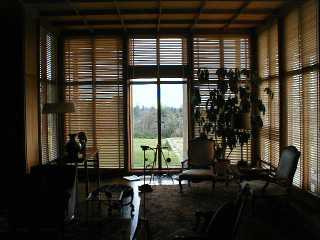
• operable, wood blinds and portico to control solar gain
• doors to patio on south side
• room partially over full basement, crawlspace at east edge
Which Questions Will Become the Right Answers
After making our brief descriptive statements about each of the rooms, we then recycled the questions we asked in order to get to those descriptions. While not all directly related to our final hypotheses, each of the questions we posed helped us to put together more pieces of the puzzle.
|
|
 |
 |
|
|