|
|
|
|
|
|
|
|
|
|
|
|
Conclusions
The surface temperatures of the floors indicate that the crawlspaces aren’t having much if any impact on the thermal comfort of the occupants in the rooms. Those temperatures are relatively consistent with the ambient air and globe temperatures in the dining room, library, and living room. It is when those temperatures are compared with the surface temperatures of the glazing - both over the longer periods of study, as well as the temperatures over the entire glazed area, that it can be seen that the conductive heat losses through the glazing have the greatest affect on thermal comfort in the house.
|
|
|
|
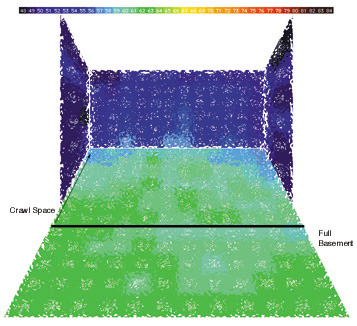
Dining Room - Surface temperatures of the floor and glazing. The graph is keyed by color, where each change in hue represents a one degree change in temperature (° F). Surface temperatures were recorded at 12" intervals across the floor and the glazing. The black line indicates the area below the floor where the foundation of the full basement ends and the unexcavated crawlspace begins. Surface temperatures in the dining room are almost ten degrees cooler at the glazing, though there is a cold shadow falling on the floor immediately below the windows, which is caused by the cold air next to the glass falling the the floor in the absence of the fully functional heating system.
 |
|
|
|
|
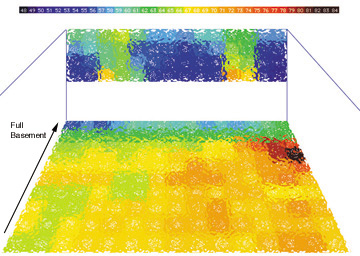
Library - Surface temperatures of the floor and glazing. Like the image above, the graph is keyed by color, and measurements were recorded at the same interval. The white areas in this image indicate opaque wall area, which weren't measured for temperature. Unlike the dining room and the living room, the floor of the library is entirely over a full basement. The cold spots on the floor near the windows are actually at the shelf above the built in sofa, where cool air is pooling. The two warmer sections on the windows show the effectiveness of the HVAC system to warm the air next to the glazing.
 |
|
|
|
|
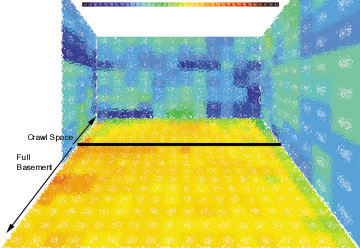
Living Room - Surface temperatures of the floor and glazing. Color changes indicate one degree changes in temperature, and the readings were taken at 12" intervals. Like the image of the dining room, the black line indicates the location of the crawlspace beneath the floor. This room has a large glazed area, as can be seen in the diagram, though the overall temperature of the glass is higher than that of the dining room, it is still cooler than the floor temperatures.
 |
|
|
|
|
Recommendations
It is clear from the data gathered that the double-glazed windows in the living room are much more effective at preventing heat loss than the single-glazed windows. For this reason the best strategy for preventing heat loss, and consequently energy loss, would be to continue the pattern of storm windows which have been installed in bedroom #1.
While uninsulated, unsealed glazing isn’t nearly as effective in preventing both kinds of loss, it is an improvement over the existing conditions. In the rooms with curtains and blinds, those can be drawn at night to provide additional layers of insulation against heat loss. This strategy does leave out the dining room, which has the biggest problem with heat loss coupled with no solar gain during the winter. In this case the addition of storm windows will help prevent some loss of heat, but it will still likely be one of the colder rooms in the house because of its orientation and the amount of exterior wall which is glazed.
Therefore it will probably simply have to be accepted as being a different thermal environment than the other rooms, which can add greatly to the overall thermal delight of the house.
|
|
|
|
|
 |
|