Crawlspaces
Hypothesis: The absence or presence of the crawlspaces doesn't affect thermal comfort.
Analysis + Conclusions
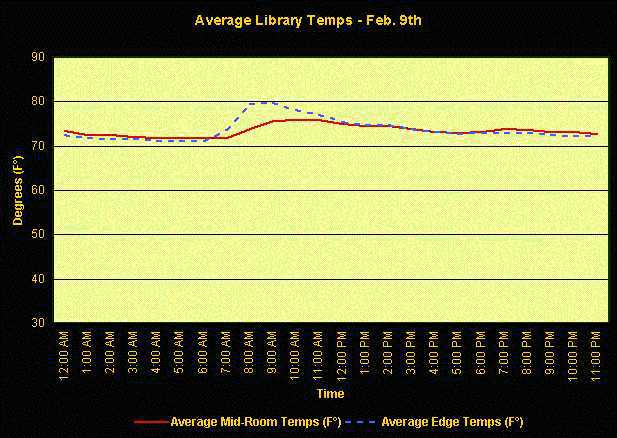
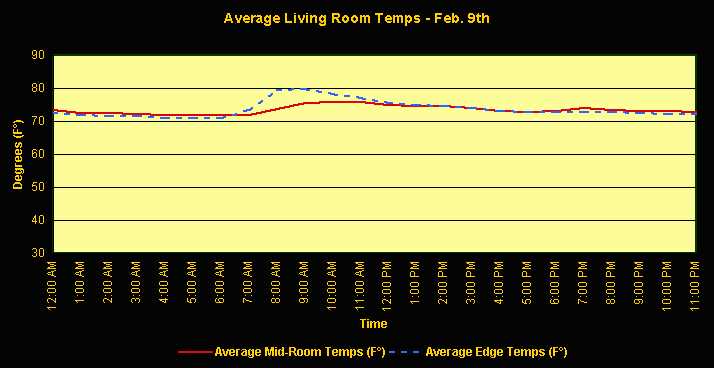
The average temperatures of the library and living room are very similar, only differing by 2 or 3 degrees. They practically track each other exactly throughout the week. This supports our hypothesis that crawlspaces have little to do with affecting thermal comfort because even though there is no crawlspace under the library and there is a crawlspace under the living room the air temperatures in both rooms were remarkably similar.
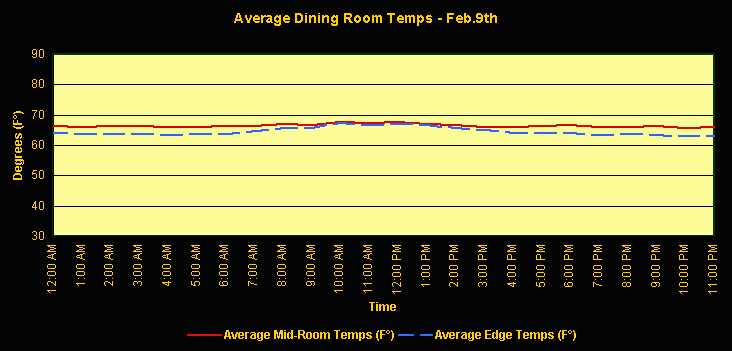
The Dining room on the other hand is significantly colder than the other two rooms. While the dining room is over a crawl space the difference in air temperature can more likely be attributed to the fact that the dining room gets little solar exposure because of its primarily north facing windows. The library and living room both have primarily east facing windows and therefore are getting solar exposure in the winter, while the dining room does not.
Also notice that the difference between the temperatures taken at the edge of the room close to the windows and those taken in the middle of the room are very close to each other in both the living room and the library. They fluctuate over the course of the week but for the most part are only a few degrees apart. If we look more closely at February 9th we can see that sometimes it is warmer by the window and sometimes it is colder. What is strange about February 9th is that round 9 am on there was a sharp increase in the edge temperature, we believe this is due to direct solar exposure to the thermistor from the early morning sun. This phenomenon occurs both in the library and in the living room. The February 9th graph for the dining room shows that there was very little warming in the space over the course of the day. This again supports the conclusion that the solar radiation through the east facing windows in the library and living room are the most significant factor that affect the difference in thermal comfort between the three rooms.
We can conclude that it is most likely not the crawlspace/basement that is causing thermal discomfort. The orientation of the windows does seem to play an important role in the thermal climate of each room. However without looking closely at another room with primarily north facing windows (like the dining room) it is hard to tell how the architect dealt with different orientations or to solve for the existing problem.
