|
|
|
|
|
|
|
|
|
|
|
|
Double Glazing
Hypothesis: The installation of double glazing will have a positive effect on thermal comfort.
The graphs below show short term data for the dining room, library, and living room respectively. These are the detailed graphs, extracted from the long term data of the graphs on the previous page. The circled ore highlighted portions of each of the graphs show the areas of interest to look at more closely.
|
|
|
|
 |
|
|
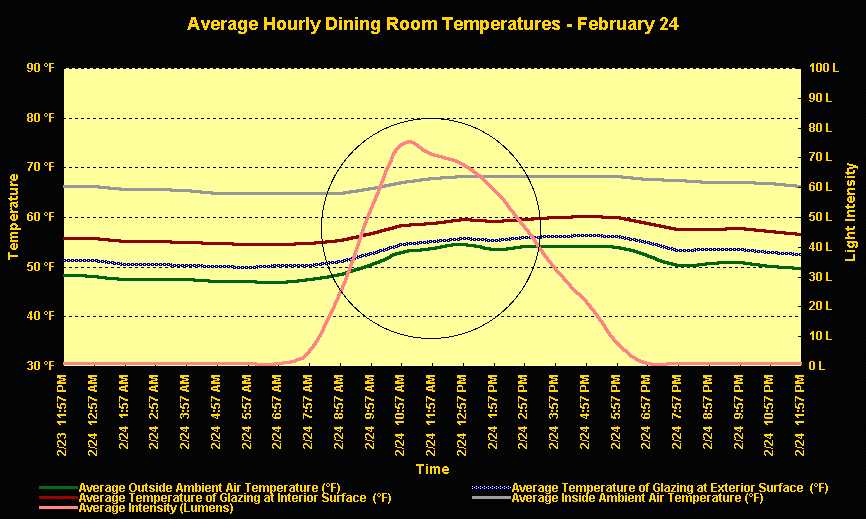
Dining Room - The 24 hour period detailed in this graph shows the minimal impact that the increase in lumens in the middle of the day has on north facing glazing. Not only was there not any direct solar gain, there was also oonly a minimal gain in temperature for each zone which was recorded. It is also clear that the single pane of glass for the dining room windows is not effective in prevening conductive heat losses - as there is little temperature difference between the interior and exterior surfaces of the glazing and the outdoor air temperature. |
|
|
|
 |
|
|
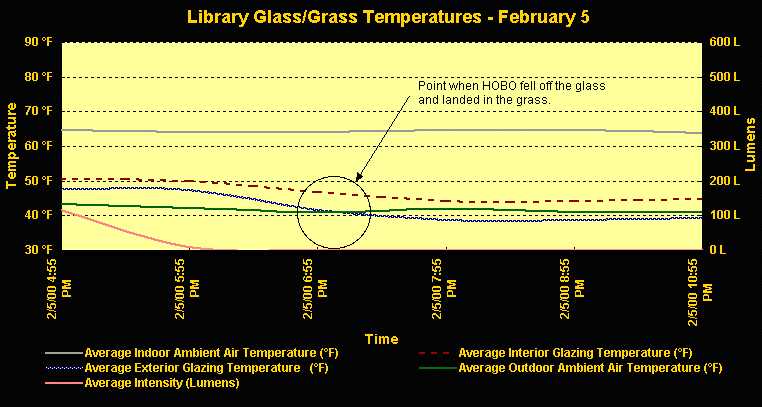
Library - The area detailed here indicates the point when the HOBO fell off of the window, and into the lawn. At approximately 7:00 PM on February 5, not more than four hours after we placed the HOBO on the library window, the tape succumbed to the rainy conditions and lost its grip on the window. At that point the HOBO began to take surface temperature readings of the lawn, which was colder than the outdoor air temperature. Until it fell off of the window, the data recorde indicates that the temperature difference between the interior and exterior surfaces of the glass were almost identical to those recorded in the dining room two weeks later. |
|
|
|
 |
|
|
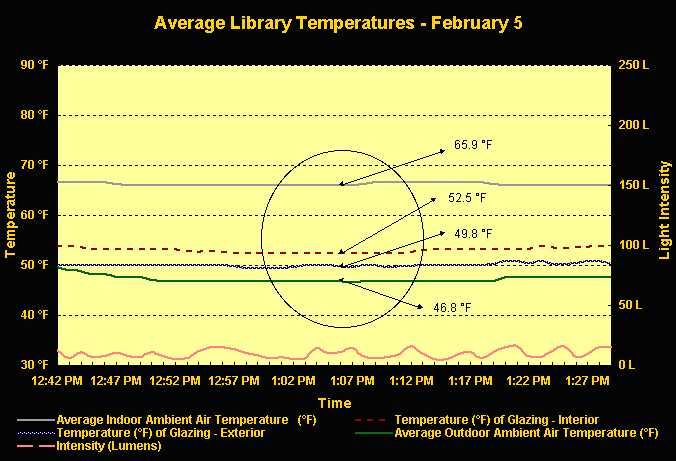
Library - The graph above is from data recorded during the duration of one of our field trips to the Watzek House. It was only intended to be used as an in house comparison for the data collected over the course of the following week. However, since that data for the library has surface temperatures of the grass, this data was used to confirm that the exterior surface of the glass should indeed be warmer than the outdoor air temperature. This can be seen in the highlighted area above, which shows the temperature differences between the indoor air, interior glass surface, exterior glass surface, and the outdoor air. |
|
|
|
 |
|
|
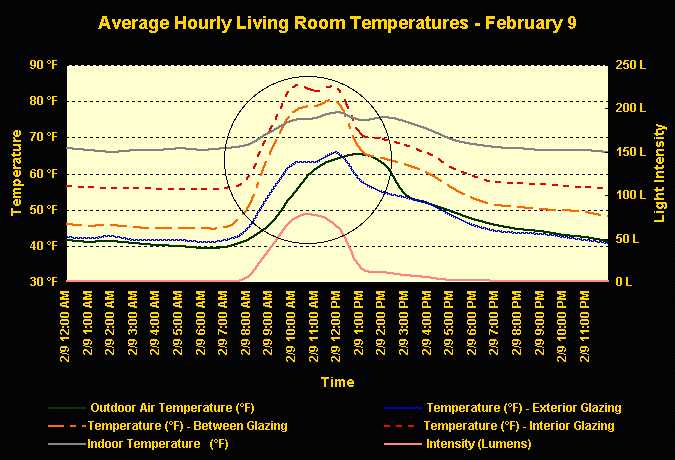
Living Room - The results of the data collected for the unsealed double-glazing system show that that system is much more effective in preventing conductive heat losses through the glazing. As a result, the thermal comfort near the glass is in the living room is much better than in the dining room and library. At the point where there was direct solar gain, between 9:00 AM and 1:00 PM on February 9, the interior surface temperature, and the airspace, were nearly ten degrees warmer than the indoor air temperature. |
|
|
|
|
 |