Design Lessons Learned
Our calculations and the energy scheming program also show that a significant
amount of heat loss may be prevented if storm or double paned windows are
installed.
Even if infiltration were a larger factor in heat loss, storm windows would
be less intrusive than any method of preventing heat loss through infiltration.
Infiltration is very hard to fix in a house, it is much easier just to build
a relatively tight building than to fix it later. This goes double when
you consider that this house is a historical house, many of the parts of
it cannot be found today. Other methods like blown in insulation would require
damaging the irreplaceable walls in the Watzek House. Making the windows
smaller in the dining room or the living room would greatly diminish the
wonderful light qualities that those rooms currently have.
We found that most of our data leads back to problems in the HVAC system. Our suggestions for improving performance are as follows:
Close the outdoor air damper. The introduction of outdoor air to the mixing chamber is lowering system performance and lowering the temperature of the warm air delivered to the living spaces.
Open the return air damper. The pneumatic servo that operates the return air damper is either not functioning or functioning erratically. If the return air damper were set to remain in the full open position better advantage could be taken of the heated air already in the air handling system.
Repair and reconnect the pre-heating coil in the mixing chamber. Increasing the temperature of the air being delivered to the ductwork will go a long way towards increasing thermal comfort, and would be a cost effective method of overcoming deficiencies in the fin-tube insert radiators.
Check the boiler settings. Although we do not know the original design parameters for boiler efficiency, it is our feeling that the boiler could be ìtweakedî to burn less gas. This adjustment should take place after the changes mentioned above so the technician making the modification can ascertain system requirements.
Locate the defective fin-tube radiators. Our readings of the steam delivery pipes indicated that steam was getting through some locations, and fin-tube radiators were acting erratically. We did not have the time in this study to fully analyze this problem, but our data points towards a clogging or valve operation problem in the steam system.
Check the fresh water supply (makeup water) source that feeds the steam system. One possible reason for clogs in the steam lines is mineral deposits from makeup water. Insure that makeup water is appropriately processed prior to its introduction to the steam lines. The maintenance company that services the boiler should be able to determine proper chemical components of makeup water.
These modifications have been listed in the order of impact and cost effectiveness. As each item is checked off, some improvement should be recognized in the thermal comfort of the home, and as the system works more efficiently, gas consumption should drop.
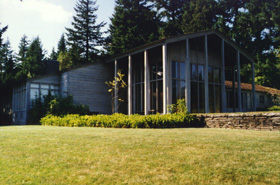
Above: View of living room projecting out into the landscape of native vegetation which was designed by John Yeon.
Below: First Floor Plan. East is up, with the primary rooms overlooking downtown Portland. The living room is on axis with Mt. Hood. From Architectural Record, Dec. 1940.

Conclusions
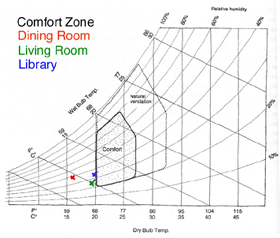
Average temperatures of the dining room, library, and living room were plotted on the psychrometric chart to see where those rooms performed with respect to the comfort zone.
All of the rooms are slightly below the comfort zone, though it should be remembered that the "comfort zone" for this chart uses modern definitions of thermal comfort - for a seated individual, in a short sleeve shirt. The comfort zone for which historic homes were built for is both cooler, and likely has the expectation that people in the house will dress appropriately as the seasons change.
The surface temperatures of the floors indicate that the crawlspaces aren’t
having much if any impact on the thermal comfort of the occupants in the
rooms. Those temperatures are relatively consistent with the ambient air,
globe, and mean radiant temperatures in the dining room, library, and living
room. It is when those temperatures are compared with the surface temperatures
of the glazing that it can be seen that conductive heat losses through the
glazing have the greatest affect on thermal comfort in the house.
This page contains the conclusions and recommendationd for our studies of the Watzek House. As described in the previous pages, the hypotheses pose questions about the effect of unexcavated crawl spaces, and unsealed double glazing on thermal comfort in the Watzek House. The conclusions are based partly on our own studies of the crawlspaces and the glazing systems in the house, however additional insight has been discovered by the other teams which studied the house, and as a group we will develop more integrated conclusions and recommendations on a linked page.
