The essential purpose of our case study was to analyze and evaluate the various components of thermal comfort as they exist in this unique historic home. We established hypotheses about the influences of different parts of the building envelope and interior on thermal comfort, and recorded data which helped us to reach conclusions about our hypotheses.
Our case study concentrated on the impacts of unexcavated crawlspaces, and glazing systems on the temperatures of three different rooms in the Watzek House. Our studies of the dining room, library, and living room were based on the similarities in characteristics in those rooms which would allow us to make definitive conclusions about what influenced thermal comfort the most.
Most importantly we had the great fortune to experience one of the region's most important and impressive buildings, while at the same time gaining insight into the function and life of an historic home.
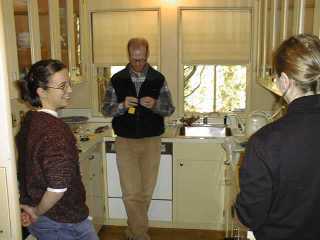
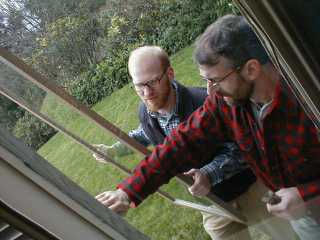
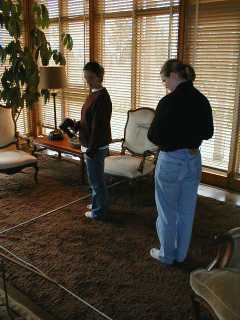
Counterclockwise from upper left: The Thermal Comfort team,
doing what we do best, pictured are Robin Elder, Greg Thomson, and Christina
Bollo; removing a storm window in one of the bedrooms as part of a less
than successful portion of our study; Robin and Christina taking surface
temperatures of the living room floor with the a Raytek gun, and comparing
that to how their stocking feet perceive the floors.
Click on the link above to visit the Thermal Comfort website.