
 |
|
 |
|
 |
|
 |
|
 |
|
 |
|
 |
ART OF THE SILK ROUTE
4 credits
Instructor: E. Jacobson Office: 240 LA
Tel.: x6-3677 E-mail: ejacobs@oregon.uoregon.edu
Course Web-Site: /~arthist/arh382/
This course satisfies non-Western art history requirements
Meets: 12:50 - 13:50, UH, 166 LA
Format: Lecture, discussion
Prerequisites: ArH 207 or 208, or courses in Buddhist art or religion.
Evaluation: Journal, open-book midterm, final paper.
This course satisfies:
non-Western art history requirement,
Arts and Letters Group I requirement,
and Multi-Cultural requirement (category C)
Description:
This course will examine the arts of the Silk Route, with particular attention to art of Buddhism in Inner. Historically, Inner Asia was marked by trade routes (the 'Silk Route' or 'Silk Road') which criss-crossed this vast landscape of deserts and mountains between China, India, the Iranian Plateau and the Mediterranean world. Its cultures were constantly intruded upon, and sometimes reinvigorated by, nomadic peoples from the steppe zone of Central Asia. Although the states, kingdoms, and empires that emerged and disappeared in this great inner basin of Asia shared to some extent in the more stable and enduring cultures of China, India, and Iran, they developed their own very distinctive styles and media. The result was a distinctive tradition that reached its most brilliant expression in the art of Buddhism.
In this course we will briefly consider the art that preceded Buddhism in Central Asia, and then go on to consider the art of Buddhism: its doctrinal and artistic origins in India; its development in Gandhara and in the kingdoms of Central Asia; and its final vital elaboration through the tradition of Lamaistic Buddhism in Tibet and Mongolia. In addition to the art of these cultures, we will also look at the records of early Chinese travelers through Central Asia, ‘in search of the Law,’ and the reopening of the Silk Route by Western explorers in the late 19th – 20th c.
Books for sale:
Frédéric, Buddhism.
Cowell, ed., Buddhist Mahayana Texts.
Hopkirk, Foreign Devils on the Silk Road
Fisher, The Art of Tibet (optional)
Basis for evaluation of student work:
- 10%: Timely completion of all assignments
- 20%: Open book midterm exam
- 30%: Mechanics, substance clarity for all written parts of the journal
- 30%: End of term paper, 8-10 pp.
- 10%: Regular attendance and participation
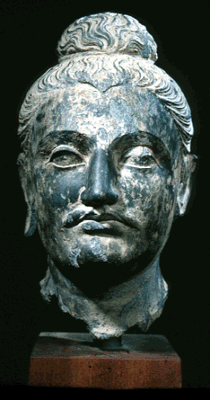
Schist originally covered with plaster and paint. University of Oregon Museum of Art.
Image © University of Oregon Museum of Art, unauthorized use strictly prohibited.
Top of Page | Art History Department | University of Oregon
Site created by Kaylyn Hipps. Site maintained by AAAWeb GTF. Last updated