ARTD 250/251 FAQ
Please note: It is the expectation that you will seek an answer to your question either here, on your syllabus or on other areas of Blackboard before you email me.
GRADES
EMAIL/OFFICE HOURS
ATTENDANCE/CLASS CONDUCT
ACADEMIC MISCONDUCT
LATE WORK/REVISION
END OF TERM QUESTIONS
DIGITAL ARTS MAJORS
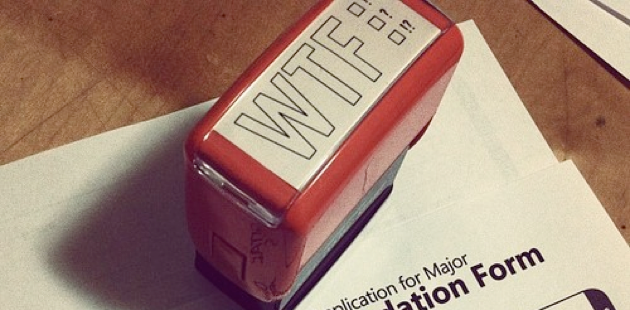
WTF?!
GRADES
Q: Isn't grading 'artwork' totally subjective?
A: Sure, grading any kind of artistic or expressive media does entail a degree of subjectivity. However, many disciplines (creative writing, or music, for example) also require large degrees of subjective evaluation. Even something as ‘straightforward’ as a literature essay can be highly subjective, and grades on the exact same essay can vary between professors. Subjective evaluation is part of the university system, and life in general. If you go into any profession involving media or creativity in any way, you will be subject to some extremely rigorous subjective evaluation—many times not very nicely (There are LOTS of Simon Cowell’s out there). You’re somewhat sheltered from that here.
Subjective does not mean ‘unqualified,’ however. Your GTF's and I have a combined background of literally decades of education, experience and working with images, video, sound and concept. We've seen pretty much everything under the sun, and-- here's the cool part- we want you to succeed. That means we'll need to tell you what can be improved. That means we need to hold you accountable for the quality of your work.
It stinks that we have to rely on extrinsic motivating factors such as grades in this system, but that's how it works. My job is to insure that process has integrity, and I take that very seriously. Of course subjectivity plays a part in this. The vast majority of it, though, is based on our expertise and experience. That's why we are here. It’s not perfect, but it is pretty solid.
Q: I worked really hard on my project and I didn’t get the grade I think I deserved.
A: First, stay cool. Take a deep breath and don’t go anywhere near your email for at least 24 hours. Take a walk. Clear your mind. Come back and watch your project as objectively as you can, not defensively. Review the grading policy very carefully. If, after doing that, you honestly feel your grade merits discussion, then come speak to me during my office hours, or make an appointment to speak to your GTF in person. Be calm and patient, and recognize we will listen to your concerns, but this does not mean we will change the grade. Remember, hard work is the absolute minimum expectation. It isn’t grounds to raise a grade.
Q. What if I disagree with/ don’t understand the rationale for my grade?
A. Then come talk to me (or your GTF) in person. We’ll talk about it. Just keep a cool head, be kind and remember that I may not agree with you either, but I will definitely do everything in my power to 1) hear your concerns and 2) address them in a way that makes you whole in this process. This doesn’t mean I will raise your grade (because I very well may not). It means I want you to learn and get constructive feedback for how to improve. We do not have to agree on your grade for it to stand, but I will try to help you understand.
Q: Why can’t I email you about my grades?
A: Because email and grades are a BAD and EVIL mix, like Nickelback and a recording studio! Sadly, even students I have excellent relationships with tend to lose their cool when it comes to grades and email. Email does not communicate body language, tone inflection or any other nuance. It also tends to be ‘easy’ and feels somewhat anonymous, which is a dangerous mix. It also gives the illusion of not having direct consequences for your words/behavior when nothing could be further from the truth. You need to understand that email is not a confidential medium, and the Student Code of Conduct is very specific about inappropriate usage. Abusive or harassing correspondence via email can result in sanctions from the Student Conduct Board. If you want to talk about grades (other than simple yes or no questions, or corrections) then you must see me in person during my office hours. And yes, you are expected to find a way to see me. It is not within my means to schedule an appointment around the personal itineraries of 330 students.
Q: But I have class/ work during your office hours!
A: That stinks and I do understand the bind this puts you in. But that’s also life. I, too, have a busy schedule and my office hours are times I have deliberately set aside to meet with you. I physically cannot make personal appointments that are structured around the individual itineraries of 300 students. You need to find a way to see me. If you do have to restructure your schedule, let me know you are coming so that I can contact you if something comes up.
Q: But you’re scary!
A: Ahhh, that’s sweet, but honestly, my hard exterior belies my soft interior. Inside, I’m all sparkly marshmallows and rainbow butterflies.
Q. I found a mistake in my grade.
A. Then tell me, yo. You can email me something like that if it’s a simple correction. Just be nice.
Q. What is the right way to do this blo?
A: In the manner that demonstrates successful application of the criteria. THERE IS NO MAGIC FORMULA. There are strong guidelines that give you enough to move forward, and leave out just enough to challenge you. This frustrates many students who are accustomed to a different model of pedagogy, but solid research supports me on this: you do better trying to figure it out within certain parameters than if I ask you to simply regurgitate and fill in the blanks. It’s harder—much harder—but better. Move past your frustration and get to work.
Q: Why was I penalized? This says I got an ’88.’ Why did I lose 12 points?
A: This is important: No one starts at perfection and then somehow ‘loses points.’ Your grade is essentially a numerical reference for how well you successfully executed all aspects of your work. By that standard, 88% is pretty damned good. Not everyone can produce awesome work every time. Remember it’s not you… it’s the work. Don’t take it personally. Learn and move forward. Fix it. Make it better.
Q: My final grade for this class was an 79.9% Will you round up? I’ll lose my scholarship/get kicked out of my housing if I don’t get at least a B-! It’s just a tiny point! It’s not fair that such a tiny fraction can threaten my scholarship/home/livelihood! PLEEEEEZ? I’ll do ANYTHING!
A: No. I mean it. No. Sorry, I know that sounds cruel, but there’s got to be a cut-off somewhere and this is it. Asking me to inflate your grade or give you extra opportunities that no one else has because you were unable to achieve the grade through the normal coursework is absolutely unethical. If you are concerned about your grade because of ANY reason, then you need to make sure you are addressing it well before your final grade is determined. Seriously, do NOT even ask me this question. Don’t.
Q: Are you serious when you say you won’t round up?
A: Yep.
Q: Really?!
A: Yep.
Q: That’s harsh!
A: Really? Look, I know we live in an era of grade inflation, but I can’t just arbitrarily raise someone’s grade because they need a point—it’s just wrong. I never in my wildest dreams asked a prof to do that for me (even when it meant losing a scholarship), and I am still creeped out when students ask me now. In this class, I usually give several opportunities to improve your grade (which results in a LOT more work for me, just FYI). If you need a certain grade, make sure you earn that grade the same way everyone else does.
Q: But what if I get down on my knees and beg?
A: Then you will look silly and I will be very uncomfortable.
Q: It’s the end of term and I’m going to get a ‘bad’ grade/fail this class! Is there anything I can do to save my grade?
A: Nope. Your chance to ‘do something’ about your grade was during the previous 9-10 weeks.
Q: It’s week 8 (or earlier). I’ve had a really hard term due to medical/personal circumstances. I’ve tried really hard to do the work, but I just can’t manage to get it in and I’m really freaked out. Is there anything I can do?
A: Possibly. Come see me and we will talk. Don’t wait until week 10 to address this with me, or I will be unable to assist you.
Q: I missed class. Can I make up for it with an ‘extra’ credit assignment?
A: No. That only creates ‘extra’ work for me and still doesn’t deliver the content of what you missed.
Q: I missed class. Did I miss anything/Can you tell me what I missed?
A: Seriously? Yes, you missed something. Ask a classmate for notes.
Q: I failed to turn in an assignment. Can I do extra credit?
A: No. If you can’t handle the required assignment, why should you get ‘extra’ credit? Do the work required of you at the time it is required.
Q: I did poorly on a project/paper. Can I do a revision?
A: For projects, ask your GTF’s. It makes more work for them to allow revisions, so they might not. For your papers, I will allow you to revise any paper that gets a D+ or below. Revisions are a privilege, not a right.
Q: How do you/the GTF’s grade revisions?
A: A little harder. You know what the expectations are and are being given a second chance. If you just fiddle with a couple of shots, vector points or fix some grammatical mistakes, I won’t even look at it. I need to see a major restructuring/re-examination of your work.
Q: Can I revise a project/paper that I submitted late?
A: No. Yet another reason to get your work done on time.
Q: If I submit a paper late, do you still grade it the same?
A: Yep. I just knock the late penalty off the top when I’m done. For example, if you submit something one day late that is B- material, your final grade will be a C-.
EMAIL AND OFFICE HOURS
Q: Why won’t you answer my emails?!
A: I don’t know. Are you giving me enough time to address them (at least 24 hours)? Are you sending them to me on days I don’t check my inbox (Friday and Saturday)? Are you sure I’m getting them? Make certain you are sending them to cwarren1@uoregon.edu. There’s a poor fellow who has a similar address that gets a lot of my emails.
Bear in mind that I spend approximately 3-4 solid hours a day doing nothing but answering emails, so I’m definitely getting to them. However, I will ignore yours under the following circumstances:
1)you don’t put the class title (ARTD251 for example) in your subject heading (at least until I know who you are).
2)the answer can be found either in your syllabus, in the Blackboard materials or in this FAQ
3)I’ve covered it extensively in lecture or made it clear via class announcement on Blackboard
-
4) You’re asking for an extension hours before the due date for reasons that are not acceptable.
If your question/concern doesn’t fall into that list above, just send me another one and try to be patient. Sometimes, especially at the end of term, I’m so swarmed with emails I occasionally miss one, or it gets buried so fast I just forget about it before I can have time to respond.
Q: If I email you a question about a policy, or extension, and you don’t reply, what should I do?
A: Assume that the policy in the syllabus stands. NEVER assume a lack of reply implies consent.
Q: Can I send you cool links and stuff? Or can I just shoot you my thoughts about a topic that really engaged me?
A: Yes! Please! In fact, much of the best teaching material I have comes from students! And as for dialogue—yeah, totally do that. That’s what I love about my job—actually talking about this stuff. I’d much rather answer an email like that than one that asks me where my office is located (info that can be found on blackboard).
Q: Can I email questions/ideas I have about the projects? Or can I ask for some feedback on something I’m testing out?
A: Sure, please do! If the feedback you need is more involved, I might either do a screen capture or ask you to come talk to me in person. If it is about a grade, then you’ll have to come see me in person.
Q: Do you prefer a particular pronoun when I address you?
A: Thanks for asking! I’m most comfortable with something gender neutral, such as my title (professor), or better yet, my name. (Professor Warren, Prof., Professor Ty, Ty, Tyrras, Digital Overlord, High Regent of the Digital Realm... etc.)
Q: Why can’t I email you about my grades?
A: Because email and grades are a BAD and EVIL mix, like Nickelback and a recording studio! Sadly, even students I have excellent relationships with tend to lose their cool when it comes to grades and email. Email does not communicate body language, tone inflection or any other nuance. It also tends to be ‘easy’ and feels somewhat anonymous, which is a dangerous mix. It also gives the illusion of not having direct consequences for your words/behavior when nothing could be further from the truth. You need to understand that email is not a confidential medium, and the Student Code of Conduct is very specific about inappropriate usage. Abusive or harassing correspondence via email can result in sanctions from the Student Conduct Board. If you want to talk about grades (other than simple yes or no questions, or corrections) then you must see me in person during my office hours. And yes, you are expected to find a way to see me. It is not within my means to schedule an appointment around the personal itineraries of 330 students.
Q: But I have class/ work during your office hours!
A: That stinks and I do understand the bind this puts you in. But that’s also life. I, too, have a busy schedule and my office hours are times I have deliberately set aside to meet with you. I physically cannot make personal appointments that are structured around the individual itineraries of 300+ students.
Q: But you’re scary!
A: Ahhh, that’s sweet, but honestly, my hard exterior belies my soft interior. Inside, I’m all sparkly marshmallows and rainbow butterflies.
Q: Your response to my last email was really short. Are you mad at me?
A: Lol, probably not. I never answer emails if I’m mad (at least I try really hard not to do that). Plus, it really takes quite a bit of poking to get me upset in the first place. I rarely take things personally, and I know what it’s like to be a stressed out student. I may just be in a hurry to answer the question. Usually, I’m pretty chill, but sometimes I can be matter-of-fact in my responses. It’s ok to ask for clarification if you’re concerned.
ATTENDANCE/LEAVING EARLY/CLASS CONDUCT
Q. I didn’t read the syllabus and I missed the part where it said I’d fail if I didn’t come to class! I’m so sorry! Please pass me! Zombies will eat me if I don’t pass this class!
A. I’m sorry, too! No. Try not to get eaten.
Q: Do you really enforce the attendance policy? Even if I go just one over the limit?
A: Yes.
Q: Why? I’m an adult! I can decide whether or not I want to be in class!
A: Because it is my responsibility as your professor to ensure you get the content of this course, which requires your presence in order to do so. Yes, you are an adult. You can absolutely decide not to come to class. As an adult, you can rationally accept the consequences of your actions. In this case, you’ve chosen to ignore the guidelines set forth in the syllabus.
Q: I already know all the software. Do I really need to come to labs?
A: Yes. Software is only a small part of what we teach. Your GTF’s will be working with you on the development of your concepts and how your skills are being applied from conceptual and aesthetic perspectives. If you do have advanced technical skills, let your GTF’s know so that they can work with you appropriately in terms of challenging you.
Q: I missed class. Can I make up for it with an ‘extra’ credit assignment?
A: No. That only creates ‘extra’ work for me and still doesn’t deliver the content of what you missed.
Q: I missed class. Did I miss anything/Can you tell me what I missed?
A: Yes, you probably missed something. Ask a classmate for notes.
Q: What if I sign the attendance sheet and then take-off?
A: Seriously? C’mon. That’s totally unethical, rude and disruptive behavior. It’s disruptive to me when I’m trying to do my job, and to other students who actually want to be there. It’s also an act of academic misconduct (intentional deception/falsification on a course document) that can get you in serious trouble. For realz. If you sign that sheet, you are verifying your presence for the entire class period. Look, if you don’t want to come to class, then don’t come. Be an adult and accept the consequences for your choices.
Q: I have to leave class early to get to another class all the way across campus in ten minutes!
A: I’ll spot you 5 minutes if you can leave discreetly. You’re responsible for learning any important info you missed in that last 5 minutes from a classmate (I often use that time for reminders about deadlines/expectations).
Q: I have a doctor’s appointment today.
A: Ok. I totally understand what a hassle that can be. As long as you are present for at least half the class and can provide me with documented proof (if I even ask for it), go take care of your health. Please notify me at the beginning of class and then leave discreetly.
Q: But I have to go to the bathroom/throw up/smoke a cigarette/answer my phone…
A: Yikes! Ok, if you are that sick, don’t come to class. That’s why you are allowed a certain number of absences. As for the rest… c’mon, man. Take care of that stuff before coming to class. If you have a legit medical condition, or an unusual situation happening where you need to take a phone call (like waiting for a doctor’s call), then just exit and re-enter the lecture hall discreetly. That stuff happens. I understand. Just put it in your mind that leaving the lecture hall really needs to be limited to special circumstances. Try to see this from my perspective. If I see you wandering in and out, I’ll pull you aside to discuss the matter.
Q: Why can’t I text in class? It’s my business, and I can multitask really well. Plus, the lecture is boring.
A: 1) When your behavior affects others around you, it becomes my business. It is distracting to those around you, and it makes them want to check their phones. Plus, it’s incredibly rude to the lecturer and that is my business as well.
2) No you can’t multitask. Sorry, all the research very strongly indicates human performance drops drastically when trying to do multiple things at one time. That research is very recent, and was conducted on college students who claimed they could multitask.
3) It’s great if the lectures are entertaining, but you have to take ownership of your role in your education. Even if it is boring, it is still the expectation that you will engage and find value in the material.
Q: I need my laptop to take notes!
A: If you have a documented note from a physician or disabilities services that says you must have a laptop in class, then that’s fine. I only ask that you sit in a designated laptop area and make certain that you are exclusively focused on class (not checking email, facebook, etc), looking up, making eye contact and participating in lecture. If you have no documented necessity for a laptop, you can take notes the old fashioned way. The fact of the matter is that the screen is distracting to other students—this policy is in place partly because of STUDENT REQUEST.
Q: You stopped lecture to tell me to put away my phone/laptop/stop talking! That was embarrassing!
A: So don’t do it, and don’t take it personally when I call you out on it.
Q: I was really dumb and sent an email to you/my GTF while, um, ‘thinking impaired’ and/or angry. What do I do?
A: Well, if you ‘went off’ on me/the GTF, then a sincere apology would be appreciated and would go a long way towards repairing any damage. If it’s not too bad, we can get a coffee and talk about it, have a few laughs, move on. If you were abusive, however, I will forward it to the Director of Student Conduct and let him take it from there.
ACADEMIC MISCONDUCT
Q: Can I reuse my old work from another class for my paper/project? Can I use another student’s/artist work?
A: Not without my explicit permission and a genuine understanding of how doing so will generate new content. Your objective is to learn, grow and challenge yourself. Mindless repetition doesn’t accomplish this. Correct appropriation generates new content that also inspires commentary upon the original footage, as you 250/251 students learn in at least one of your projects.
Q: What if I do it without your permission?
A: I’ll forward the details and documents of the suspected incident, along with recommended sanctions (usually at least a zero for the assignment, sometimes failure for the course) to the Director of Student Conduct Board for adjudication after notifying you via email. If you are found responsible, the sanctions will take effect and a permanent mark will appear on your record. It’s how I handle ALL academic misconduct cases. It’s not a judgment thing, but simply a matter of time. They are paid to handle cases like this, and I need to focus on teaching my students who are trying to genuinely do the work with integrity.
Q: Do you really prosecute academic misconduct cases?
A: Yep. Every term, students fail my classes for this reason alone. It gives me a sad : ( My natural mode of operation is to give you the benefit of the doubt, which is why I do enforce sanctions so adamantly when I find cheating has occurred. They are a violation of trust and ethics.
Q: But I’m a good student and I work really hard! I just screwed up this once!
A: Look, I’m not judging you. I just don’t have the resources to attend to these matters when there are people who get paid to deal exclusively with them. Take it up with Student Conduct. If your particular case is so flagrant that it caused me to investigate and report it, then it wasn’t just a little screw-up.
Q: But aren’t you required to at least meet with me before reporting the incident?
A: No. If I elect to meet with you, it is out of courtesy, not requirement. I will if I have the time, but sometimes that’s a real problem. I often simply don’t have the time, and there is a board of student conduct that exists specifically to deal with these matters. Be advised that I never report an academic misconduct case unless I have very strong evidence to support my conclusion.
Q: If I get a notice from you that I committed academic misconduct, can I just drop the class?
A: No. University Guidelines specifically prohibit any student from dropping a class to avoid sanctions for academic misconduct. You will be re-enrolled and—if you are found responsible-- the sanctions will be enforced.
Q: What if I sign the attendance sheet and then take-off?
A: Seriously? That’s totally unethical, rude and disruptive behavior. It’s disruptive to me when I’m trying to do my job, and to other students who actually want to be there. It’s also an act of academic misconduct (intentional deception/falsification on a course document) that can get you in serious trouble. If you sign that sheet, you are verifying your presence for the entire class period. Look, if you don’t want to come to class, then don’t come. Be an adult and accept the consequences for your choices.
Q: I was really dumb and sent an email to you/my GTF while, um, ‘thinking impaired’ and/or angry. What do I do?
A: Well, if you ‘went off’ on me/the GTF, then a sincere apology would be appreciated and would go a long way towards repairing any damage. If it’s not too bad, we can get a coffee and talk about it, have a few laughs, move on. If you were abusive, however, I will forward it to the Director of Student Conduct and let him take it from there.
LATE WORK/REVISION POLICIES
Q. The syllabus says that you accept late work, but with a pretty harsh grade penalty. Surely you’ll make an exception!
A: Nope. Not unless you had prior approval (at least 24 hours), or have a documented family or medical situation. It’s not a judgment thing, folks, it’s a ‘Keep-Ty-Alive-To-Teach-Another-Day’ thing. There’s no negotiating.
Q: But the syllabus says you make exceptions in the case of illness or ‘family emergency.’
A: Yes, documented illness. You’ll need a note from the health center or a physician. If you are so sick that you’ve been unable to do your work that you’ve known about all term, you need to get it checked out.
Q: What constitutes a family emergency?
A: Well, the obvious stuff that I hope NEVER happens to you: death of a close family member such as a sibling or parent/grandparent. Sudden hospitalizations. Car wreck… that kind of thing. It can be good stuff too, like if you or your partner/spouse goes into labor.
If something like this happens to you, it’s likely that it will affect more than just an assignment. You should contact the Office of the Dean of Students right away to get the support you need. They will often contact all your professors and ask that we work with you during your recovery.
What isn’t acceptable: My friend’s dog died, my buddy needed help moving, my roommate locked her keys out of her car…
Please don’t make up deaths just to get around a late sanction. That’s weird and kinda creepy. One term, I had a student whose grandma died 3 times. Seriously… don’t do that.
Q. But I put a lot of work into it! It’s not fair that missing the deadline means I get no credit for it!
-
A. It definitely sucks that you get no credit for something you put a lot of effort and time into, I agree. But, it’s totally fair. It’s been stated in the syllabus all term, and the syllabus clearly indicates that continued enrollment constitutes agreement with all the policies.
Q. But that means I could lose my scholarship!
A. That would totally suck, I agree. Make sure you get it in on time so that doesn’t happen.
Q: But it was a technical error! It’s not my fault!
A: That stinks, and it’s still your responsibility to anticipate such things. Don’t put yourself in a corner where a technical glitch can derail your entire grade. Save your work (often) on external devices and don’t wait to the last minute to upload/execute.
Q: But I paid for this class!
A: I know, right? That’s why I can’t understand why you didn’t submit the work on time/show up/follow the guidelines in the syllabus when it’s been made very clear that such actions will result in failing this class!
Q: It’s finals week and I have a question about my grades, but all your office hours are filled up!
A: Then clearly email is the only way to proceed at this time. Be courteous and stay polite at all times, even if you are frustrated. I’m not the enemy. Remember that I probably have a gazillion other emails to get to, so I may not answer right away, and when I do, it will be polite but concise.
Q: I did poorly on a project/paper. Can I do a revision?
A: For projects, ask your GTF’s. It makes more work for them to allow revisions, so they might not. For your papers, I will allow you to revise any paper that gets a D+ or below. Revisions are a privilege, not a right.
Q: How do you/the GTF’s grade revisions?
A: Harder. You know what the expectations are and are being given a second chance. If you just fiddle with a couple of shots, vector points or fix some grammatical mistakes, I won’t even look at it. I need to see a major restructuring/re-examination of your work.
Q: Can I revise a project/paper that I submitted late?
A: No. Yet another reason to get your work done on time.
Q: If I submit a paper late, do you still grade it the same?
A: Yep. I just knock the late penalty off the top when I’m done. For example, if you submit something one day late that is B- material, your final grade will be a C-.
END OF TERM QUESTIONS
Q: My final grade for this class was an 79.9% Will you round up? I’ll lose my scholarship/get kicked out of my housing if I don’t get at least a B-! It’s just a tiny point! It’s not fair that such a tiny fraction can threaten my scholarship/home/livelihood! PLEEEEEZ? I’ll do ANYTHING!
A: No. I mean it. No. Sorry, I know that sounds cruel, but there’s got to be a cut-off somewhere and this is it. Asking me to inflate your grade or give you extra opportunities that no one else has because you were unable to achieve the grade through the normal coursework is absolutely unethical. If you are concerned about your grade because of ANY reason, then you need to make sure you are addressing it well before your final grade is determined. Seriously, do NOT even ask me this question. Don’t.
Q: Are you serious when you say you won’t round up?
A: Yep.
Q: Really?!
A: Yep.
Q: That’s harsh!
A: Really? Look, I know we live in an era of grade inflation, but I can’t just arbitrarily raise someone’s grade because they need a point—it’s just wrong. I never in my wildest dreams asked a prof to do that for me (even when it meant losing a scholarship), and I am still creeped out when students ask me now. In this class, I usually give several opportunities to improve your grade (which results in a LOT more work for me, just FYI). If you need a certain grade, make sure you earn that grade the same way everyone else does.
Q: But what if I get down on my knees and beg?
A: Then you will look silly and I will be very uncomfortable.
Q: It’s the end of term and I’m going to get a ‘bad’ grade/fail this class! Is there anything I can do to save my grade?
A: Nope. Your chance to ‘do something’ about your grade was during the previous 10 weeks.
Q: I didn’t realize poor attendance could actually result in a failure for this class! I missed too many classes! Is there anything I can do?
A: Nope. Make sure you always go understand the attendance policies set forth in your professor’s syllabus.
Q: I got bad grades all term but didn’t come and talk to you about them. Can I do anything now? Extra credit? Revisions?
A:. Nope. Shoulda coulda woulda...
Q: My grade is too low for my scholarship. My parents will kill me! Can I please do some extra credit to get a better grade? I promise to work really hard on it!
A: Sorry, no. If I extend that opportunity to you, then I have to do it for everyone, and I just can’t handle the extra workload. If you can’t achieve the desired results within the context of the normal workload, then why would I extend the privilege of ‘extra’ credit?
Q: It’s finals week and I have a question about my grades, but all your office hours are filled up!
A: Then clearly email is the only way to proceed at this time. Be courteous and stay polite at all times, even if you are frustrated. I’m not the enemy. Remember that I probably have a gazillion other emails to get to, so I may not answer right away, and when I do, it will be polite but concise.
Q: I love your teaching style and want to take more classes with you! What other courses do you teach?
A: Thanks! I also teach ART 101 Understanding Contemporary Media, ARTD 250 Print Based Media, ARTD 251 Time Based Media, ARTD 350 Digital Drawing, ARTD 360 Digital Imaging and ARTD 410 Advanced Digital Drawing.
Q: I hate your teaching style and want to avoid any future classes with you at all costs! Can you tell me what other classes you teach?
A: Thanks! I also teach ART 101 Understanding Contemporary Media, ARTD250 Print Based Media, ARTD 251 Time Based Media, ARTD 350 Digital Drawing, ARTD 360 Digital Imaging and ARTD 410 Advanced Digital Drawing.
DIGITAL ARTS MAJORS
Q: Why do you and the GTF’s show/talk about so much weird art shit in this class? I just want to learn Illustrator/AdobePremiere/Photoshop!
A: Boy, are you going to get more than what you expect! This is an art class. There are some great 2 week, 1 credit professional development classes that focus entirely on just learning the software. Or, you can do Lynda.com tutorials on your own time and save yourself some money. These 250 series courses are core requirements for the Digital Arts program (within the Art school), and I have a primary responsibility to insure those students get the content they need to be successful in out program. Check out the Digital Arts Mission statement on the link I have provided. It explains why we look at that weird art shit ; ) (hint: cuz we make weird art shit. Kick ass, critically bustin’ weird art shit.)
What makes these 250/251 classes so awesome is that you get technical AND critical/creative thinking skills! Plus, I like to use them to convert you to the dark side…
Come on, you know you want to be a digital arts major (Ty waves hand mysteriously...).
Q: I want to be a digital arts major!!
A: I knew it! Congratulations on a wise and digital ass-kicking decision! Start by downloading the Digital Arts Admission form and reading it very carefully. Then, go here and look at some cool stuff.
Q: Will you write a letter of recommendation for me?
A: I won’t generally do this unless you’ve really made an effort to develop a relationship with me (coming to office hours regularly, asking questions, etc.) I take the letters seriously and I need to be able to speak to your abilities honestly. An excellent resource though, is your GTF (provided you’ve established a relationship with her/him). It never hurts to ask me-- if I feel comfortable writing a letter for you, I will. Just understand that I may not if I haven’t had an opportunity to engage with you.
Q: What can I study in the digital arts program?
A: Almost anything you want. Check out what we are up to. We are an extremely diverse program that equips our students with a broad range of skill sets and a highly developed ability to think creatively and critically. We have elements of graphic design, digital drawing, image capture, video and animation. We have interactive spaces and collaborative opportunities. Our faculty specialize in everything from design to programming to experimental video games, film, music and animation. We believe digital tools are exciting and powerful, but we welcome more traditional media as well. Read our mission statement.
Q: I just want to study graphic design (or video/animation/whatever). I’m not interested in ‘visual theory’ or all the art stuff.
A: Well, we can certainly provide you with skills and tools that will help you in your goals. Every year, we have graduates go directly into firms such as Weiden & Kennedy as production artists. If that’s what you want, you can make it happen. Our goal, however, is more broad reaching and you will be required to have an understanding of some critical issues surrounding visual culture and art. It will make you better. You’ll learn that graphic design (or video/animation/whatever) and art are, in fact, mutually inclusive and that some of the greatest ‘fine’ artists are graphic designers (video gurus/animators/whatever), and vice versa.
Q: I’m not really interested in commercial production. I want to show work in galleries, work with communities, etc.
A: We’ve got you covered, and we’ll also try to help you gain skills and understanding that will enhance all professional opportunities for you. Most faculty members have navigated the ‘fine arts’ and the ‘commercial’ approach. The only real difference is a shift in emphasis that is highly flexible in application.
Q: I’m having trouble getting into my digital arts classes!
A: Yeah, that’s a pain, and I know what it feels like. Believe it or not, many majors have this issue. With art/ digital art, it’s more pronounced because we have limited resources (even though we actually have a pretty remarkable set of resources in the context of what most universities offer). You can try emailing your professor of the class you are attempting to enroll in. Better yet, email the professor AND show up to the class in question with a yellow add slip in your hand. If a student bothers to show up to the class, I’ll usually try to squeeze them in if possible.
Q: If resources are a problem, then why aren’t there more lecture based classes like the 250 series? Why are all the upper level classes so small?
A: Because the upper level classes are concentrated studio courses, which are small by design. It allows intensive focus on more complex nuanced development of your work and individual attention from the professor. Large lecture classes are good at setting some basic foundations, but they aren’t workable for more advanced, personalized study. This is the case in almost every discipline.
Q: What is the BFA? Should I apply?
A: The BFA is an additional 1 year intensive study that is essentially a mini-grad school. You will usually apply for this when you have nearly completed all the requirements of the digital arts program. I highly recommend it and encourage many people to apply each term. You can learn a good deal about it here.
WTF?!!
Q: I really love the music you play before class. Can I have your playlist?
A: Yup. Spotify: Ty’s Lecture. Send me yours, too.
Q: Star Wars or Star Trek?
A: Both.
Q: What is your dream job?
A: The one I have now. After that, running my own cafe with only local, sustainably farmed products. Or, I’d be a chicken herder and professional kitten/puppy handler. Or, being a test rider for bicycles/motorcycles of all kinds. Or, I’d be a stand-up comedian.
Q: Is it true that you have superpowers?
A: Yes.
Q: Would you consider yourself a geek, nerd or dork?
A: A geenerork. Pronounced GEE-ner-ork.
Frequently Asked Questions