Overview
Research in the group explores problems in coordination chemistry and organic synthesis using the relatively new field of supramolecular chemistry as a tool. Research projects include developing specific metal chelators for a variety of toxic and environmentally hazardous metals; using organic reactions to mediate inorganic cluster formation; designing efficient syntheses of nanoscale organic cage structures through supramolecular intermediates; and using multiple weak interactions within small molecule receptors to target environmentally and biologically relevant substrates. The research in the group spans a diverse range of disciplines: organic synthesis of ligands and receptors; inorganic chemistry of supramolecular coordination complexes and inorganic clusters; computer modeling and ligand design; analytical chemistry of metal extractants; solution thermodynamics of host-guest and metal-ligand complexes; and materials science of supramolecular assemblies. The characterization of these nanoscale molecules requires investigation by X-ray crystallography, calorimetry, multidimensional NMR techniques and other spectroscopic methods.
Research Interests

About Professor Johnson

Education:
Postdoc, The Scripps
Awards: -Forthcoming-
Favorite Color: Burnt Orange
Favorite Food: Barbecue
I. Supramolecular Main Group Chemistry and Specific Metal Chelation
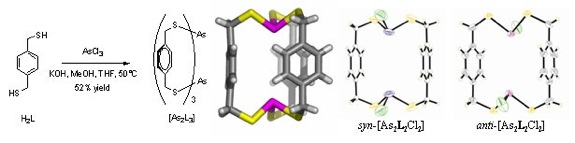
We are elaborating a design strategy for forming coordination capsules comprised of toxic metal ions or main group elements (such as arsenic or lead). We have recently shown that ligand H2L binds arsenic(III) within a very stable As2L3 cage. Surprisingly, two As2L2Cl2 macrocycles were also isolated as intermediates in the reaction. Applications in metal remediation, both environmental and medical, are envisioned by designing the ligands to target a specific toxic or hazardous metal ion. Furthermore, incorporating these nanoscale coordination capsules into extended solid-state structures leads to applications in materials science, and the novel cavity environments in these capsules will lead to unusual host-guest properties.
We are elaborating a design strategy for forming coordination capsules comprised of toxic metal ions or main group elements (such as arsenic or lead). We have recently shown that ligand H2L binds arsenic(III) within a very stable As2L3 cage. Surprisingly, two As2L2Cl2 macrocycles were also isolated as intermediates in the reaction. Applications in metal remediation, both environmental and medical, are envisioned by designing the ligands to target a specific toxic or hazardous metal ion. Furthermore, incorporating these nanoscale coordination capsules into extended solid-state structures leads to applications in materials science, and the novel cavity environments in these capsules will lead to unusual host-guest properties.

II. Anion-π Interactions
-Summary Forthcoming-
III. Inorganic Nanoclusters
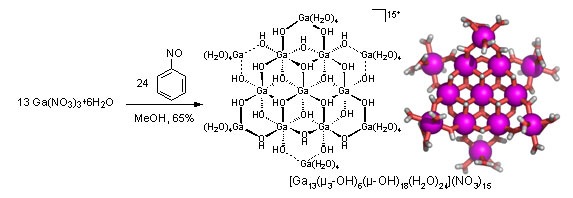
Developing predictive design strategies to prepare inorganic cluster compounds has attracted much research interest, due in part to the potential applications of these novel materials. We have developed an unusual new synthetic strategy for preparing discrete inorganic clusters, and we have used this strategy to prepare the first crystalline example of an inorganic tridecameric Ga cluster (Ga13, see figure). This same facile synthetic methodology also yields the analogous tridecameric aluminum complex and a mixed Ga/In tridecameric cluster in preparative scales after several days. We are currently exploring the use of these inorganic aggregates as synthons for the generation of a wider range of particles and assemblies via exchange of the peripheral water ligands with appropriate organic ligands.
Developing predictive design strategies to prepare inorganic cluster compounds has attracted much research interest, due in part to the potential applications of these novel materials. We have developed an unusual new synthetic strategy for preparing discrete inorganic clusters, and we have used this strategy to prepare the first crystalline example of an inorganic tridecameric Ga cluster (Ga13, see figure). This same facile synthetic methodology also yields the analogous tridecameric aluminum complex and a mixed Ga/In tridecameric cluster in preparative scales after several days. We are currently exploring the use of these inorganic aggregates as synthons for the generation of a wider range of particles and assemblies via exchange of the peripheral water ligands with appropriate organic ligands.