
|
|
 |
|
|
A6: WHOI OBS Configurations & Performance Summary
|
|
|
|
|
 | For the Santorini study, the Woods Hole Oceanographic Institute (WHOI) OBSIP IIC provided 30 short-period ocean-bottom seismometers (OBSs). The WHOI team at sea included Alan Gardner, Tim Kane, Jimmie Elsenbeck.
|
|
|
|
|
|
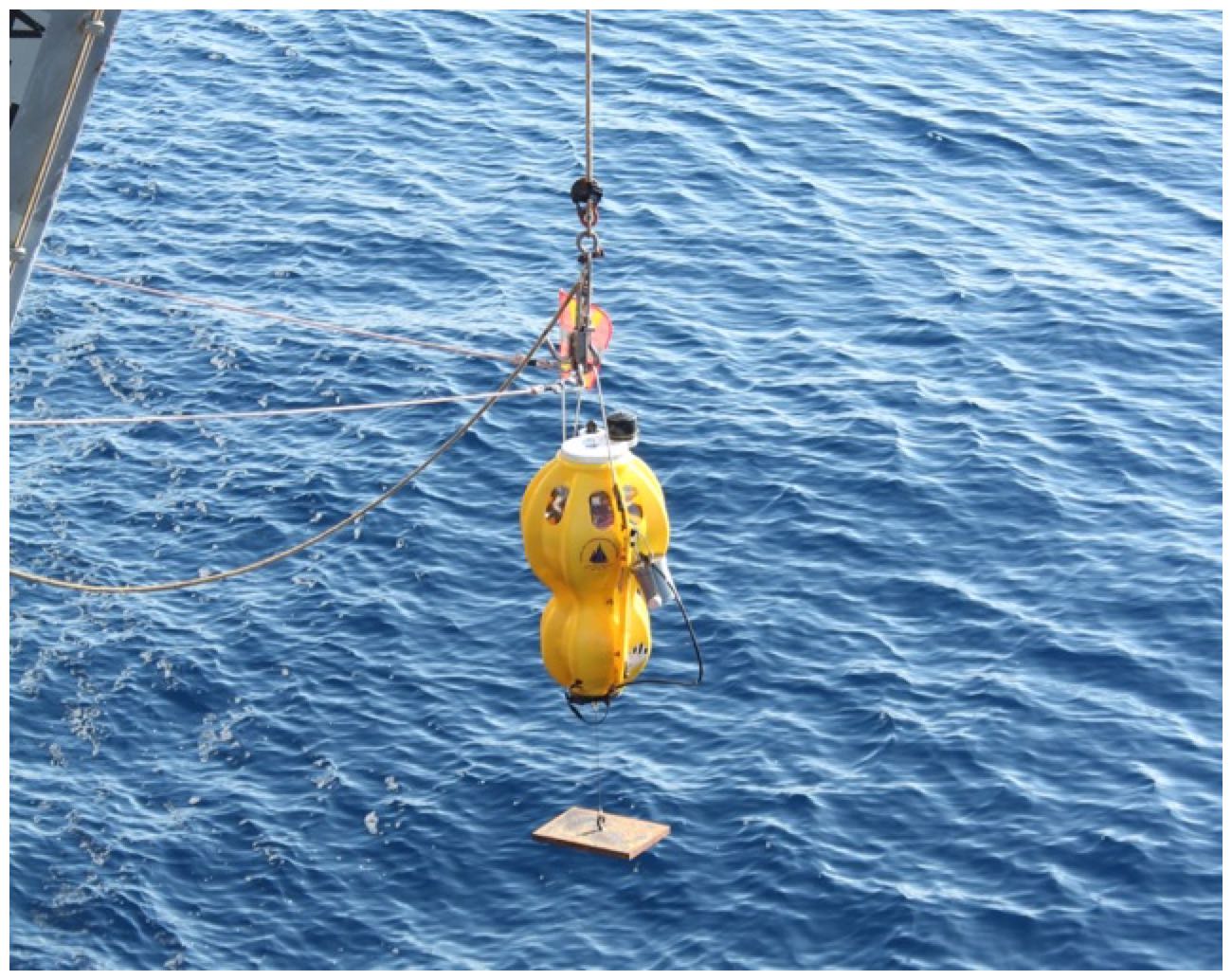
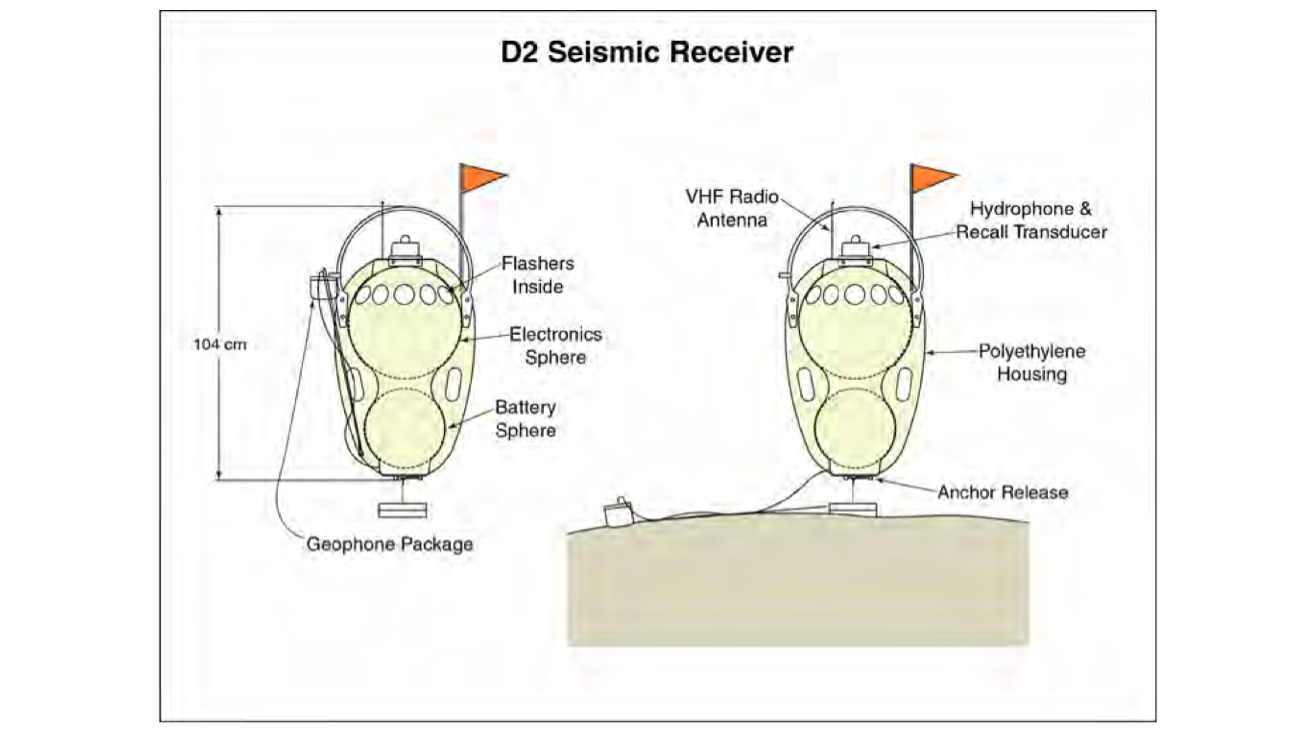
| The WHOI short-period OBS, “D2”, is a compact, relatively lightweight system, which allows recording of three components of ground motion and one of pressure at sampling rates of up to 200 Hz. Physically, D2 is comprised of two glass balls containing electronics and batteries enclosed within a rigid plastic housing. The system stands 39“ high and weighs approximately 115 lb in air (with anchor).
|
|
|
|
|
|
| The upper glass ball (17” diameter) contains a Quanterra Q330 data engine, a Quanterra Packet Baler storage device with 20 GB hard disk and Ethernet hub, an EdgeTech acoustic release board, recovery aids, and custom electronics. A Seascan clock is located on a system control board and is accessible via a serial ASCII current loop. Recovery aids include four flashers and a programmable VHF radio with a minimum range at sealevel of ~2 nm. The VHF antennae is attached to the inside surface of the glass ball. The Q330 includes operating software, a low-power analog-to-digital converter with 140 dB dynamic range, digital filters, clock, and 8-16 Mbytes of buffer memory. Engineering data and four channels of signal are continuously recorded and intermittently logged via an Ethernet connection onto the disk drive in miniSEED format. For this experiment, we used a sample rate on all data channels of 200 Hz. In the lower glass ball (10“ diameter) are battery packs comprised of both alkaline and lithium cells that supply power separately to the Q330 and hard drive, the recovery electronics board and aids, and to the EdgeTech release board (separate cells for acoustic ranging and releasing). Ethernet connections can be used to program the operating software and to recover data from the hard drive.
|
|
|
|
|
|
| The external plastic case or ”hard hat“ provides protection for the glass balls and structural rigidity. An ITC 12 kHz acoustic transponder is attached to the upper cover of the case. Next to the transponder is a HighTech model HTI 1-90-U hydrophone. Three orthogonally mounted 4.5 Hz geophones are mounted in a 5” diameter (5.5“ high) titanium case, which is attached by a weighted cable through the plastic case to the upper electronics ball. The case is filled with high viscosity silicone oil. Internal gimbals allow the geophones to passively orient themselves with respect to gravity through 180 degrees of motion. Prior to deployment, a bail is screwed to the seismometer case, and the bail is hooked to the tip of a 23” long fiberglass wand. The bottom of the wand is attached to the base of the plastic housing by a rotatable joint. The tip of the wand and the seismometer are raised and attached to the side of the plastic housing by a galvanic link that dissolves in seawater after ~4 hours. When the link dissolves, gravity carries the sensor can out and away from the D2. The sensor can slips from the tip of the wand, which is then pulled up and away from the can by a bungee cord.
|
|
|
|
|
|
| The D2 has ~25 lb of buoyancy and is weighted by a 55 lb steel plate anchor (6“x15”x2“). A 9” length of stainless steel wire rope to a 2“ diameter ring connects the anchor plate. The ring is held to the D2 by a lever arm. One end of the lever arm is attached to the D2 base plate by a burn-wire that can be severed by an electric current triggered by a coded acoustic signal to the EdgeTech transponder. A battery that is separate from the battery supplying power to the Q330 and the hard drive powers the burn-wire and the release electronics.
|
|
|
|
|
|
| ***Check Format Post-Processing***
|
|
|
|
|
|
 | WHOI SEGY files contain all four channels in one file. For each OBS there is one SEGY files. The naming of the SEGY file and the numbering of the data channels is as follows (where ### is the OBS number):
|
|
|
|
|
|
| 1E_OS###_ELZ_EL1_EL2_EDH.segy (E1 is the IRIS DMC network code)
|
|
|
|
|
|
| Channels 2 & 3 = horizontals
|
|
|
|
|
|
| *This is different from the numbering system used in the SIO SEGY headers
|
|
|
|
|
|
| Hardware-specific FIR Filters
|
|
|
|
|
|
| OBS 180 was noisey due to shallow water depth at deployment site.
|
|
|
|
|
|
| OBS 172 had a flooded can and the vertical did not record good data. The hydrophone did.
|
|
|
|
|

;)
;)
;)
;)
;)
;)