NAME ________________________________________________________
Test 3
Astronomy 121
July 10, 2014
20 multiple choice questions each worth
1 point. Select the best answer
1. When we refer to the process of chemical differentiation, we are talking
about the process _____ .
a. that led to the formation of the Moon
b. whereby dust grains and other particles sink to the mid-plane of the
Solar Nebula
c. that drives convection in the asthenosphere
d. that led to the separation of the elements in the interior of the Earth
e. that explains why the Terrestrial planets formed closer to the Sun than
did the Jupiter-like planets
2. In our Solar System, _____ .
a. the Earth (and all of the other planets) orbit about the center of the
Sun
b. the Earth orbits about the Sun; the other planets orbit the center of
mass of the Solar System
c. the Sun is stationary and at the center of the Solar System
d. the Sun and planets orbit about the center of mass of the Solar System
e. the Earth actually orbits about the Moon, not the Sun
3. Which of the following is a characteristic of all of
the Terrestrial planets?
a. high density
b. solid outer layer (hard surface)
c. strong magnetic fields
d. A and B only
e. A, B, and C
4. The chemical composition of the atmosphere of Mars is
most similar to the atmosphere of _____ .
a. Jupiter
b. Venus
c. the Earth
d. the Moon
e. Mercury
5. Magnetic fields are thought to arise from _____ .
a. the decay of radioactive nuclei
b. the interaction of three massive particles
c. the decay of dark matter
d. electrical currents
6. The Heisenberg Uncertainty Principle _____ .
a. says we can never hope to understand how the Solar System formed
b. alludes to the uncertainty that underlies all theories for the formation
of the Solar System
c. says we can never simultaneously know the precise location and momentum
(motion) of a particle
d. explains the origin of the Titius-Bode Law
e. was used by Tycho to improve his observations of Mars
7. Active geology on a planet _____ .
a. requires the existence of a lithosphere composed of many segments
b. requires an extensive and thick atmosphere and liquid oceans
c. needs for the planet to have a moon so that it feels tidal forces
d. occurs when the planet has a hot interior
e. occurs only on smaller planets today
8. Over the last twenty years_____ .
a. nearly 2,000 extra-Solar planets have been discovered
b. around 700 other planetary systems have been discovered whose properties
are nearly identical to those of our Solar System
c. a handful (around 20) Jupiter-like planets well-within the snowlines
of their planetary systems, the rest sit outside the snowlines
d. A and B are correct
e. A, B, and C are correct
9. The surface of Mercury is more like that of _____ while its
interior is more like that of _____ .
a. the Moon; Jupiter
b. Mars; Venus
c. the Moon; the Earth
d. Mars; Jupiter
e. Mars; the Earth
10. Which of the following is a true statement about P waves?
a. They are waves where the disturbance is in a direction parallel to
their direction of propagation
b. P waves may act like a compressions moving along springs
c. P waves may act like waves travelling down ropes
d. A and B only
e. A, B, and C
11. Based on the composition of the Earth, we define the following regions
in the interior of the Earth (in order of increasing distance from the
center of the Earth).
a. core, lithosphere, crust
b. core, mantle, crust
c. mantle, core, crust
d. lithosphere, asthenosphere, atmosphere
e. core, asthenosphere, lithosphere
12. The Habitable Zone _____ .
a. is the region on the surface of the Earth where life is possible
b. is the region in the Galaxy where life is possible
c. is the region in the Solar System where life may develop
d. is the layer inside the Earth where life may have developed
e. refers to the region on Mars where ancient life may have developed
13. In the process of differentiation ____ .
a. heavy elements are pushed outward by an outward flow of heat
b. heavy elements are pushed inward by an inward flow of heat
c. light elements are pushed outward by an outward flow of heat
d. heavy elements sink because the interior is molten
e. light elements sink because the interior is molten
14. The interior of the young Earth was heated by _____ .
a. the energy released in its formation (compression)
b. the decay of radioactive isotopes
c. solar energy and the solar wind
d. A and B only
e. A, B, and C
15. Convective motions in the _____ .
a. lithosphere are thought to drive plate tectonics
b. asthenosphere are thought to drive plate tectonics
c. inner core are thought to lead to differentiation
d. Earth's outer core are thought to drive plate tectonics
e. lithosphere are thought to produce differentiation
16. The principal reason that the atmosphere of Venus has evolved
so that its current surface temperature is 850 - 900 F while the
current surface temperature of the Earth is only 50 - 60 F, is _____ .
a. Venus started with a pure carbon dioxide atmosphere while
the Earth started with significant amounts of nitrogen and
oxygen in addition to carbon dioxide in its atmosphere
b. Venus is closer to the Sun than is the Earth
c. that the Earth shows vigorous plate tectonic activity
d. that life on Venus was never able to advance beyond simple
microorganisms
17. Al26 decays to Mg26 with a half-like of 720,000 y.
A rock composed of 16 atoms of Al26 and 48 atoms of
Mg26 is found. The rock is _____ .
a. about 16 y old
b. about 720,000 y old
c. about 1,440,000 y old
d. about 2,160,000 y old
e. about 2,880,000 y old
The figure below represents a seismic event occurring at point Z inside of a
body having a liquid core and a rocky mantle.
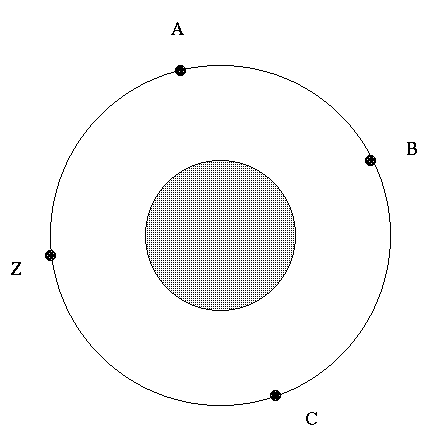
18. At which point would one detect only P waves?
a. A
b. B
c. C
d. P and S waves can be detected at all points
19. If I receive both S and P seismic waves at a station, _____ .
a. I expect to see the P waves first
b. I expect to see the S waves first
c. I expect that the S and P waves will arrive at the same time
d. I cannot predict which type of wave will arrive first
20. Of the following, which is a true statement about
gravitational microlensing.
a. Light rays from a distant star are bent by an intervening massive object
b. The brightness of a distant star is magnified by an intervening massive
object
c. Gravitational microlensing was used to discover one of the
first extra-Solar Earth-like planets
d. A and B only
e. A, B, and C
Short Answer Questions--5 questions each worth 4 points.
1. List the methods that have been used to search for extra-Solar planets?
Which methods have successful?
2. What is the Doppler Effect? Briefly describe how it works.
3. Describe accretional heating. Describe radioactive heating.
4. List the ways astronomers probe the interiors of Terrestrial planets.
Choose one method and describe how it yields information about the interior
of the Earth.
5. Explain why obejcts with large diameters cool more slowly than objects with
small diameters.