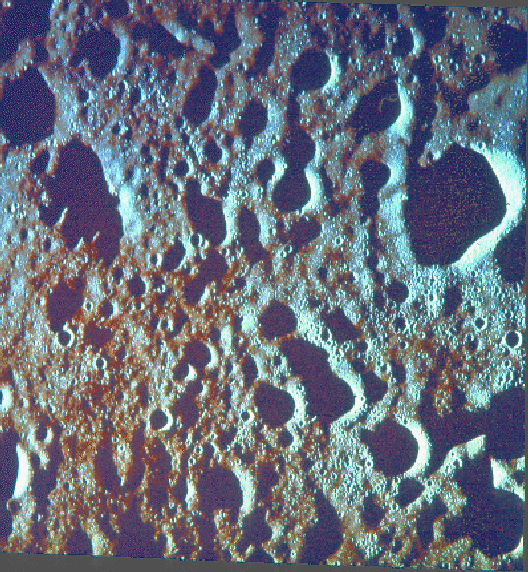
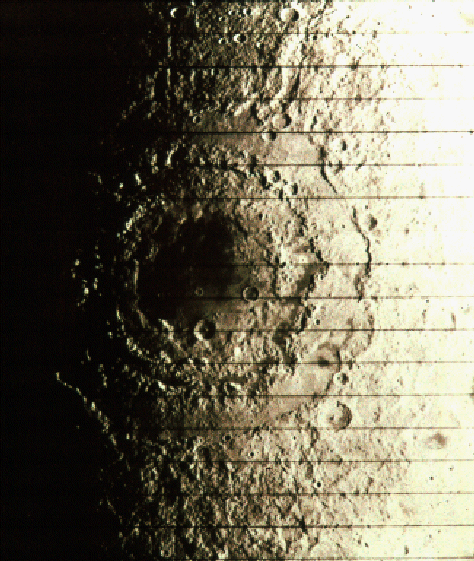
RE-CAP of Previous lecture
To demonstrate the rich range of structures and behaviors which are possible for Terrestrial planets, consider the current Earth.
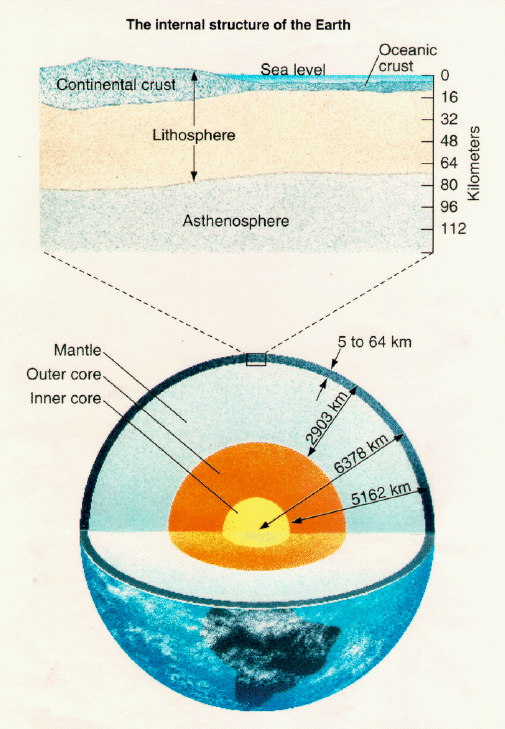
COMMENTS

The structure of the Moon is quite similar to that of the Earth, however, there are differences in detail. Note that the crust of the Moon is asymmetric. It is thinner on the side which faces the Earth.
Important differences arise simply because the Moon is smaller than the Earth. The size of the Moon controls whether the Moon is hot or cold in its interior today. The amount of internal heat in a planet is crucial to its geological activity--the geological activity of a planet is driven by heat flow from the interior to the surface.
Today, the appearances of the Terrestrial planets are grossly different. We, again, will look at the Earth and the Moon in detail, but this time we will also consider Mercury, Venus, and Mars as well.
The planets are divided into two groups: (1) Venus and Earth; and (2) Mercury and the moons. Mars is an intermediate example. The division is based on the amount of current ongoing evolution of the surface of the planet (which is determined by the size of the planet). Recall that the larger planets are hot which leads to significant heat flow from their centers to their surfaces. The heat flow drives geology (in particular, tectonic activity) which has a significant effect on the evolution of the surfaces of the planets. For example, the geologically dead Moon has surface features as old as 4.1 billion years and most features are older than 3 billion years while the geologically active Earth has a few rocks almost 4 billion years old on the continental plates, but the oceanic plates are all less than a few hundred million years old.
THE MOON
A neat animation of the Moon put together using images obtained by Clementine. Also, see some pictures of the Moon, Mercury, and Mars which exhibit the various features in which we are interested.
The Moon
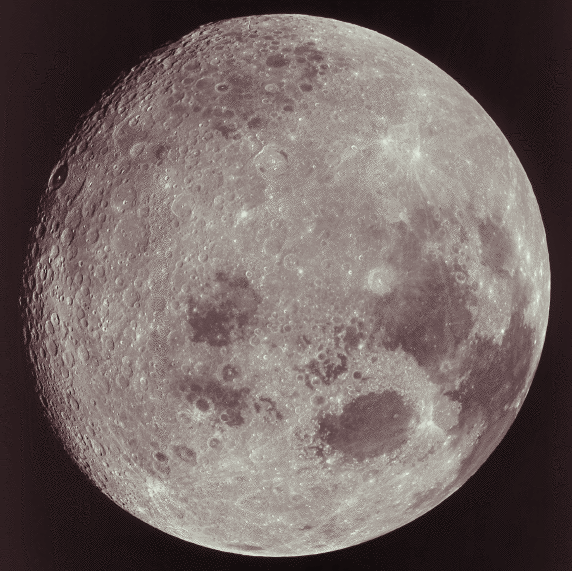

There is, however, a lack of maria on the far side of the Moon. (Perhaps due to the asymmetry in the crutal thickness of the Moon.)
LUNAR CHRONOLOGY
The chronology for the Moon is very good because we have been there, seen it. This has allowed the gathering of rock samples from various terrains on the Moon. The importance of this is that the rocks could be age-dated using the technique of radioactive age dating which allowed us to set a firm chronology for the evolution of the lunar surface features. This is important not only for the Moon but also for the inner Solar System in general as, presumably, the chronology of the Moon roughly follows the timeline as the rest of the inner Solar System (that is, it tells what the cratering rate was for all of the inner Solar System bodies.)
Here, we present the chronology of the Moon's evolution and the cratering rate for the inner Solar System over the last 4 billion or so years.