|
Topic 4B:ARE WE UNIQUE?
Planet Hunters:
S.E.T.I.: Other Planetary Systems, The New Science of Distnat Worlds, Chapter 10 |
|
|
Topic 4B:ARE WE UNIQUE?
Planet Hunters:
S.E.T.I.: Other Planetary Systems, The New Science of Distnat Worlds, Chapter 10 |
The types of searches can be broken down into direct planetary searches and indirect planetary searches.
In orbital systems, the bodies move around the center-of-mass of the system. The center-of-mass of a system is located a distance D from object 1 (mass = M) and a distance d from object 2 (mass = m).
In planetary systems, the star is always much more massive than the planets and the center-of-mass is very close to the star. In our Solar System, the center-of-mass is just outside the surface of the Sun ===> the planets do not orbit about the Sun. The Sun and planets all orbit about the center-of-mass of the Solar System. In our Solar System, the Sun and Jupiter are dominate ===>The orbital period is roughly 11.9 years and the Sun's orbital speed is roughly 13 meters per second, the speed of a very fast human. Indirect planetary searches look for the small changes in the position of the star ( astrometric searches) and for effects due to the fact that the star is undergoing a slow orbital motion ( spectroscopic searches and pulsar-type searches).
To get a feel for the difficulty of astrometric searches, suppose that we lived on the nearest star to the Earth (excluding the Sun), Proxima Centauri. Could we see our Solar System? Proxima Centauri is a distance of 4.3 light years kilometers from the Earth. This is a long way away -- 1 Astronomical Unit = 8.3 light minutes.
Jupiter orbits in our Solar System in an orbit of size 5.2 A. U. with orbital period of 11.9 years. From the distance of Proxima Centauri this would correspond to an orbit of angular size ~ 0.004 arc-seconds. Recall 1 degree = 60 arc minutes. 1 arc-minute = 60 arc-seconds ===> 1 arc-second = 1/3,600 of a degree!!
Given current technology for ground-based observatories, this is not do-able. It is possible that Jupiter-sized planets might be detected in the future this manner for the nearest stars, however.*
There are currently no good candidates based on astrometric searches. In the future, we will develop space-based experiments which will have pointing accuracies of better than 0.00001 arc seconds and may thus be able to see nearby planetary systems.
* as a sidenote, a planet has been discovered orbiting Proxima Centauri, Proxima Centauri b. Proxima Centauri b has a mass 1.2 times that of the Earth, orbiting about Proxima Centauri in an orbit of size 0.05 A.U. with orbital period 11.2 days. Proxima Centauri is as an M_type red dwarf star, a low mass star only 12 % the mass of our Sun. Proxima Cenatauri b sits in what is known as the Habitable Zone of Proxima Centauri. Proxima Centauri b was discovered using the spectroscopic method (see next section).
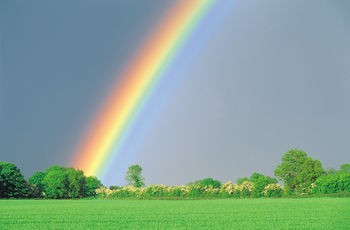
Spectroscopic searches try to detect evidence of the motion of the star. In order to understand what is done, we need to discuss the phenomenon of Doppler Shifts. Before we begin, let's note something about sunlight (and, in fact, the light from all stars). White light is actually a blend of colors
  |
 |
Doppler shifts are part of the phenomenology of waves (here, we treat the light we receive from stars as a wave-like phenomenon). To understand the Doppler phenomenon, consider what happens to a pan-full of water if I drop a rock into it (or, in fact, disturb it in any manner).


Videos: Disturbance and Waves and Why is there a series of crests
Now, consider a slightly different situation. Apply periodic disturbances (that is, tap the water once every second) but instead of tapping the water at the same spot (e.g., at the center of the pan), I move the point at which I tap the water. For example, I start tapping the water at the center of the pan but for each successive tap, I move a short distance out from the center.

In the case where the source does not move, a series of concentric circular waves moves away from the disturbance. |
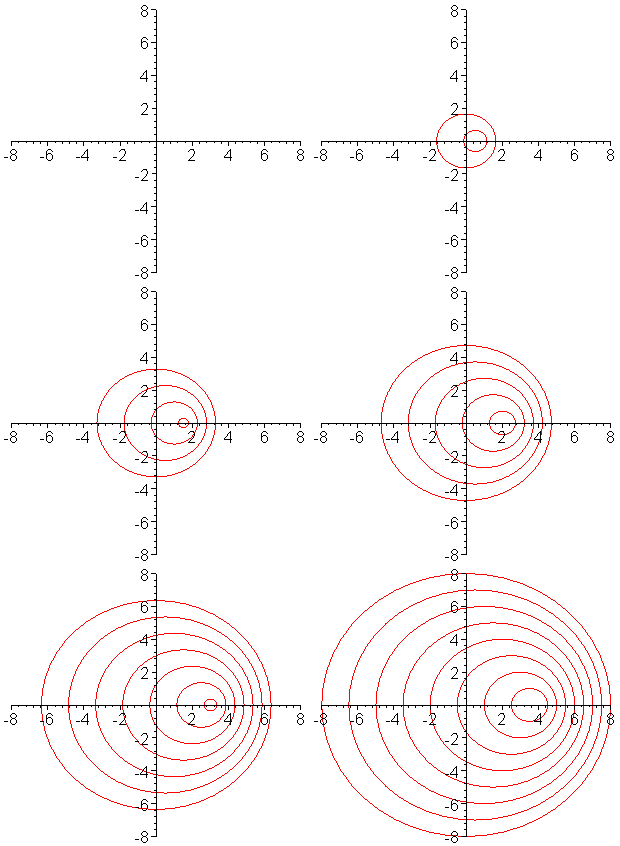
In the case where the source of the waves moves to the right, we see that circular waves are still produced but the distances between the crests of the waves depends upon where you sit. |
Q: What if I sat at the bottom of the picture, what wavelength would I measure?
The preceding phenomenon is the Classical Doppler Effect. An analogous effect occurs for the light produced by a star. In this case, the size of the effect (the amount of stretching or contraction) is given by how fast the sending object moves.
The orbital speed of the Sun is on the order of 13-14 meters per second. To observe this effect, we need to be able to observe something like a fast person running in the extra-solar system. The rather amazing thing is that with current technology this is possible! We now know of more than 3,500 planets outside of our Solar System in nearly 2,600 other planetary systems. Note that many of the stars around which planetary systems have been found are similar to the Sun. The way to see this is to go to the Exoplanets website and to bring up the Table. In the far left column is the Name of the star about which the planets orbit. Click on the Name of the star (e.g., the first star is HD 142 b) and to find the Spectral Type and Luminosity Class of the star. The Sun is of spectral class G2 V. Star with temperatures fairly similar to the Sun will have spectral class F, G, or K. The Luminosity Class is a measure of the power (and diameter) of the star (the Sun is Luminosity class V, a main sequence star). There are many dozens of Sun-like stars with planetary companions. There is even a planet five times the mass of the Earth in the Gliese 581 system which lies in the habitable zone of the star.
Transits
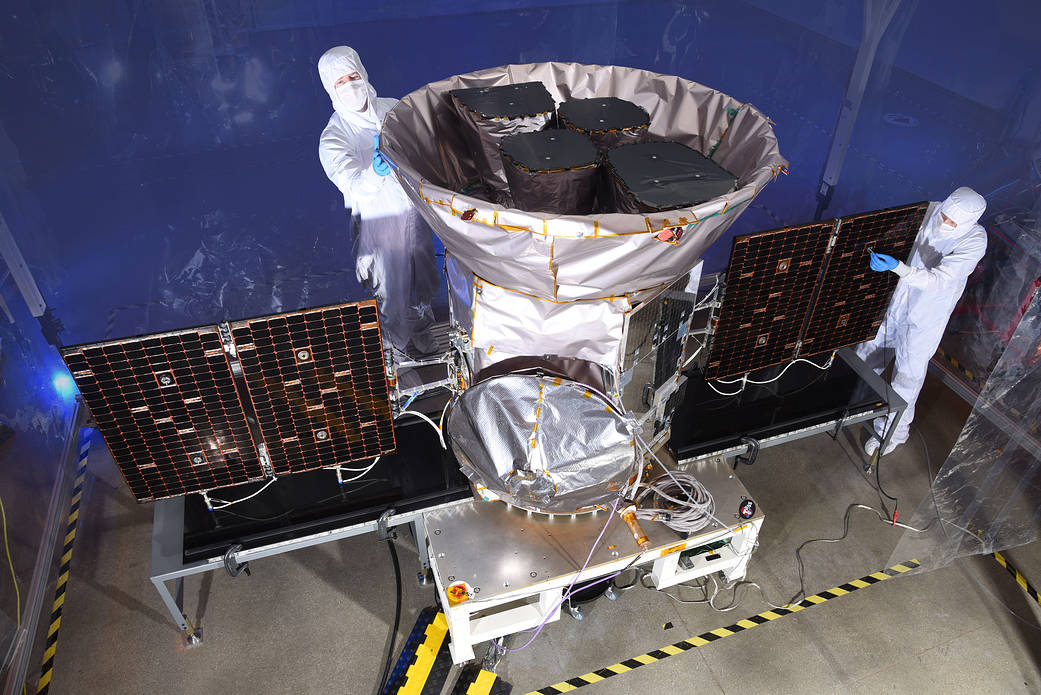
The obvious problem with direct detections of planets is that stars are very bright and planets are very faint. This means that it is very difficult to see planets in the glare of the stars. Further, because planets are small, eclipses of stars by planets are not likely to lead to large changes in the light output. This makes direct detections of planets difficult. Despite this, Kepler and TESS (Transiting Exoplanet Survey Satellite) have been very successful having dicovered many hundreds of planets and thousands of candidate planets. Beyond this, transits can yield further information about the planetary system.
 |
|
 Click on image for a Kepler Orrery |
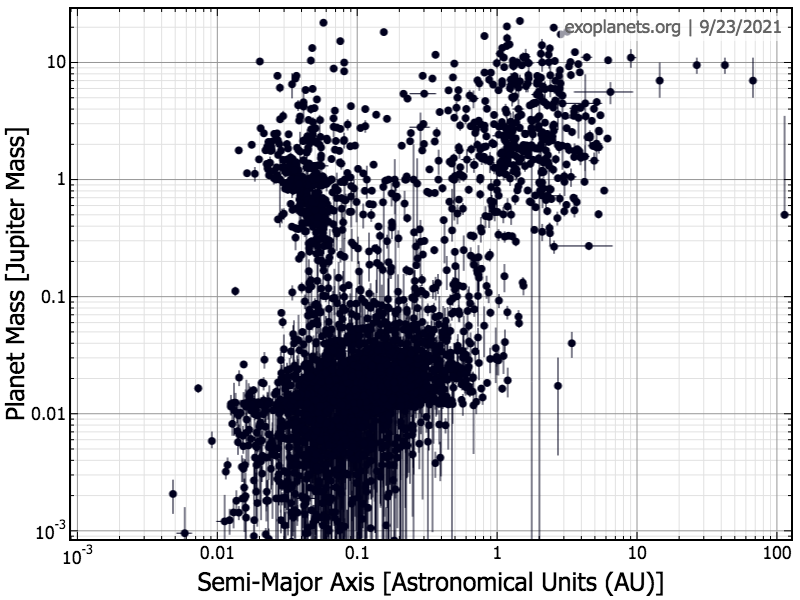
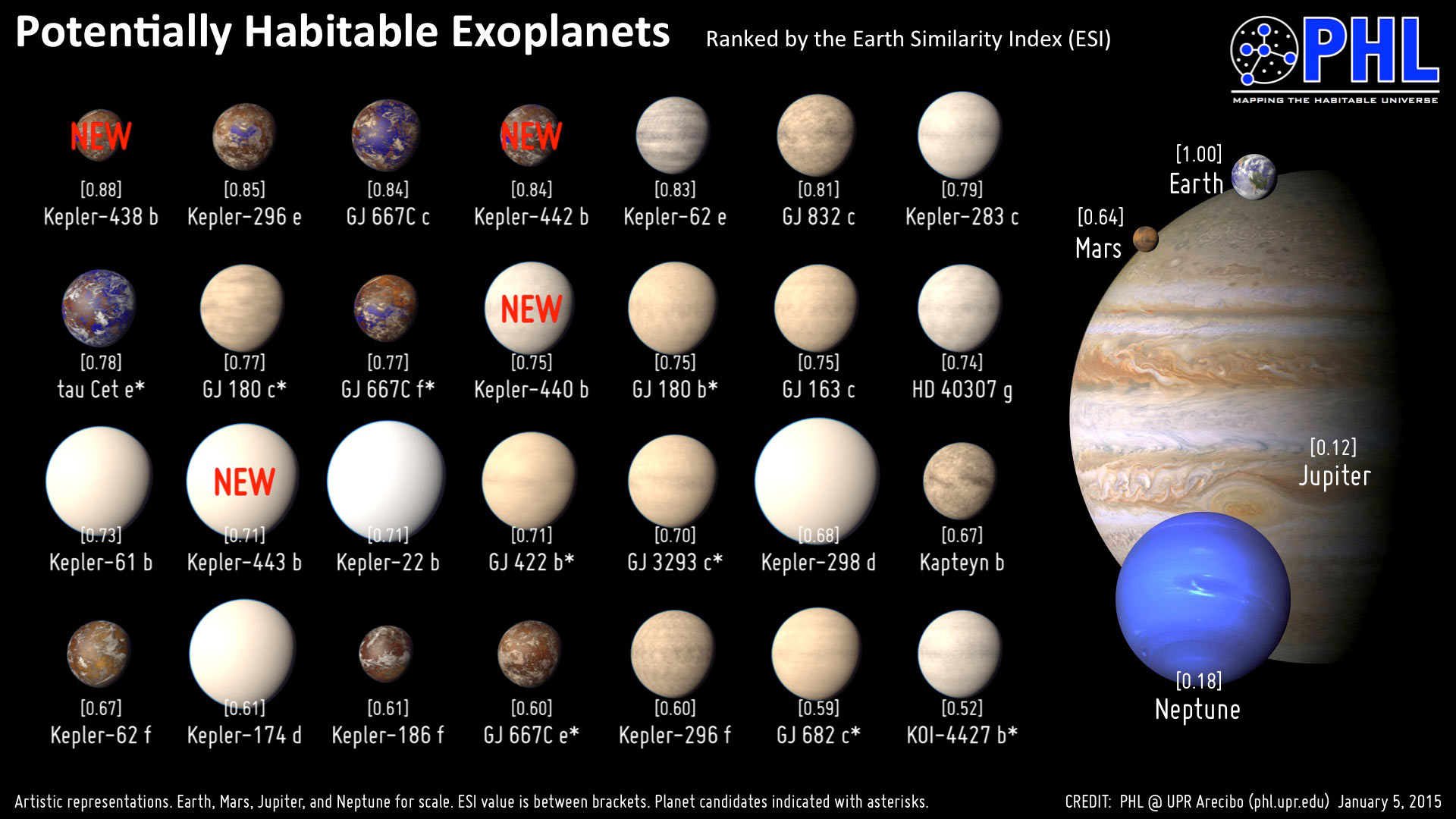
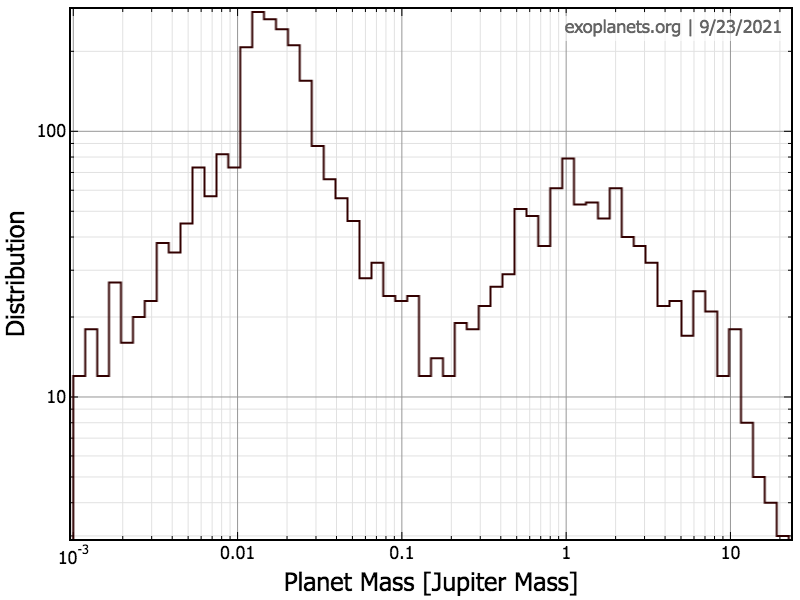
| To the left is the distribution of planet masses with respect to their orbital sizes and to the right is the number of planets with given mass. Note the size of Jupiter's orbit is 5 A.U. and that there are many Hot Jupiters, and also that most of the newly discovered planets have masses in-between those of the Earth and the lowest mass Jovians, Uranus and Neptune. Does this mean that our current understanding of Solar System formation is in trouble? |
|
To see some other properties of the planets (e.g. their orbital eccentricities, the misalignment between their spin axes and their orbital axes, the relation between their oribal periods and their orbital sizes (the semi-major axes of their orbits), let's return to the Exoplanets website and use their plotting tool.
Well, the current lore has it that our basic notions of Solar System formation is probably okay in that we think the general ideas are correct. However, the current results suggest that after planets start to form, their orbits must somehow be modified so that Jupiter-like planets will be found close to their stars, within the zones where water would be in vapor form, not solid form, that is, inside the snowlines in their systems. Orbital migration must occur and is a topic of current research.
Gravitational Microlensing
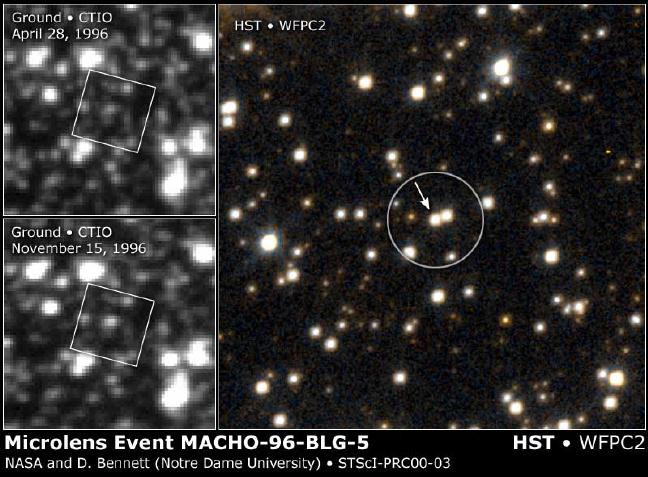
An exciting recent development was the discovery of an Earth-like planet in the constellation Sagittarius (news story).
The planet was discovered using a new technique that involves gravitational lensing.
 |
 |
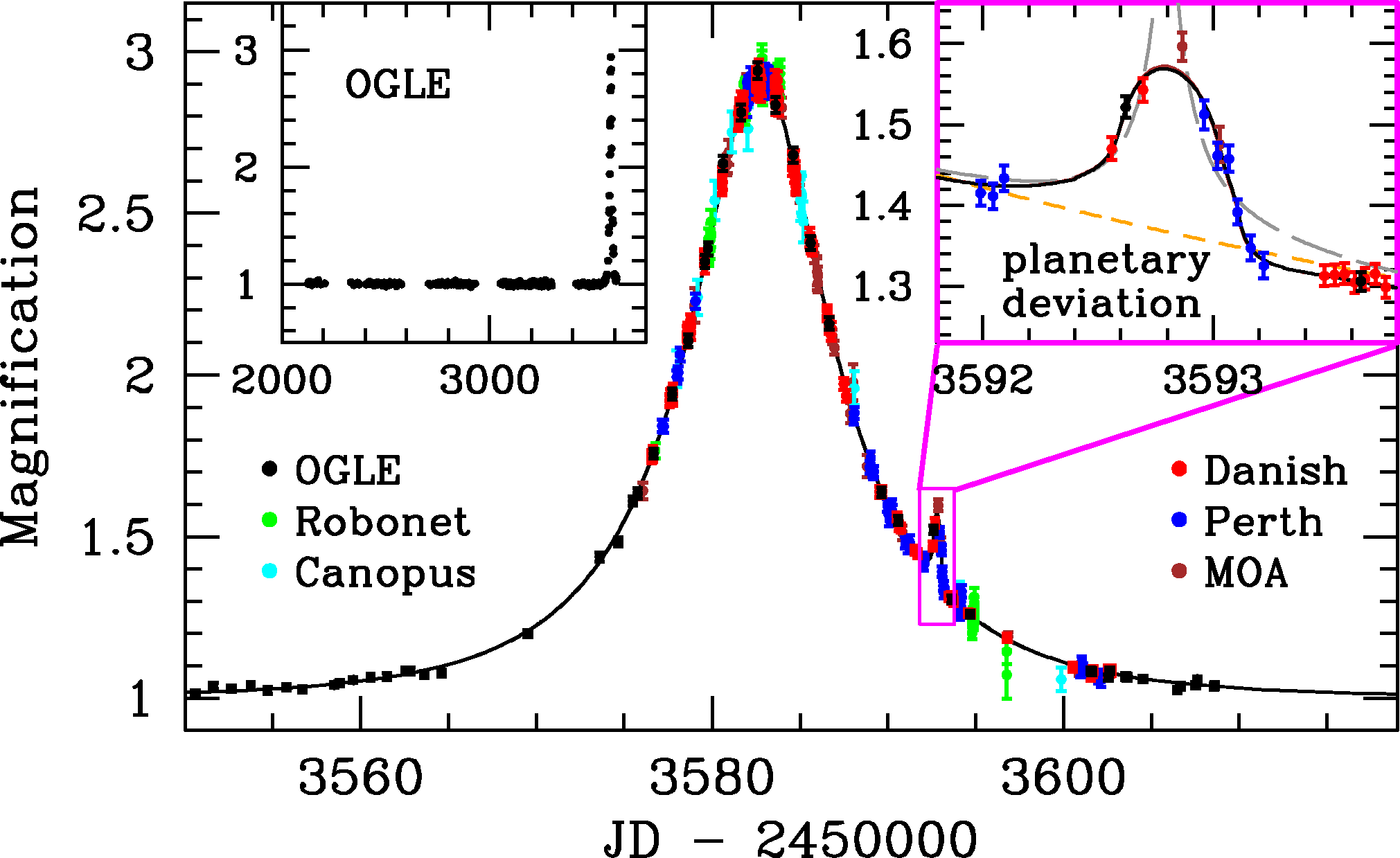
If a single star passes in front of a background star then we expect a single increase in the magnification of the light. However, if the lensing star has a planet circulating about it, then we expect to see a secondary magnification in the light from the distant star as the planet passes in front of it. | |
Detection of Earth-like planet: 5x mass of Earth with an orbital period of ~10 years |
 |