
The Terrestrial planets are similar to each other in terms of their masses and diameters, and their distances from the Sun. Because of this, it is expected that their atmospheres should share many similar qualities. Despite having several similar qualities, their atmospheres also show significant differences.
Remarks:
There are other differences between the planets, but we consider the above as the key points for developing an understanding of the atmospheric evolution of the Terrrestrial planets.
After their formation, the Terrestrial planets essentially had no atmospheres (if they had captured some hydrogen and helium from the Solar Nebula, it was rapidly lost to space). Whatever atmospheres the Terrestrial planets have today was captured or was generated after the planets formed; the Terrestrial planets have secondary atmospheres.
There are two modes for the generation of secondary atmospheres:
It is not clear which of the above theories are correct.
OUTGASSING
Current studies of Terrestrial volcanoes show that they do emit large amounts of volatile materials such as water, carbon dioxide, nitrogen, and sulfur dioxide, however, it is not clear if enough volatile material can be trapped during the formation of the planets.
For example, consider water. On the Earth, there is enough water to cover the planet to a depth of around 3 kilometers. How much water is this? Well the mass of water on the Earth is
 x volume
mass of water = 1 gm per cc x 4  R**2 x depth of the oceans
mass of water ~ 1.5x10**24 grams
If this rate is typical, it would have taken roughly 15 billion years to make the oceans via outgassing. If the rate were higher in the past (as it surely must have been), then we could produce the oceans in 4.6 billion years (the age of the Solar System).
"COMETS"
A typical comet might be half water ice. The mass of a 1 km x 1 km x 1 km comet is roughly
/3) x
10**15 cc
 8x10**15 grams
If half of the comet is water, then we would need roughly 400 million cometary impacts to bring in the water. There are many hundreds of billions of comets in the Oort cloud and so, there is an ample supply of comets, but is the rate of cometary impacts sufficiently large to warrant considering this as a viable model. Based on recent cratering history, the rate of crater formation by 1 km objects is roughly one every few tens of thousands of years. At the current rate, deposition of water by comets would take tens of trillions of years. So, unless the rate was significantly higher in the past (as it probably was) or there is a class of small comets which completely dominates the mass of the typical comet, this scenario has problems.
Why don't Mercury and the Moon have atmospheres?
There are two competing effects which determine whether a planet retains an atmosphere:
So, we note that there are two important properties to consider:
Comment
An important point to bring up is that the temperature of a gas measures the average energy of the gas particles. That is, some particles have less energy and some particles have more energy than the value given by the temperature. Around 0.1 % of the particles will have energies greater than 10 times the average energy. What this means is that even if the average speed of the gas particles seems too low for atmospheric evaporatation, a non-negligible fraction of the particles will be moving fast enough to escape. It turns out that if
v /v
/v > 1/6
> 1/6
then gas particles can escape from the planet in a reasonable amount of time. What is a reasonable amount of time?
Let us define R = v /v
/v . For the Earth and a 1,000 K
gas:
. For the Earth and a 1,000 K
gas:
R-values for Various Gases
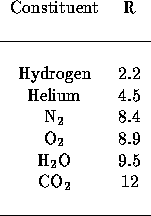
So, H and He escape, but the heavier compounds are retained.
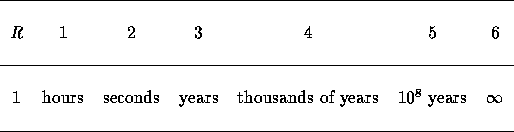
Timescales for Atmospheric Escape
Let us estimate the surface temperature for the planets. We will define what is known as the Equilibrium Temperature
Assumptions:
For an atmosphereless (and cloudless) planet have,
 a
a
Albedo, A, is the fraction of the solar radiation which is reflected to space. This means that a fraction (1-A) of the radiation reaches the Earth.
Atmospheric Temperatures
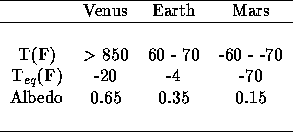
For Mars, the two temperatures are roughly the same while for Venus and Earth the temperatures differ significantly. Why? Well, the reason is is that Venus and Earth both exhibit Greenhouse Effects. The Earth has a much milder Greenhouse effect than does Venus, but it still has one. The mild Greenhouse effect is important because it is what makes the planet comfortable.