
| Galaxies and the Expanding Universe |
|---|
|
| The full night sky reveals a concentration of stars (the "Milky Way") |

| Sprinkled around the sky are objects that look like collections of stars |

| Many of these collections have spiral shapes, which are revealed when magnified by powerful telescopes |

| The deepest region of space ever explored (galaxies are denser there). (from the Hubble Space Telescope) |

|
Early astronomers had very practical reasons for studying the sky.
|

| In the southern winter sky, a collection of stars form a pattern that can be interpreted
as the image of a hunter, Orion
By connecting the stars with lines, the hunter's image appears But these stars are not really associated with one another |

| Many such constellations were defined |

|
|

| The Milky Way is a spiral galaxy. |

| Very similar to the neighboring galaxy, Andromeda. |

| Galaxies appear to be moving away from us in all directions, and the farther away they are, the faster they move away. |

|

|

|

|

|

| Barringer Crater |

| Tunguska event in 1908 in Siberia |

|
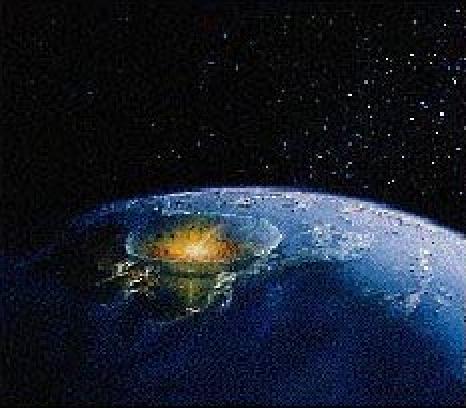
| The dinosaurs were probably eliminated by the impact of an asteroid or comet on the Earth |