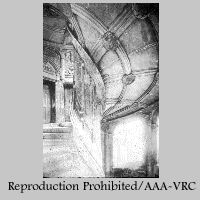
1. Francois I Style. Blois, Chateau, interior view of staircase of Francois I. Note combination of medieval and Renaissance architectural features.
1. Francois I Style. Blois, Chateau, interior view of staircase of Francois I. Note combination of medieval and Renaissance architectural features.
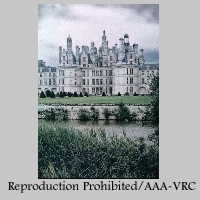
2. Francois I Style. Chateau Chambord. Loire River Valley. Note the combination of Renaissance symmetry with complex medieval roofline.
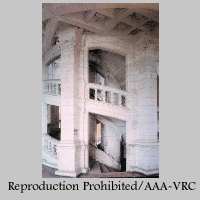
3. Francois I Style. Chateau Chambord, circa 1519. The great double helix staircase in the center of the central block of the chateau. There are actually two staircases that ascend from opposite sides of the circular opening on each floor; thus it is possible for one person to ascend on one of the staircases while another descends on the other staircase, and they never pass each other. The attention given to ease of vertical circulation in Early Renaissance France is significant because it illustrates a new sense of security in large buildings following the establishment of a centralized government. The sense of unrest from the Medieval feudal system was left behind.
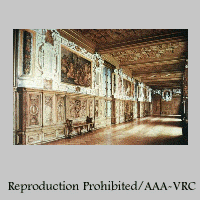
4. Francois I Style. Chateau Fontainebleau. Gallery of Francois I (1534-1539) Rosso Fiorentino and Francesco Primaticcio principal designers.
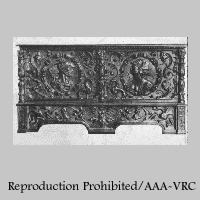
5. Francois I Style. Early 16th Century chest of carved walnut from Azay-le-Rideau, a chateau on the Loire River. Note the Romayne work carved on the front.
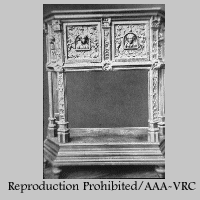
6. Francois I Style. A Renaissance dressoir, about 1540. Note that the basic carcass carries on the form of the medieval credence, but the decoration exhibits Renaissance ideas. The doors show an unusual variation on Romayne work.
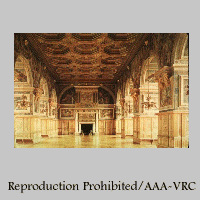
7. Henri II Style. Chateau Fontainebleau. Gallery of Henri II. Interior was decorated by Francesco Primaticcio. Second half of the 16th century.
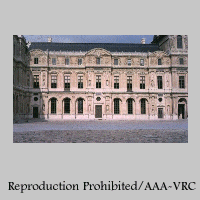
8. Henri II Style. Paris, The Louvre, Court Carree. Facade by Pierre Lescot, begun in 1546. Note decorative use of the human figure, and the retention of a sense of an attic story.
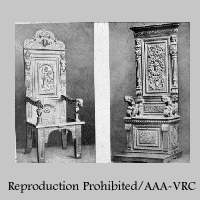
9. Henri II Style. High backed seats, 2nd half of the 16th Century.
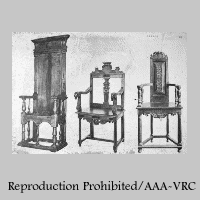
10. Henri II Style. Three chairs. The chair on the left maintains a reference to the Gothic box chair without the enclosure under the seat. The middle chair is a lighter, more movable armchair called a fauteuil. The chair on the right is a very light, narrow-backed chair with arms bowing outward called a caquetoire.
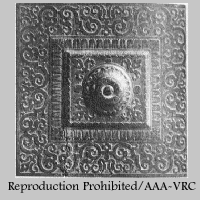
11. Henri II Style. Detail from the panel of a chest of the 1560s. The scrollwork, which is called strapwork, is derived from cut leather which was originally applied to wooden chests with nails in Damascus. It had been an ornamental way to apply straps of leather to strengthen chests made in the ancient city of Damascus. Strapwork became a much used decoration in many countries of Europe during the Renaissance.
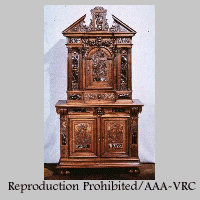
12. Henri II Style. Two-part carved walnut cupboard or buffet, inset with marble panels, circa 1550. Note extensive use of the human figure in carved decoration.