History 407
Memory, Commemoration, and Popular History
University of Oregon, Spring 2001
Tuesdays, 3:00-5:20, 473 Grayson Hall
CRN35576
[History 507: CRN35577]
Matthew Dennis, Department of History
357 Grayson Hall; mjdennis@darkwing.uoregon.edu
Office Hours: Tuesday, Thursday, 11:00-12:20
|
|
Introduction
Not all history is academic. This research seminar
will focus on “the history that people carry around in
their heads” (to quote the Progressive historian Carl
Becker)—the history that common people observe during
holidays, or when they visit historical monuments, sites,
even theme parks. We will study history and popular memory
through an examination of commemorative practices in
America, both the observation of annual or less frequent
commemorative occasions (like centennials) and the
construction and maintenance of monuments, memorials, and
historic sites. Such a focus can yield insights about the
complex nature of American nationalism, patriotism, and
identity.
|
Common readings and weekly discussions will probe these
themes, while individually students will define their own research
projects, conduct research in primary sources, write an original
historical essay, participate in critique sessions, and revise and
rewrite their work.
Student will have the freedom to examine a wide range of topics,
which can center on any period or place in American history, as long
as they relate to key sites or moments of commemoration—places
or occasions when Americans remember, celebrate, or redefine their
past and construct a sense of who they are as Americans.
Assigned Readings:
|
|
- John R. Gillis, ed., Commemorations: The Politics
of National Identity (Princeton: Princeton University
Press, 1994).
- Mike Wallace, Mickey Mouse History and Other Essay
on American Memory (Philadelphia: Temple University
Press, 1996).
- Cecelia Elizabeth O’Leary, To Die For: The
Paradox of American Patriotism (Princeton: Princeton
University Press, 1999).
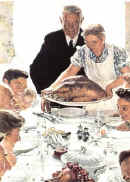
Norman Rockwell's "Freedom from Want,"
from his "Four Freedoms" series (1943).
|
These books are available at Mother Kali’s Books, 720
East 13th Avenue (343-4864), two blocks from campus. Additional short
readings may be assigned and made available via links from this
site.
Format and Requirements
This is a seminar and, as such, it requires full attendance and
participation by all its members. Students will be evaluated based
both on the quality of their weekly participation (approx. 25%) and
their final essay (approx. 75%). There are no examinations.
Weekly Schedule of Reading and Written
Assignments
[assignments due on day they appear on the schedule
below.]
Week 1 (April 3): Introduction
Begin identification of research topics; begin reading Gillis, ed.,
Commemorations, parts 1 and 2 (pp. 3-123).
Week 2 (April 10): Commemoration, Nationalism, Tradition
Discussion of Gillis, ed., Commemorations, 1-123. Discussion
of research topics.
Week 3 (April 17): Commemoration, Nationalism, Identity
Read Gillis, ed., Commemorations, 127-280. Present preliminary
paper prospectus, with brief bibliography.
Week 4 (April 24): American Memory
Read Wallace, Mickey Mouse History, vii-xiv, 3-174.
Preliminary paper prospectus due.
Week 5 (May Day): American Memory and the Politics of History
Read Wallace, Mickey Mouse History, 177-309.
Present working outlines.
Week 6 (May 8): Memory, Nationalism, Patriotism
Read O’Leary, To Die For, 3-128.
Week 7 (May 15): Memory, Patriotism, Race
Read O'Leary, To Die For, 110-245
Rough drafts of papers due Friday, May 18.
Week 8 (May 22): Writing History
Paper critiques: students will read and critique each other's
drafts--student will prepare written critiques and present them
during our critique sessions.
Week 9 (May 29): Revising [no class]
Week 10 (June 5): Concluding Discussion of Memory and History
Final Papers Due Friday, June 8, 2001.