 Photovoltaics; conversion of solar photons into electrons that
flow down a semi-conductor. Class Demonstration: Solar Cells and
Solar Panel.
Photovoltaics; conversion of solar photons into electrons that
flow down a semi-conductor. Class Demonstration: Solar Cells and
Solar Panel.
Photovoltaics; conversion of solar photons into electrons that
flow down a semi-conductor. Class Demonstration: Solar Cells and
Solar Panel.
Photovoltaics; conversion of solar photons into electrons that
flow down a semi-conductor. Class Demonstration: Solar Cells and
Solar Panel.Charge Generation
Photons:
Photoelectric Effect: Classroom Demonstration
When photons strike a metal, their energy is used to liberate loosely bound electrons and therefore induce a current.
Efficiency of this process depends upon the material
To make use of the photoelectric effect, we need material that is a good conductor of electricity and which can be manufactured in bulk at reasonable cost. This conditions strongly constrain the available choices. For most practical aspects, Silicon is the material of choice.
Silicon:
Schematic structure of energy bands in Silicon:
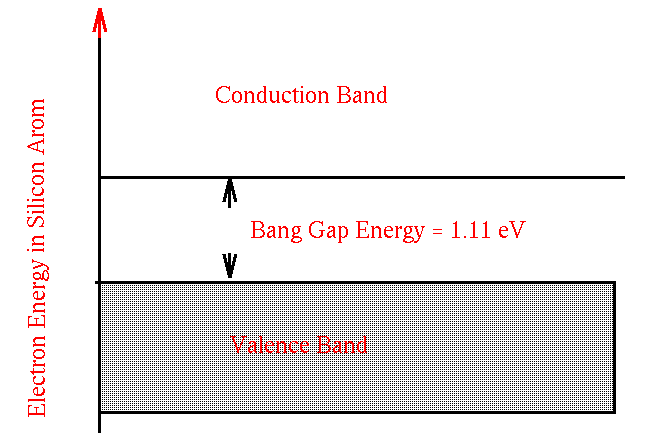
Hence, if a silicon atom receives at least 1.11 Electron Volts from some source, a valence electron will move to the conduction band. Once an electron is in the conduction band, the material can carry a current and the material is now a conductor.
So much energy is 1.11 Electron Volts?
This does not mean that the efficiency of silicon in converting solar photons to electrons is 77%!
Energy Losses:
The efficiency is strongly temperature dependent. As the temperature is raised, the internal resistance of the material increases and the electrical conductivity decreases.
The fundamental physical limitation in production photovoltaic cells is then this decrease in efficiency as the temperature of the cell increases. Because of this, for a material like silicon, the operating efficiency of a photovoltaic array will probably never be higher than 20% and will most likely be between 5 and 15%.
This doesn't mean that production is not possible. It does mean that relatively large collection areas must be obtained which means high capital costs. If those costs can not be subsidized, then PV arrays can never be competitive in the commercial energy market place.
To have a production photovoltaic cell, one must mix impurities into silicon (like boron). This will create an internal electric field which will allow the liberated electrons to move down the material.
To obtain the proper Voltage and Current from an array of photovotaic cells or modules, you have to conect them in series and paralell combinations. To obtain the proper voltage, you connect cells in series. To increase current capapbility you connect cells, or combinations of cells in series, in paralell.
Cell Connection Activity to help understand is available here.
An example of Module Connections to gain proper voltages and currents is available here.
Remember, cosuming electricty is about Power = Voltage x Current. devices are made to run at a certain power and voltage and your system will need to be designed to meet those demands.
Over the last 40 years, the effort has gone into increasing the efficiency of PV cells and bringing down the manufacturing costs.
Calculation for Solar Energy which shows that relative inefficiency can be compensated for with collecting area.:
Recent Advances:
Advances in Amorphous Silicon technology has led to continuous thin-film deposition process.
Can increase efficiency by using solar cells in conjunction with focussed systems (parabolic collectors).
BUT
Now and Beyond in Solar Cells
First Generation: Single-crystal, single layer p-n junction diode, capable of generating usable electrical energy from light sources with the wavelengths of sunlight.
Second Generation: Thin epitaxial deposits of semiconductors on lattice-matched wafers. There are two classes of epitaxial photovoltaics - space and terrestrial. Space cells typically have higher AM0 efficiencies (28-30%) in production, but have a higher cost per watt. Their "thin-film" cousins have been developed using lower-cost processes, but have lower AM0 efficiencies (7-9%)
Third Generation: o not rely on a traditional p-n junction to separate photogenerated charge carriers. For space applications quantum well devices (quantum dots, quantum ropes, etc.) and devices incorporating carbon nanotubes are being studied - with a potential for up to 45% AM0 production efficiency.
Review
1) To get work out of electricity you have a way to separate charges. They like to get back together and they do that by flowing through wires connected to a light bulb, refrigerator, tv set, stereo, etc.
2) A battery separates charges by chemical reactions. When the stuff that is making a chemical reaction runs out, the battery is dead and no current can flow, and you can't listen to Puddle of Mud (or Hendrix!)
3) A PV Cell separates charges when light is incident on the cell. If there is no light, charges don't separate, no current flows and again, no Jimi....
Current Economics:
Price per Kilowatt of Electricity from PV CellsCurrent Price $0.48/kWp
Need to get to $0.15 -) $0.20 per kW
Consumer cost for energy from newly constructed coal-fired plant in the US ranges from 8-20 cents per KW
Today PV power generation would cost the consumer around 30 cents per KWH.
55% of the world population living in remote areas, PV is actually competitive. (Lifestyle with electricity does not exist. Demand on a system would be less. Hopefully we are the experiment that shows what not to do!)
Lifestyle needs to be changed here. For Example
Energy use in U.S. is 9500kWhr/person each year. Germany, 3270kWhr/person each year.
Costs might be equivalent when pollution from coal is also considered but still, the structure is not here for the consumer to pay the true cost of energy.
Only currently strongly applicable in remote locations or the RV Industry.
Solar Info and Energy Cost comparisons
Environmental Impacts from Manufacturing PV Cells
Energy Payback Time (4 years? 2 years?)
Examples of Solar Cells Available.
Crystal Silicon Panels Like the one used in class (Astropower Model 7105)