|
|
|
|
 |
|
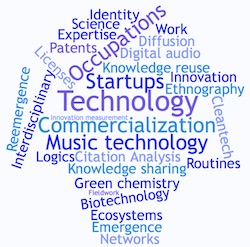
My research addresses the role of institutional contexts in shaping the development, commercialization and diffusion of technologies. I am particularly interested the roles of universities versus firms in contributing to these processes.
To address questions of institutions and innovation, I employ a mixture of quantitative and qualitative data to explore longitudinal trends in technology development and adoption. Qualitatively, I am trained as both an ethnographer and a historian, and I spend significant research time in various archives and "in the field" engaged in interviews and observations of practitioners. Quantitatively, I employ large databases of patents, publications, CVs, and other measures, which I use to construct networks and comparisons between individuals, organizations and technologies themselves.
My work focuses on four fields -- digital audio and computer music; information technology; green chemistry; and biotechnology -- and can be roughly categorized into the themes listed below. (The headings below will take you directly to papers/projects connected to each theme and the icons next to each title provide a quick indication of the field.) For further details, click on the "show/hide" link to view a short description or on the "view/download" link to access the full paper -- or, simply send me an email at ajnelson (at) uoregon.edu
[Return to home page]
Measurement and Metrics for Innovation Development and Diffusion
|
 |
Obliteration, Symbolic Adoption and Other Finicky Challenges in Measuring Innovation Diffusion (with Andrew Earle, Jennifer Howard-Grenville, Julie Haack, and Doug Young)
Short version forthcoming in 2012 Academy of Management Best Paper Proceedings Reject and resubmit at Strategic Management Journal
[Click to show/hide abstract]
Although innovation diffusion is a central topic in strategy, its measurement remains difficult -- particularly in cases where the innovation is a complex and possibly ambiguous practice. In this paper, we develop four theoretical mechanisms that may bias diffusion markers by leading to the understatement and/or overstatement of diffusion at different points in time. Employing the case of "green chemistry," we then compare three different diffusion markers -- keywords, database index terms, and domain expert assessments -- and we demonstrate how they lead to different conclusions about the magnitude and timing of diffusion, organizational demography, publication outlets, and collaboration. Building on these findings, we make a case for the incorporation of practitioners in construct measurement and for the integration of comparative metrics in diffusion studies.
|
 |
Putting University Research in Context: Assessing Alternative Measures of Production and Diffusion at Stanford
Research Policy. 2012. Vol 41, no 4: pp. 678-691.
[View/Download]
[Click to show/hide abstract]
Much of the literature on university research evokes a linear model from "science to products" and focuses, therefore, upon a limited set of indicators such as patents and licenses. Such a perspective runs the danger of missing the myriad ways in which science and commerce are intertwined and the myriad ways in which these activities might be assessed. In this paper, I draw upon a unique data set that captures 30 years of activities and engagement surrounding Stanford's computer music center (CCRMA) through a wide variety of measures, ranging from publication citations to industrial affiliates to graduate student employment mobility. Employing the analytic categories of "description" and "enactment," and distinguishing between "indicators" and "pathways," I show how different measures reflect different activities and learning processes, and how they dramatically alter perceptions of active individuals, organizational reach, and timing and sequencing of activities. Building on these findings, I present a more complete model of university research production and diffusion, I discuss how alternative measures challenge certain assumptions in the literature, and I suggest concrete policy initiatives to improve our measurement and assessment of university research.
|
 |
Measuring Knowledge Spillovers: What Patents, Licenses and Publications Reveal about Innovation Diffusion
Research Policy. 2009. Vol 38, no 6: pp. 994-1005.
[View/Download]
[Click to show/hide abstract]
Patents are a common proxy for innovation. Nevertheless, questions remain as to how well patent citations truly reflect diffusion. (On one hand, patents may under-represent innovation since not all innovations are patented. On the other hand, patents may over-represent innovation since not all patented inventions enter into use and become economically relevant innovations.) In this paper, I compare patent data surrounding a key biotechnology invention (rDNA) to two other measures: technology licenses and publications. This comparison highlights the role of different indicators, raises serious questions about the efficacy of patent data for capturing diffusion, and encourages the use of multiple indicators of innovation.
|
|
Innovation Development Processes and Environments
|
 |
"Defining What We Do -- All Over Again": Occupational Identity, Technological Change, and the Librarian-Internet Search Relationship (with Jennifer Irwin)
Under third review at Academy of Management Journal
[Click to show/hide abstract]
A growing literature on social constructivism emphasizes how technology and social groups influence one another. Little work, however, has taken an explicitly occupational lens to explore how a particular occupational identity may respond to and shape a new technology. As a result, our understanding of the influences upon technology development, adoption and use -- and of the ways in which technology shapes work -- remains limited. In this paper, we explore the question of how the occupational identity of librarians -- a group focused on information search and retrieval -- both shaped and was shaped by the emergent technology of Internet search. Drawing on an in-depth content analysis of 22 years of articles from core library journals, we demonstrate how and why librarians initially discounted Internet search technology and differentiated themselves from it. We argue that these responses were associated with a "liability of closeness," by which librarians failed to innovate with one of the most important information technologies in history. Later, however, we demonstrate how librarians engaged with this same technology, drawing upon it to redefine their occupational identity. Our findings, more generally, demonstrate the promise of integrating an occupational perspective in social constructivist approaches, highlight the relationship between technology and occupational identity, and elaborate upon why expert insiders may not, in fact, be best positioned to take advantage of emerging technologies.
|
 |
Help-seeking and Help-giving as a Routinized Process (with Stine Grodal and Rosanne Siino)
Under second review at Academy of Management Journal
[Click to show/hide abstract]
Based on a grounded qualitative study of helping interactions in a high-technology firm, we propose that the literatureÕs portrayal of help-seeking and help-giving as isolated events enacted in dyadic exchange is incomplete. Rather, we find that workplace help-seeking and help-giving are inextricably-bound behaviors enacted through an organizational routine. By showing that help-seeking and help-giving constitute a routinized workplace process, our research also recasts help-seeking and help-giving as a process that requires the creation of continual engagement; as a collective and not merely dyadic phenomenon; and as a behavior that is not isolated, but rather shaped by the work context in which help is sought.
|
 |
From the Ivory Tower to the Startup Garage: How Organizational Context Shapes Commercialization Processes
Under review at Research Policy
[Click to show/hide abstract]
An impressive literature documents how individual-level factors correlate with and influence entrepreneurship and commercialization behaviors. We have far less insight, however, into how different organizational contexts may, in fact, play a dominant role in shaping these individuals and their behaviors. In this paper, I leverage a unique case of commercialization in which the same team attempted to commercialize the same technology in two different organizational contexts - first, in a university and later in a startup firm. By detailing the contextual features in each organizational environment and by linking these features to the participantsÕ differing approaches and attitudes towards commercialization, I extend the current literature through a demonstration of how organizational context shapes not only the initial decision to become an entrepreneur, but also the specific ways in which individuals interpret and act upon an entrepreneurial mission. More generally, I contribute to the literature on the commercialization of university research by highlighting some of the challenges inherent in adapting a context optimized for exploration to the task of exploitation.
|
 |
'A Towering Virtue of Necessity': Interdisciplinarity and Computer Music at Vietnam-Era Stanford (with Cyrus Mody)
Forthcoming in Osiris
[View/download]
[Click to show/hide abstract]
Stanford, more than most American universities, was transformed in the early Cold War into a research powerhouse tied to the military-industrial complex. The budgetary and legitimacy crises that beset the military-industrial complex in the 1960s thus struck Stanford so deeply that many feared the university itself might not survive. We argue that these crises facilitated the rise of a new kind of interdisciplinarity at Stanford, which was evident in the university's computer music center. Focusing on the "multivocal technology" of computer music, we thus investigate the relationships between the broader institutional environment on one hand and the interactions between musicians and engineers, administrators and activists, and funders and faculty on the other hand in order to explain the emergence of one of the most creative and profitable loci for Stanford's contributions to industry and the arts.
|
 |
Cacophony or Harmony?: Multivocal Logics and Technology Licensing by the Stanford University Department of Music
Industrial and Corporate Change. 2005. Vol 14, no 1: pp. 93-118.
[View/download]
[Click to show/hide abstract]
The Stanford University music department was one of Stanford's earliest and most profitable centers for the licensing and commercialization of technology. This paper explores the institutional features that facilitated the rise of technical and commercial logics within the department. I examine the initial framing of these novel activities in terms of musical composition, and the subsequent interaction between technical, commercial and musical logics over a thirty-year period. Ultimately, positive feedbacks between the various logics have led to a mutual dependence, solidifying the centrality of musical composition within the department while underscoring the complementary role of technical and commercial endeavors.
|
 |
Understanding Path Dependence as a Process Beyond "Lock In": Path-Constrained Melioration and User-Group Tensions in Technology Development
Preparing for submission to Research Policy
[Click to show/hide abstract]
Using the example of the musical keyboard interface for electronic synthesizers, this paper extends the theory of path dependence to cases of amelioration -- steps that innovative firms may take within a path to address shortcomings of a standard while simultaneously adhering to it. I offer particular attention to heterogeneous user preferences that, under certain conditions, act as an additional constraint upon ameliorative efforts, leading to inter-temporal negative externalities that users unknowingly impose on their future selves.
|
 |
The Musical Machine: Interdisciplinarity, Creativity, and Commercialization at Stanford's CCRMA
Manuscript in preparation
[Click to show/hide abstract]
This ongoing project details and dissects the emergence, functioning, and impact of one of Stanford University's most creative and commercially-active centers, the Center for Computer Research in Music and Acoustics (CCRMA). I continue to work with data on: geographic patterns; development and diffusion networks; career trajectories; grants, grant applications, and other sources of funding; and in-depth interviews with nearly 50 computer music pioneers. I am preparing to release a cataloged electronic archive of nearly 600 historical documents related to the center's commercialization efforts and funding.
|
|
Innovation Diffusion Processes and Influences
|
 |
Public Science, Private Science, and the Sharing of Scientific Know-How
Second revise and resubmit from Organization Science
[Click to show/hide abstract]
Through a deep longitudinal investigation of the diffusion of key university- and firm-invented techniques in biotechnology and digital audio, this study explores the ways in which researchers' simultaneous attention to the norms of public science and private science shaped the diffusion process for those techniques. Drawing upon extensive archival materials and interviews with 132 researchers, I unpack different learning processes and diffusion mechanisms active over time and I show how norms condition diffusion through their influence, specifically, upon these processes and mechanisms. My results highlight a more nuanced and complex view of public and private science within both universities and firms, and they demonstrate how differing and competing norms serve unique and complementary roles in diffusion processes.
|
 |
The Renaissance Chemist or the Schizophrenic Scientist?: Ambiguity, Identity, and Insider-Driven Change with Jennifer Howard-Grenville, Andrew Earle, Julie Haack and Doug Young
Under review at Academy of Management Journal
[Click to show/hide abstract]
Insiders can be particularly effective at mobilizing to bring about change in their own organizations, occupations, or fields. However, identity tensions can arise as individuals pursue such change, and identity work may be needed to bring individual identities in line with a change effortÕs aims. Using the case of Ògreen chemistry,Ó we build theory on how ambiguity enables and encourages the development and growth of an insider-driven change effort, by allowing individuals to align in different ways. Sustaining the movement, and the ambiguity that draws adherents, demands ongoing identity work at the collective level, however, to maintain multivocality and define boundaries. We discuss implications for theory on insider-driven change, the strategic use of ambiguity, and innovation adoption.
|
 |
Managing Collaborations at the University-Industry Interface: An Exploration of the Diffusion of PCR and rDNA
Forthcoming in Kimberly Elsbach and Beth Bechky (Eds), Qualitative Organizational Research, Best Papers from the Davis Conference on Qualitative Research, Volume 3
[View/download]
[Click to show/hide abstract]
Scholars and practitioners alike view university-firm collaborations as key to knowledge diffusion. The literature on university-firm collaborations, however, has not engaged in a deep exploration of the actual processes by which knowledge may "diffuse" through collaboration. In this study, I explore the diffusion of recombinant DNA and polymerase chain reaction -- two key techniques in biotechnology -- and I employ the frames of "public" and "private" science to investigate how different incentives shape perceived collaboration costs and, therefore, behaviors. My analysis demonstrates the important role of collaborations not merely in "diffusing" know-how but also in mutually extending techniques. In contrast to most studies of university-firm relationships, I also point to firms as important partners in diffusion to universities. Finally, I demonstrate how public and private science frame collaboration issues differently for university- versus firm-based researchers, resulting in different patterns and network structures whose overall functioning may actually depend upon the conflicts between incentives.
|
 |
Economic Rationalizations and Concepts of Control: Lessons from the Diffusion of Railway Signaling in the United States and United Kingdom
Manuscript in preparation
[Click to show/hide abstract]
In the nineteenth century, railroads in the United States and United Kingdom employed different approaches to "signaling," or the real-time management of train traffic. (I argue that this case constitutes one of the earliest examples of geographically-dispersed information technology management.) The effects of these different choices were clear: the U.S. had rates of accidents, injuries and deaths that were one and two orders-of-magnitude higher than those in the U.K. This study explores the interplay between the economic rationalizations that justified the U.S. and U.K. choices and the changing cultural notions of where and with whom "control" should reside.
|
 |
The Social Shaping of Technological Fields: An Analysis of Telecommuting (with Steve Barley and Diane Bailey)
Data analysis
[Click to show/hide abstract]
Telecommuting has been around since 1973, hailed for benefits ranging from reductions in oil consumption to improvements in productivity to sensitivity to work-family conflicts. Unfortunately, the actual practice of telecommuting has not matched this rhetoric. We base our research upon an analysis of every telecommuting article published between 1973 and 2011 in the popular press, in trade journals, and in peer-reviewed outlets. We demonstrate how commercial interests, in particular, seized upon telecommuting and reshaped it as an opportunity to sell new equipment and services and to further extend work into the home environment.
|
|
Entrepreneurship Education and Technology Transfer
|
 |
Technology Ventures: From Idea to Enterprise (with Tom Byers and Dick Dorf) [Textbook website]
Third edition. McGraw-Hill. 2010.
Translated into Italian as Technology Ventures: Management dell'imprenditorialitˆ e dell'innovazione McGraw-Hill. 2011.
[Click to show/hide abstract]
From the back cover: "For business, engineering, and science students and professionals who demand a comprehensive guide to high-growth entrepreneurship, Technology Ventures is the leading resource for analyzing opportunities and building new enterprises. Drawing on the latest academic research and practitioner insights, Technology Ventures integrates clear theoretical frameworks with action-oriented examples and exercises. Its broad perspective on 'technology,' including clean tech, information technology and the life sciences, ensures wide-ranging appeal to anyone with an interest in high-potential ventures."
|
 |
Organizational Modularity and Intra-University Relationships Between Entrepreneurship Education and Technology Transfer (with Tom Byers)
in University Entrepreneurship and Technology Transfer: Process, Design, and Intellectual Property (Gary Libecap, ed.) Stamford: Elsevier Science/JAI Press, pp. 275-311. 2005.
[View/download]
[Click to show/hide abstract]
Both entrepreneurship education and commercialization of university research have witnessed remarkable growth in the past two decades. These activities may be complementary, though they remain distinct along a number of dimensions. We argue that this situation presents an organizational dilemma: How should entrepreneurship and technology transfer groups within a university maintain independence in recognition of their differences while still facilitating synergies resulting from overlapping areas of concern? In response to this dilemma, we draw upon organizational modularity and we present network images and statistics of inter-group relationships at Stanford University to illustrate this perspective. As a demonstration of the actual functioning of this system, we present three thumbnail case studies that highlight ways in which universities can manage technology transfer and entrepreneurship education relations.
|
 |
Challenges in University Technology Transfer and the Promising Role of Entrepreneurship Education (with Tom Byers)
forthcoming in Handbook of University Technology Transfer (Albert Link, Donald S. Siegel, and Mike Wright, eds.) Chicago, IL: University of Chicago Press. 2013.
[View/download]
[Click to show/hide abstract]
This chapter outlines the many challenges that confront efforts to commercialize university technologies via spinouts or startups, and it discusses the role of entrepreneurship education in relation to these challenges. We begin by considering the role of startups vis-à-vis other mechanisms in the commercialization of university research. We then outline the resource requirements for successful startups. Next, we consider the role of entrepreneurship education in addressing these resource requirements and, drawing upon an extensive literature review, we elaborate on best practices for entrepreneurship education in terms of audience, curriculum, and external engagement. Finally, we highlight a number of important distinctions between entrepreneurship education and technology transfer, and we propose a set of questions that can aid programs in assessing the relationship between these areas.
|
 |
Entrepreneurship Education and Technology Transfer: Towards an Analysis, Synthesis and Integration of the Literature
Preparing for submission to Academy of Management Learning and Education
[Click to show/hide abstract]
Both the entrepreneurship education and university technology transfer literatures have grown dramatically in recent years. Despite significant overlap in practice between these two topic areas, however, the literatures have remained largely disconnected. In this paper, I conduct a novel literature review of each subject area, drawing upon a structural analysis of overlapping and intersecting topics, authors, and organizations. I then demonstrate the lack of connection between the literatures and I discuss possibilities for their greater integration.
[Return to home page]
|
|
Contact: |
Prof. Andrew Nelson
Lundquist College of Business
University of Oregon
Eugene, OR 97403
T: 541.346.1569
E: ajnelson (at) uoregon.edu
|

|