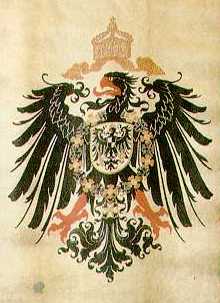
Modern Germany 1871-1989
|
Modern Germany 1871-1989 |
Week 1: From Revolution to Unification
Textbook reading: Orlow, A History of Modern Germany, chapter 1.
Course Introduction
Did Germany Follow a “Special Path?”
The Empire that Bismarck Built
Week 2: Society and Politics in the
Kaiserreich
Textbook reading: Orlow, A History of Modern
Germany, chapter 2.
Defining a Nation—Religion, Class, and Ethnicity,
1871-1890
Discussion: The Politics of Race and Class in the Empire
Read for discussion in class: Otto
von Bismarck,“The Polish Question” (1886) and Heinrich
Class, “If I Were Kaiser” (1912).
The Rise of Mass Politics: Interest Groups, Feminism,
and Political Antisemitism
Study Questions on Otto von
Bismarck, “The Polish Question” (1886)
Study Questions on Heinrich Class, “If
I Were Kaiser” (1912)
Week 3: The Road to Sarajevo
Textbook reading: Orlow, A History of Modern Germany, chapter 3.
Ships, Guns, and a Place
in the Sun, 1898-1914
Discussion: The Birth of Popular Nationalism
Read for discussion in class: Peter Fritzsche, Germans
into Nazis, pp. 11-82.
Attack, Stalemate, and the Home Front
Study Questions on Peter Fritzsche,
Germans into Nazis, pp. 11-82.
Week 4: War and the End of Empire
Textbook reading: Orlow, A History of Modern Germany, chapter 4.
Defeat, Revolution, Democracy
Discussion: Experiencing
Upheaval in the 1920s
Read for discussion in class: Fritzsche, Germans into Nazis,
pp. 83-136, and “Memories of the
Great Inflation” (1923)
Stability and Instability in the
Study Questions on Peter Fritzsche,
Germans into Nazis, pp. 83-136.
Week 5: Weimar Culture and Society
Textbook reading: Orlow, A History of Modern Germany, chapter 5.
The “Good Years”: Society and Culture in the 1920s
Economic Depression, Crisis, and the Ascent of Hitler
Read for discussion in class: Fritzsche, Germans into Nazis, pp. 137-214.
Study Questions on Peter Fritzsche,
Germans into Nazis, pp. 137-214.
Midterm Examination
Week
6: Hitler to the Helm
“Working Toward the Führer”:
The Dynamics of Power in the Nazi Regime
Terror and Complicity in the National Socialist State
Read for discussion in class: Peter Fritzsche, Germans into Nazis,
215-235.
Discussion: The Nature of Nazi Propaganda
Read for discussion in class: Josef
Goebbels, “Knowledge and Propaganda” (1928)
Week
7: Nazi Dictatorship in Peace and
War
Textbook reading: Orlow, A History of Modern Germany, chapter 6.
The Great Justification: Jobs, Expansion, and War, 1937-1939
The Road to Auschwitz: Genocide Against Jews & Gypsies, 1939-1945
Discussion: Survival in Auschwitz
Read for discussion in class: The
“Hossbach Memorandum,” 10 November 1937.
Week 8: Military Collapse and a New
Beginning
Textbook reading: Orlow, A History of Modern Germany, chapter 7.
Why Did the Allies Win?
Discussion: Under the Bombs
Read for discussion in class: “The
Collapse and Occupation, 1943-1949
Week 9: Cold War in Two Germanies
To the Wall:
Prosperity...and its Discontents
Week 10: Two Germanies into One
Textbook reading: Orlow, A History of Modern Germany, chapter 10.
Living in the Workers’ Paradise
Discussion: Surveillance
Read for discussion in class: Timothy Garton Ash, The File (all).
“We Are the People”: The
Kohl Era to Unification