Blower
Door Test
While less heat is lost through the building envelope by means of infiltration
than by conduction, the Watzek house is leaky for a building of its size,
location, and use.
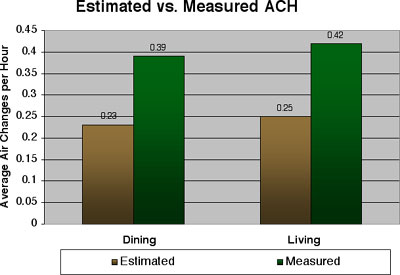 |
In both the living and the dining rooms, we measured a significantly greater number of air changes per hour than our calculations had predicted. However, while the equation used to estimate the normal number of air changes per hour does take the location, size, and construction of the building into account, the age of the building is not factored into the equation. |
This is an important consideration because during the era in which the
Watzek house was designed and built, ventilation was considered more important
than preventing heat loss due to infiltration. Therefore, even though our
data shows that the Watzek house is leakier than may be expected, it it
quite likely that it is performing well for an historic house.
It was also to hard to accurately measure the living room for a couple
reasons. First the room has noble fir panels and to cover up all
the cracks could really hurt those panels, which are irreplaceable.
Second the room itself is quite large and has a tall ceiling, so there
was a lot of volume to pressurize. Third the door that we had to
put the fan in caused the air to blow around the south wall which made
it impossible to find leaks. This was due to the fact that the anemometer
was measuring the fans wind velocity instead of leaky areas. We did
take some measurements, in the areas we could get to, and areas where the
fan did not skew the results.
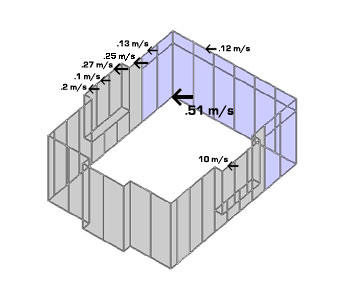 |
The picture to the left shows the locations of the larger leaks in the dining room. The most noticeable was in the bottom NW corner where the wall met the floor. There were a greater number of leaks in the living room, but they were generally too small to measure. |
Heat Loss Calculations
Using the heat loss equations and an estimate for the ACH value, we calculated the total heat loss in the dining room to be 23168 Btu/h, with 205 Btu/h lost due to infiltration, and 22963 Btu/h lost due to conduction. Using the same equations, but our own measurements for ACH, we calculated the total heat loss in the dining room to be 23057 Btu/h, with 94 Btu/h lost due to infiltration. Both Calculations show that less than 1% of the heat lost is lost through infiltration.
Energy Scheming
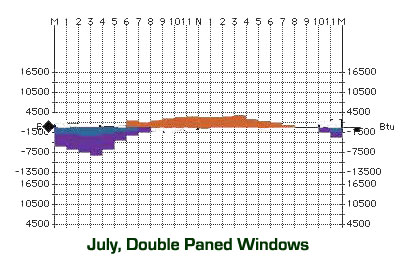
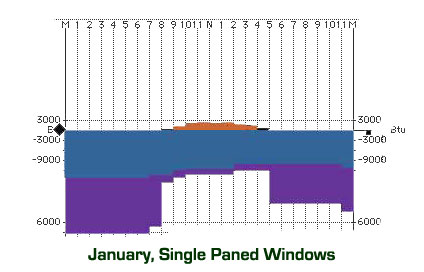
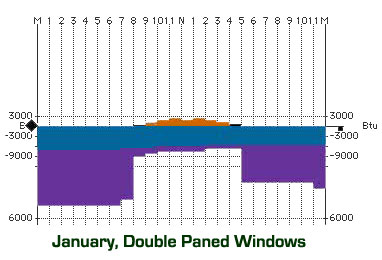
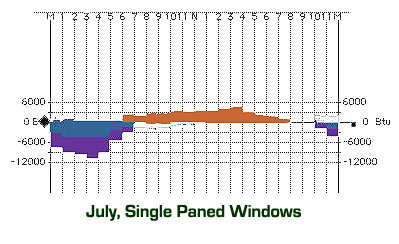
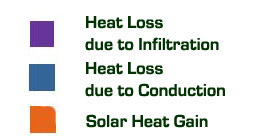
The Energy Scheming told us that there is more heat loss through conduction of the windows than through infiltration through the walls. When we told the program that the windows were double, rather than single, paned the graphs showed a drop on the amount of heat being lost through conduction.
|
 |
 |
 |
 |
 |
 |
 |
 |
 |
 |