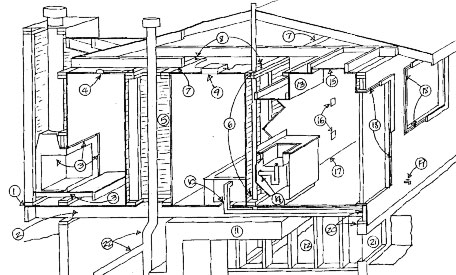
likely locations of leaks1 |
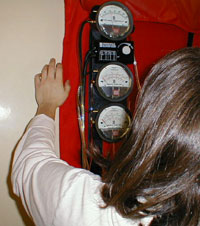
We will measure the "leakiness" of the house using a Minneapolis Blower Door. The blower door is used to create a pressure difference between the interior and exterior which in turn exaggerates any existing leaks. We will compare our data to estimates2 for houses of its size and location. |
To calculate the amount of conduction through the building envelope we must first determine the R value (a coefficient related to conduction) of the materials used in the building and the amount of each material used. That data will then be plugged both into equations that we will solve ourselves and into a computer program called Energy Scheming. The computer program, developed by University of Oregon Professor G. Z. Brown, uses the data we give it to create graphs showing the comparative heat loss and gain due to various factors such as infiltration and conduction. The equations estimate the actual amount of heat lost due to infiltration and conduction.
Infiltration:
Minneapolis
Blower Door
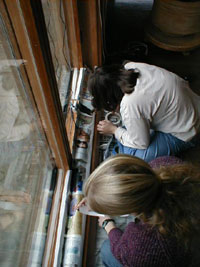 |
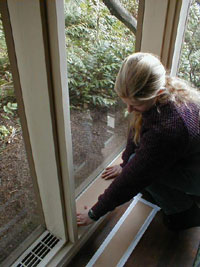
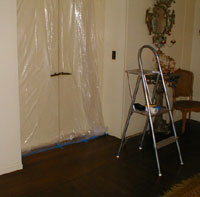
1) Prior to performing the blower door experiment, we will close and seal all openings to the exterior (except for the door in which the blower will be place). This includes vents, windows, and doors to unheated spaces such as attics and crawl spaces. All interior doors are open in order to allow air to flow throughout the house. All combustion appliances will be turned off to prevent the creation of a fire hazard. |
 |
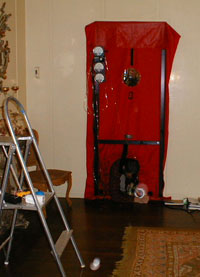 |
2) Once the blower door is in place the fan is turned on and the house will begin to be pressurized. When the air pressure between the outside and inside has reached 20 Pa we will walk through the house to determine whether or not there are any potential dangers (such as fire hazards) and to make preliminary observations regarding where the major leaks are. |
 |
3) The next step will be to record the amount of air flow it takes to maintain various constant house pressures. It is this quantitative data which will be compared to estimated values. |
|
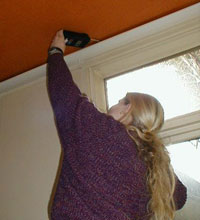
5) We may move the blower door and concentrate our efforts on a certain room (or rooms) or we may plug the leaks we have discovered and repeat the first part of the test. This depends upon how time consuming the preparation and experiment are.
6) The data we have collected will be used in a series of equations to calculate the average air changes per hour in each of the rooms tested.
Infiltration vs. Conduction: Heat Loss Equations and Energy Scheming
After using the information found from the blower door, we will use a series
of equations which calculates the heat loss
through the building envelope. This data will give us numbers to
compare how much of heat loss is due to infiltration. Next we will
compare data from energy scheming to see how much heat is lost through
conduction from the windows again for comparison. We will use one
wall in the dining room for these comparisons.
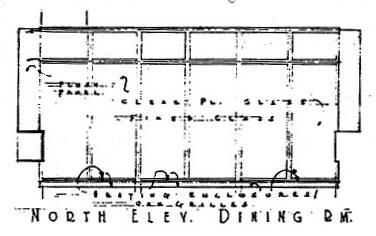 |
The Energy Scheming program is usually used in the initial stages of the design process. For this project it will be used to asses the current performance of an already existing building. Without assessing the whole building, the north dining room facade will be put into the program as a picture. The program will be told which areas of the picture are windows, walls, etc. as well as the types of window, and the types of walls that are in the building. |
Using
this data the computer produces a graph giving it's estimate of where the
energy from the house is going. We may do this again, altering the
window to double pane, to see if it makes a large improvement. The
information Energy Scheming gives us will not be exact but, will tell us
if our heat loss equations are "in the right ballpark" so to speak.
It will help us check our own calculations against the computer for verification.
1.
Vital
Signs Curriculum Project, Dean Heerwagen, Judith Heerwagen, David
Hudacek & Lisa Kirkendall
Department of Architecture, University of Washington
2.
ASHRAE
Fundamentals I-P Ed. ASHRAE, Atlanta, GA,1997, p.25.1-25.24
 |
 |
 |
 |
 |
 |
 |
 |
 |
 |
 |