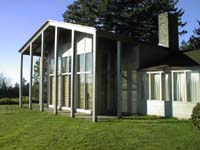
East Elevation
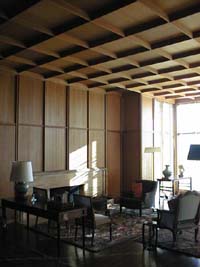
Living Room

Dining Room
|
Upon our first visit to the Watzek House, we were immediately struck by
both its high level of craftsmanship and our lack of thermal comfort.
We were curious as to why the latter was so and why particular rooms were
noticeably colder than others. We discussed the different factors
which contribute to the thermal characteristics of the house and decided
our focus would be on infiltration1 and conduction through the
building envelope. It seemed that the house was old, yet well constructed,
and we were curious as to how much heat was lost due to air leaking out
of (or into) the building, as opposed to the amount of heat that was lost
through conduction.
Rather than attempting to analyze the entire house, which would have
been too large of a task for two people, we focused on two particular rooms.
We decided to focus on the living room and dining room for various reasons.
First, the thermal comfort we experienced between the two rooms was so
great as to be remarked on by nearly everyone in the class. Secondly,
since other groups were focusing their efforts on these rooms, any data
we collected could be compared to the data gathered by other groups more
easily and accurately. Together our teams could give a more detailed
analysis of the building.
1)
Heat lost through infiltration is heat that finds a way out through gaps
or cracks in the building because of the temperature pressure difference.
Heat lost through conduction ,is heat that is lost through the windows
because glass doesn't have much insulating value.
|