| |
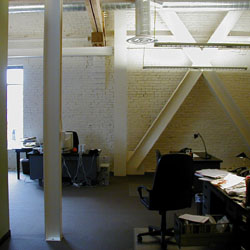
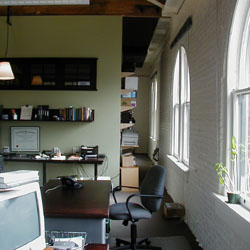
During our initial visit to the Progressive Investment office, it was
very clear that the average illuminance levels were quite low. We were
struck by a number of facts:
- All desks had task lights, and all were in use
- Illuminance levels seemed low throughout the space
- All surfaces below the plane of the ambient electric light fixtures
received relatively little light relative to the surfaces above the
light plane (yet there was no reflective surface available to redirect
any of that light down toward any surface)
- The electric light fixtures were illuminating the wall and ceiling
above them quite brightly, but the surfaces below the luminaries received
little incident light, and therefore remained quite dark.
|
| |
The lighting in the Progressive Investment office does
not provide sufficient task surface illumination for the users (per
CIBSE = 50 footcandles)
It quickly became quite clear, after a first round of data collection
(illuminance map, see below), that this hypothesis was indeed correct.
In order to explore the problem in more depth, we developed a second
hypothesis with regard to improving the daylighting in the office space.
The fastest way to improve the illuminance levels in the space
would be completely based on improving the light output from the electric
lighting system. However, this type of intervention seems dramatically
out of character with the Ecotrust Building. If the building and its
tenants are to be role models for sustainable practice, the solution
should not rely purely on an increase in the output of the electric
lights. Rather, we propose that by increasing the daylight in the space,
the illumination levels in the space can be met through more sustainable
means.
|