CONCLUSIONS
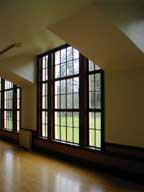
- repairing cracks in the window framing
- adding thermal mass to the floor or ceiling of the space
- planting trees to block summer sun
- shading the windows
- adding insulation to the building
|
CONCLUSIONS
|
||||||||
| It is evident that the temperature in the Gerlinger Hall sunspace is often either above or below the ASHRAE comfort zone due to solar radiation and heat exchange through the glazing assembly by way of infiltration and conduction. Of these factors, the most significant is conduction through the windows themselves. Therefore, the most effective method of stabilizing temperatures in the sunspace would be to replace the old, single-glazed windows with high-performance windows. The original window framing could remain, especially since it adds to the ambience of the space, but it should be weather-stripped and detailed for maximum insulating effectiveness. | ||||||||
|
||||||||
| However, since the ratio of glazing to floor area would still be significantly over the maximum recommended, there might still be problems with both heat gain and loss in this space. | ||||||||
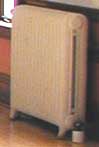
| A less expensive solution (proposed by Joe Snider) is to turn off the radiators in the sunspace completely and designate it as an unconditioned space. It would continue to be warmed by the sun during the day, and would be a buffer zone between the interior practice spaces and the outdoors. This would solve the problem of making the space comfortable: as unconditioned space, it would not need to comply to comfort standard. Since there is no optimum setting for the radiators because of the extreme temperature fluctuations, this would be a cost-effective and simple solution, and might not actually change temperatures in the space very much from what they are now. People would continue to come to the sunspace to sit and talk or study despite extreme temperatures,just as they do now. | ||||||||
| Other solutions which could be combined with either of the above options to help stabilize temperatures include: | ||||||||
|
||||||||
| However, since the heat exchange through conduction was such a significant factor, these solutions would probably have little impact by themselves.. | ||||||||
| This case study was limited to the study of the temperatures within one area of this building. Further studies could be done regarding how heat from the rest of the building interacts with this space, airflow within each bay and along the corridor, and how temperatures change during the summer and when the radiators are turned off. | |
|||||||
|
|
|||||||