RESULTS & ANALYSIS
Qinfil = 8,277 Btu/h
Qconduct = 41,979 Btu/h
Qtotal = 8,277 Btu/h + 41,979 Btu/h = 50,256 Btu/h

|
RESULTS & ANALYSIS
|
||||||||||
| Temperatures inside the sunspace changed drastically with the sunlight, but were not consistently below ASHRAE comfort levels. However, it is evident that heat is being lost and gained through the glazing assembly. As observed, the temperature of the windows changed at nearly the same rate as the outdoor temperature, but the temperature at the ceiling fluctuated less. After analyzing the data, we determined that the heat differential at the windows is caused by several components: the amount of solar radiation the window is receiving, infiltration through cracks in the framing of the windows, and conduction through the exterior walls and glazing assembly. We also determined that the sheer amount of glazing in this area of the building has a major effect on temperatures within this space. |
||||||||||
|
||||||||||
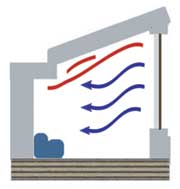
| The temperatures measured at the ceiling remained much more stable than those near the windows and were similar to one another. We determined that warm air was rising to the ceiling and staying there throughout the day. At night temperatures at the ceiling fell, but not as drastically as those near the window. | ||||||||||
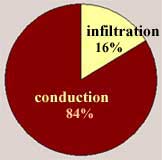
| The total heat exchange through the glazing assembly, accounting for conduction and infiltration, is as follows: |
||||||||||
| Qtotal = Qinfil + Qconduct Qinfil = 8,277 Btu/h Qconduct = 41,979 Btu/h Qtotal = 8,277 Btu/h + 41,979 Btu/h = 50,256 Btu/h |
|
|||||||||
| Qtotal = 50,256 Btu/h | ||||||||||
| It is clear that in this space more heat is exchanged through conduction than through infiltration. | ||||||||||
| The heat exchange through the glazing assembly represents a considerable amount of power which is made up by mechanical means. | ||||||||||
|
||||||||||
| Our hypothesis is partially correct. There is a significant amount of heat exchange through the glazing assembly which causes the Gerlinger Hall sunspace to be thermally uncomfortable. Because of the drastic temperature changes caused by solar radiation, conduction, and (to a lesser degree) infiltration, there is no effective radiator setting that could be used to combat these temperature swings. An HVAC system would have to both heat and cool every day to create a thermally comfortable space in the present situation. Since this would be inefficient energy use, other solutions must be considered. | ||||||||||